Black bag fly-tipping rise 'horrible' and 'lazy' say frustrated residents

 Alice Gardner
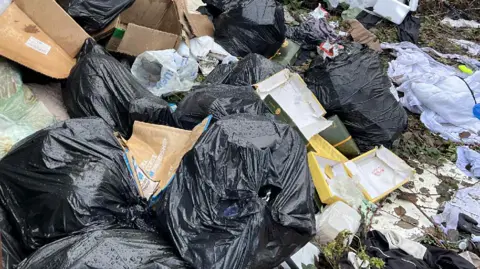
Fly-tipped black bags are a growing problem, an action group has said, as people describe the impact on their neighbourhoods as "horrible".
Alice Gardner, from Cardiff, said the amount of bagged waste being dumped on her street had tripled in two years, while Cat Bills, from Rhondda Cynon Taf, said the problem in her area was so severe she wished she could move away.
Cardiff council said fly-tipping "harms the environment and costs taxpayers", while Rhondda Cynon Taf council said there was "never an excuse to fly-tip".
Fly-tipping Action Wales said it was working on a new national awareness campaign "in response to concerns raised by councils about growing levels of black bag dumping".
The Welsh Local Government Association said up to half of the waste disposed of in black bags could be recycled.
 Darren Lloyd
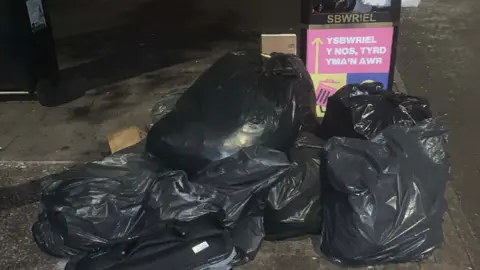
Alice, 28, said the area around Brook Street in Riverside, where she lives, was a "fantastic" location but poorly maintained.
She said while she and her partner recycle their waste, some others "just don't bother" or do not know how to recycle, which she finds "really frustrating".
"We walk home from a day at work and we walk down our street, and we just see litter all over the place," she said.
"We see more rubbish than was there when we left to go to work.
"It's just quite disheartening and it does affect us quite a lot."
Alice believes the neighbourhood lacks public bins, meaning litter ends up everywhere.
She said she reported rubbish through the council website "all the time" but found removal to be inconsistent and believes the council should focus on recycling education, fines and community drop-off points to tackle the problem.
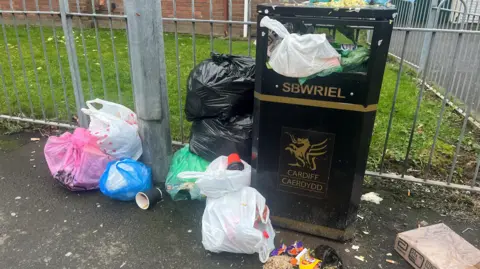
Darren Lloyd, 60, from the Grangetown area of Cardiff, said he had become used to seeing fly-tipping around local bins and in gated lanes in his area.
He said some people were "just lazy" but believes the council should do more to educate residents on proper waste disposal.
Cardiff council said fly-tipping was "completely unnecessary" and cost taxpayers a significant amount of money each year.
"The council is committed to funding frontline services and these services have not been cut. In fact, a restructure within the street cleansing department will ensure there are more enforcement officers on the streets to report and deal with any fly-tipping that does occur," a council spokesperson said.
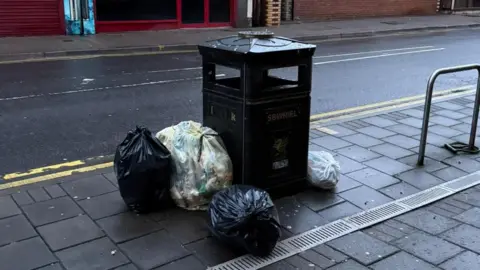
The council said it provided "an extensive kerbside collection service to recycle and dispose of household waste" as well as two recycling centres.
"Household waste should not be disposed of in litter bins," a spokesperson added.
"Our message to those who continue to damage the environment we all share is please stop. If you are caught, you will either receive a fixed penalty notice or face court action, which could result in a fine of up to £50,000 or six months' imprisonment, depending on the severity of the case."
'Quite horrified'
In Tylorstown, Rhondda Cynon Taf, local resident Cat, 54, said she and her children were "quite horrified" by the level of littering and fly-tipping near their home.
She said rubbish was often dumped directly outside her door, on nearby steps and on surrounding wasteland, blocking drains and creating serious health risks.
Cat said fly-tipping had "progressively" increased during her time in the area, adding that "something has changed for the worse".
She said council black bag collections being reduced to once every three weeks had not helped.
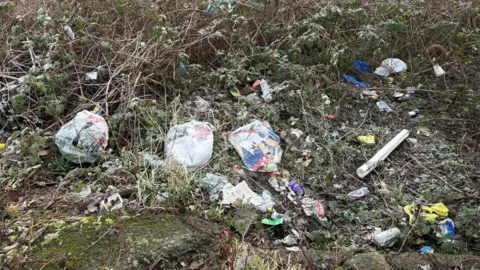 Cat Bills
Cat said some people were simply "lazy" and disrespectful, and she could not understand how some households generated so much waste.
"We live in a place of outstanding beauty - beautiful mountains and countryside - and it breaks my heart to see it being so disrespected," she said.
She added that if she had the means she would consider returning to England, where she used to live, saying "the problem does not seem as severe there".
"It could be so nice living here," she said, "but the rubbish is everywhere, it's nasty to see, and it's a massive danger to health."
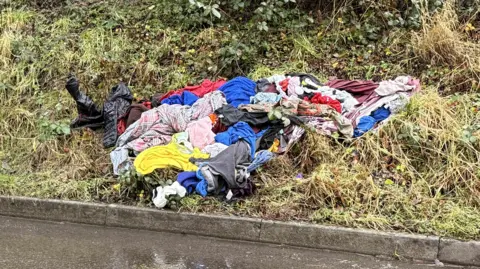 Rosanna Bird
Rosanna Bird, 34, a mother of three originally from Brighton, has lived in Tylorstown for nine years and recently moved to Maerdy, where she said fly-tipping was widespread and happens "all year round".
She said waste problems worsened after bin collections were reduced to every three weeks, leading to rubbish building up in gardens, attracting rats and causing bad smells, especially as many residents could not store bags indoors.
Rosanna said she was "really struggling" with waste and it was building up in her garden.
She said she now relies on extra waste stickers for pet litter and mess, but said few people seemed aware the scheme exists.
'A blight'
The Welsh government wants Wales to become a zero waste nation by 2050 and recently advised councils against collecting general waste more frequently than once every three or four weeks.
Rhondda Cynon Taf council said fly-tipping was a "blight" on communities and it took all reports of fly-tipping seriously.
"Like most local authorities across Wales, Rhondda Cynon Taf (RCT) moved to three-weekly collections in 2023 and can confirm that they have not decreased the number of public bins in the area," a spokesperson said.
"Following recent campaigns there has been a 17% increase in food waste recycled and a 36% decrease in black bag waste collected. This has resulted in RCT consistently recycling over 70% of our waste, exceeding Welsh government's targets."
The spokesperson said its weekly recycling scheme for all households "which should take care of over 70% of household waste", as well as a number of recycling centres open seven days a week.
"However, if a household is genuinely struggling, we also encourage them to reach out and look at additional allowance," they added.
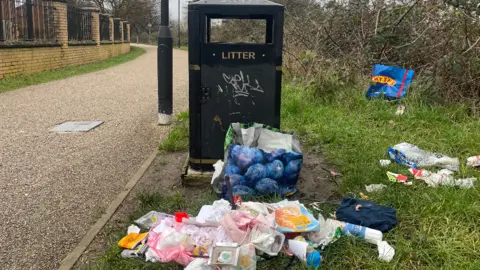
Councils are the primary enforcement bodies for most fly-tipping offences, while Natural Resources Wales investigates larger scale cases and incidents on the land it manages.
Fly tipping Action Wales, a national partnership programme coordinated by Natural Resources Wales and funded by Welsh government, said fly-tipping "harms our environment, endangers wildlife, disrupts local communities and is expensive to clean up".
"In response to concerns raised by councils about growing levels of black bag dumping, Fly tipping Action Wales is working closely with local authorities on a national awareness campaign for the spring," the spokesperson said.
"The campaign will focus on raising awareness that leaving bags of waste next to public litter bins is still fly-tipping and will promote simple steps people can take to manage household waste responsibly."
The Welsh Local Government Association said councils were tackling illegal fly-tipping "while managing significant financial pressures".
"In the longer term, councils are clear that the cost of dealing with waste and litter needs to be shared more fairly, with producers taking greater responsibility through measures such as extended producer responsibility," a spokesperson said.
The Welsh government said: "As our recycling rates increase, less materials will need to be collected as black bin waste.
"Fly-tipping is a crime and is never justified under any circumstances.
"We will continue to target those who choose to break the law and pollute our environment.”
