Is there a future for carbon capture and storage in Scotland?

 Getty Images
It's long been seen as a vital technological solution to dealing with our hard-to-tackle greenhouse gas emissions.
But a catalogue of issues have led some academics to believe the Acorn carbon capture, usage and storage (CCUS) project in Aberdeenshire is facing an uncertain future.
Technical problems in potential storage fields, the loss of two key industrial sites in Scotland and funding are all identified as stumbling blocks.
One of the major stakeholders, Storegga, has put its share up for sale - but project leaders insist that should not be interpreted as a sign of wider problems.
 Getty Images
It comes as the regulator, the North Sea Transition Authority (NSTA), has launched a fresh round of licence applications for storing the planet warming carbon dioxide in the seabed.
The second licensing round offers 14 new locations in Scottish and English waters with a storage capacity of two gigatonnes of CO2.
Mossmorran and Grangemouth closures
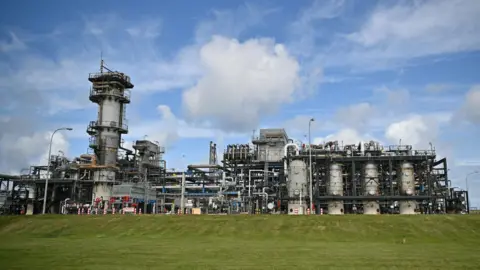
The Acorn project aims to decarbonise Scotland's high polluting industrial sites by capturing and transporting emissions using redundant underground gas pipes.
It has long focused on Grangemouth and Mossmorran as the two main sites for capturing that carbon dioxide.
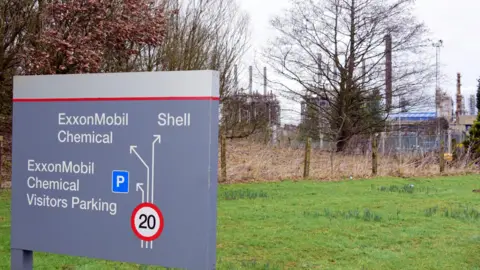
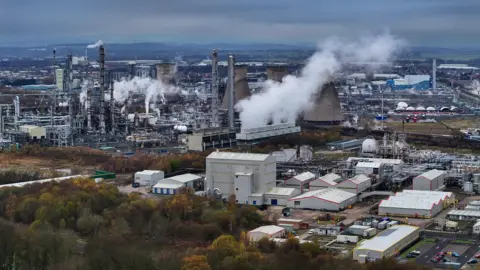
But the refinery at Grangemouth has now closed and the chemical works at Mossmorran will follow suit in the new year.
 Getty Images
Prof John Underhill, director of the Energy Transition Institute at Aberdeen University, believes the closures mean the amount of available carbon dioxide from Scottish sites is "much reduced."
He added: "Storegga is now seeking to reduce its stake so that suggests that investor confidence in the project is not what it was.
"Done properly... there's no reason carbon storage couldn't and shouldn't work and indeed many of the other sites around the UK are optimal for CO2 storage.
"But in the case of the Acorn project, there have been geological challenges (and) engineering challenges."
Is Acorn still viable?
The Acorn project is owned jointly by Storegga, Shell and Harbour Energy who each have a thirty percent stake with the remaining 10% held by North Sea Midstream Partners.
Shell said it is still involved and has no plans to relinquish its stake.
Storegga has insisted that its decision to seek a buyer is nothing to do with the project's viability.
The Department for Energy Security and Net Zero (DESNZ) has also said it believes the decision has no bearing on the commercial viability of the project.
A DESNZ spokesman added that it was "working closely with the Scottish government and industry to secure a buyer and realise the site's potential to create thousands of jobs and drive industrial renewal in Scotland."
The identified storage sites focus on the depleted Goldeneye gas field, about 60 miles north-east of Aberdeen, which is already connected by pipeline to the St Fergus gas terminal in Aberdeenshire.
Acorn then explored the potential of two neighbouring storage sites, one of which has been ruled out for geological reasons while the other has been reduced in size by about a third because wells were not plugged in a way that is suitable for CCUS.
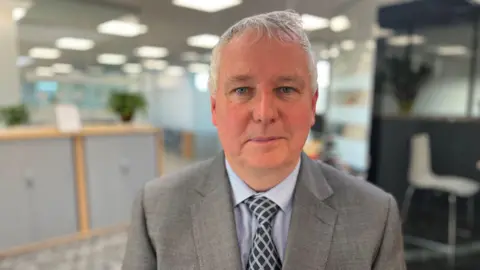
But Nic Braley, Acorn's general manager, said the areas they have identified still provide a huge amount of space to store carbon dioxide.
He believes the project is vital to enable the decarbonisation of Scotland's industries and enable future growth into technologies like sustainable aviation fuels.
He added: "We can bring in revenues from overseas and we maximise the benefit of what is a UK national resource. So, I don't see failure as a risk."
The energy transition
Acorn says the now-closed refinery at Grangemouth was never regarded as a significant source of carbon dioxide for the project with the neighbouring Petrochemicals works seen as the much larger contributor.
Dozens of other potential sites have been identified as a source of emissions with some even being able to be brought to the north-east by ship.
Apollo Engineering in Aberdeen has diversified from an oil and gas company into low carbon energies, including carbon capture technologies, which now account for about 50% of their business.
Like many in the supply chain, they see CCS as an important part of the energy transition and have been working on port infrastructure to send and receive shipments of carbon dioxide.
Co-founder Ryan Menzies said it would be extremely disappointing if the Acorn project faltered and hopes CCS can drive expansion in his own business.
He added: "We have all the skills and the supply chain to do the necessary work and it's essential in achieving net-zero and maintaining the UK's industrial competitiveness."
 Getty Images
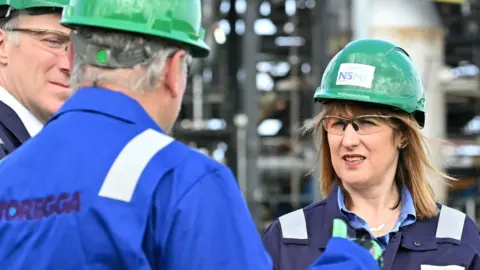
At the government's comprehensive spending review in the spring, the Chancellor Rachel Reeves announced £9.4bn in capital funding for the first two CCUS projects in England.
On a visit to St Fergus, the energy security minister Ed Miliband confirmed that £200m would be allocated to the project.
Professor of carbon capture and storage at Edinburgh University, Stuart Haszeldine, said he believes Acorn is one of the best evaluated projects in the world but is struggling with the speed at which that funding is being made available by the UK government.
He said: "Clearly the developer wants to get out, or wants to find some more money to help it stay in the market because they've been really patient.
"Since 2016 or so, this project has existed in some form or another. What needs to happen is some of that £200m needs to be unlocked."
However the UK government says that money will not be made available until the 2026/27 financial year.
It added: "This is entirely normal, as this is when the spending period begins. It is not delayed."
The influential Climate Change Committee has calculated that CCUS is a vital component in the drive to decarbonise the UK by the middle of the century.
Some environmental groups, like Friends of the Earth Scotland, have long argued that it is unproven technology which acts only as a mechanism for the oil and gas industry to continue 'business as normal'.
For businesses in north-east Scotland, where oil and gas production peaked 25 years ago, low carbon technologies like CCUS and hydrogen are seen as vital for ensuring an energy transition does not create industrial wastelands.
The Acorn project was so-named because of the visual to create 'mighty oaks'.
But after many years of nurturing the seed, it still often feels like it hasn't left the tree nursery.
