Visit the North Sea oil field used to store greenhouse gas

 Ineos Energy
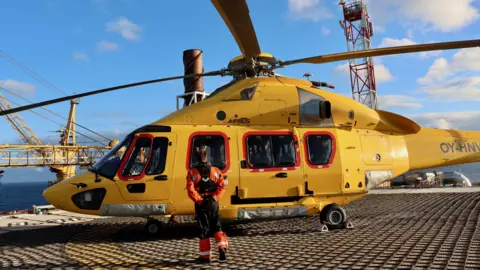
"Prepare for an offshore landing," the pilot announces, before landing on a platform 250km (155 miles) from Denmark's west coast.
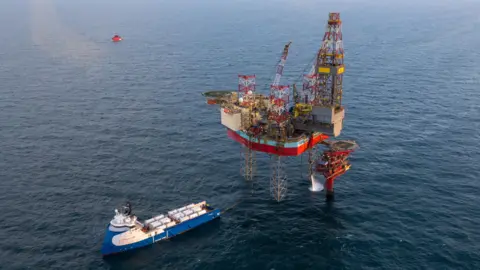
The helicopter has just circled around Nini, a nearby rig rising up from the choppy waters of the North Sea.
The rig sits over an almost-depleted oilfield that's about to get a second life as a massive carbon storage project called Greensand Future.
The plan is to pump thousands of tonnes of climate-warming CO2 into the old oil field.
We step on to Siri, a larger "mother platform" that has a control centre manned by offshore workers.
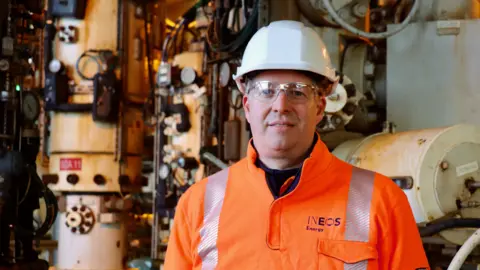
Mads Gade, CEO of Ineos Energy points to the huge pipes of the wellhead which, for decades, carried oil and gas up from below the seabed.
"Instead of pulling the oil and gas up from the ground, we're going to inject the CO2 into the ground instead," he says.
 Ineos Energy
Carbon Capture and Storage technology (CCS), involves capturing and permanently storing carbon dioxide.
Greensands Future, which is backed by a consortium led by British multinational chemicals company Ineos, will become the EU's first large-scale offshore CO2 storage site, when commercial operations get underway in the next few months.
The plan is to stash away around 400,000 tonnes of CO2 this year, potentially rising to eight million tonnes annually by 2030, the company claims.
"That's almost 40% of the Danish emission reduction target. So that's quite impactful," says Gade.
Both the UN's top climate science body, the Intergovernmental Panel on Climate Change (IPCC), and the International Energy Agency (IEA), have said that, in addition to deep and rapid emissions cuts, technologies to capture and remove carbon are important tools to help limit global warming.
Meanwhile, the EU says CCS is necessary to achieve the goal of "net zero" emissions by 2050.
However, CCS technology is not without critics, who warn it might discourage efforts to cut CO2 emissions.
It's also expensive and some environmental groups argue that emission reductions can be achieved at a lower cost, using more existing technology such as wind power, solar, and electric cars.
"I don't mind CCS on those sectors where emissions are truly hard-to-abate or impossible-to-abate," says Helene Hagel, head of climate and environmental policy at Greenpeace Denmark.
"But there are also places where it makes no sense at all," she says.
Hagel argues that we could also be making problems for the future.
"If our generation, uses the seabed for storing carbon that we shouldn't have emitted in the first place, then the generations coming after us won't be able to use the seabed to store their emissions."
Globally, hundreds of CCS initiatives are underway or in development.
In Europe, several very large-scale projects are advancing in the North Sea region, particularly in Norway, the Netherlands, Denmark and UK.
Billed as the world's first commercial carbon storage service, last August, Norway's Northern Lights project, began storing CO2 under the seabed off Bergen.
In the UK, a number of carbon capture clusters are under development, including Scotland's Acorn Project and the Viking project off Lincolnshire.
One reason the North Sea is emerging as a CCS hub, is its oil and gas legacy. After decades of production, the geology of potential storage sites is well explored, says Niels Schovsbo, a senior researcher at the Geological Survey of Greenland and Denmark (GEUS).
There's also existing offshore infrastructure and technical know-how. That's one reason his firm is among the first-movers, says Gade.
"[Nini]'s coming to the end of its lifetime," he says.
"Instead of dismantling everything, we can actually reuse the facilities, the skills, the competencies we have."
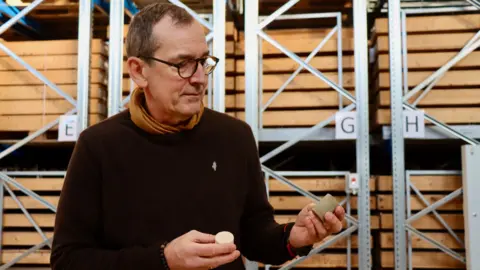
Inside a large warehouse on the outskirts of Copenhagen, cases of rock samples are stacked floor to ceiling.
Schovsbo, opens a box to show me a grainy green slab drilled from the seafloor.
The geology in this area of the North Sea is well-suited for CO2 storage, says Schovsbo. The rock has a large number of pores, or small cavities, that can hold the CO2.
An almost kilometre thick layer of clay or cap rock will lock away the CO2, just as it trapped oil and gas for millions of years, Schovsbo explains.
"It's the same sealing mechanism," he says.
A comparable amount of CO2 can be stored, to the volume of oil and gas that's been extracted, he added, suggesting an operational lifespan for CCS sites of 10 to 30 years.
For the region's many offshore workers, carbon storage opens up new opportunities.
"A lot of the work we're doing today by maintaining turbines and gas compressors will be shifted to maintaining high pressure pumps that inject the CO2," maintenance manager, Peter Bjerre told the BBC.
The Esbjerg local adds, "Fifty years back, it was fishing we made money off, then going into oil and gas," he says.
"It is just amazing seeing a future building up here with the green transition here."
