Explosions reported on two foreign vessels in the Gulf, authorities say
Two foreign fuel tankers in the Gulf were hit by explosions on Thursday, authorities say.
One person was killed and another 38 people were rescued after the incident near the Iraqi port of Umm Qasr, which appeared to be caused by Iranian boats rigged with explosives, Reuters and CNN reported.
Ship tracking websites show the two tankers suspected of being attacked surrounded by rescue boats. Oil ports have stopped operations following the attack, Iraqi authorities added.
The explosions came after maritime authorities said three cargo vessels were hit by "unknown projectiles" in the Strait of Hormuz, a vital corridor for global oil shipping.
Separately, an unidentified projectile struck a container ship 35 nautical miles off the coast of Jebel Al in the United Arab Emirates, according to the United Kingdom Maritime Trade Operations (UKMTO).
The agency said that all crew were reported safe and that, "No environmental impact has been reported at this time."
Among the three cargo vessels that were hit was a Thai-flagged vessel, which was 11 nautical miles north of Oman. A fire broke out on board and the Royal Thai Navy said the 23 crew members were rescued.
Iran has claimed responsibility, saying the ship's crew ignored warnings.
The second vessel was a Japanese-flagged container ship that was struck 25 nautical miles off the coast of the United Arab Emirates, sustaining minor damage.
A third cargo vessel was hit about 50 nautical miles north-west of Dubai, according to UKMTO.
The attacks came on the same day as 32 countries voted unanimously to the release of 400 million barrels of oil due to the "unprecedented" situation, the International Energy Agency (IEA) announced.
Since the US and Israel attacked Iran late last month, instability in the Gulf and Strait of Hormuz - both critical waters for international trade - has caused traffic to drop and global energy prices to soar.
Iran has said it would "not allow even a single litre of oil" heading for the US, Israel and their partners to pass through the strait.

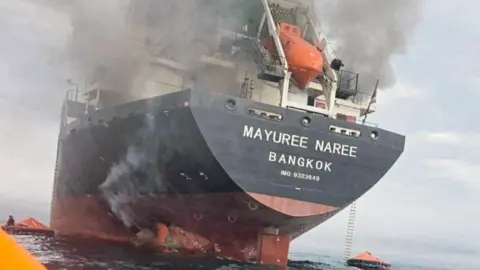 Royal Thai Navy
Following the attacks, a spokesperson for Iran's military command, Ebrahim Zolfaqari, said: "Get ready for the oil barrel to be at $200 because the oil price depends on the regional stability which you have destabilised".
There have been 13 suspected Iranian attacks on vessels operating around the Gulf since the war began.
G7 leaders said in a statement on Wednesday that they were working to "explore the possibility of escorting ships when the right security conditions are in place".
US Central Command said civilians should stay away from Iranian ports along the Strait of Hormuz because Tehran was using sites to conduct military operations.
Trump described fluctuations in the price of oil on Wednesday as a "matter of war" and later said "oil prices are already coming back down".
He has previously warned Iran of unprecedented military consequences if it mined the strait to stop Gulf oil passing through, saying the US military could escort ships.
The decision made by IEA members on Wednesday to release 400 million barrels of oil was to offset the "effective closure" of the shipping channel - through which about 20% of the world's oil usually passes - the body's executive director, Fatih Birol, said.

Elsewhere in the region, Iran said it unleashed another volley of retaliatory attacks across the Gulf on Wednesday, with targets including a major oilfield in Saudi Arabia and Dubai International Airport.
Officials said two drones had been intercepted near the airport, injuring four people.
The Islamic Revolutionary Guard Corps (IRGC) also said it launched its "most devastating and heaviest operation" including attacks to US bases in Qatar, Kuwait and Iraq.
Saudi Arabia reported that it had intercepted seven ballistic missiles, most heading to the Prince Sultan Air Base, while the country also stopped two drones heading for an oil field.
In Oman, several fuel storage tanks on the post of Salalah were struck by drones according to state media. British maritime security firm Ambrey says there was no damage to merchant vessels, the Reuters news agency reported.
The Israeli Defence Force said it struck a number of Hezbollah targets that were command centres and weapon stores in the Dahieh suburb of Beirut in Lebanon on Wednesday morning.
Lebanon's health ministry said on Wednesday that seven people were killed and 23 injured following strikes on villages in the Bekaa Valley in eastern Lebanon.
Also on Wednesday, the son of Iran's President Masoud Pezeshkian wrote on Telegram that the country's new Supreme Leader Mojtaba Khamenei was "safe" after reports he had been injured.
A senior Israeli official told Reuters that its assessment was that Khamenei was lightly wounded during US and Israeli attacks, while Iran's ambassador to Cyprus told the Guardian the supreme leader was injured.
Khamenei has not issued any statements or appeared in public since his appointment on Sunday.
