Cuba accuses US of building 'fraudulent case' for military action

 Getty Images
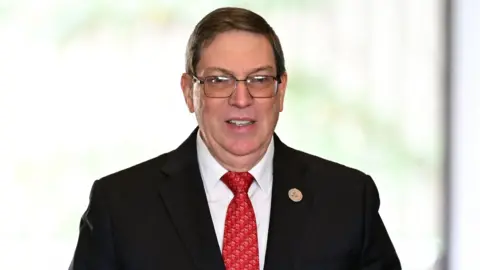
Cuba's foreign minister has accused the US of building a "fraudulent case" for military intervention, following a report that it had acquired attack drones capable of targeting Florida.
Bruno Rodríguez stressed that Havana "neither threatens nor desires war" after US news site Axios reported, citing classified intelligence, that Cuba now possessed 300 drones and was discussing striking nearby US targets.
Cuba is suffering from a fuel crisis exacerbated by an effective US oil blockade, while under pressure from the Trump administration to "make a deal".
US President Donald Trump has threatened Cuba's communist regime with similar intervention to the capture of Venezuelan President Nicolás Maduro.
Cuba is thought to now be considering using the drones to hit Guantanamo Bay, the US military base on the Caribbean island, as well as naval vessels and possibly Key West in Florida, according to the Axios report published on Sunday.
It quoted a US official who said the intelligence - which it characterised as a potential pretext for US military intervention - also suggested Iranian military advisers were in Havana.
Iranian drones have been central to drone warfare in both the war in the Middle East and Ukraine.
"Without any legitimate excuse whatsoever, the US government builds, day after day, a fraudulent case to justify the ruthless economic war against the Cuban people and the eventual military aggression," Rodríguez wrote on social media.
"Specific media outlets play along, promoting slander and leaking insinuations from the US government itself."
He added that, while Cuba did not wish for war, it was preparing itself for "external aggression" and self-defence.
Havana has been in talks with the US on finding solutions to the two countries' differences for several months, with a single Russian shipment of oil that was allowed to reach the island running out earlier this month.
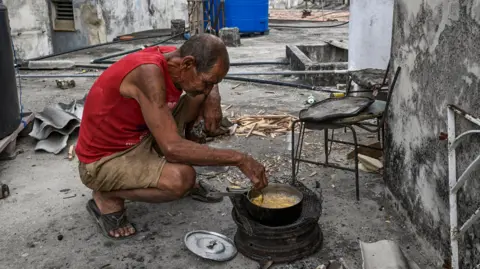
Cubans are now suffering through rolling blackouts that have affected hospitals and pumping stations, as well as disrupting public transport and rubbish collections.
Coupled with shortages of food and medicine, the situation has triggered rare shows of public dissent against the communist government, which has presided over deteriorating infrastructure.
 Getty Images
Cuba had until recently survived crippling Western sanctions due to the help of regional allies, such as Maduro's government in Venezuela, which was believed to have sent it around 35,000 barrels of oil a day prior to his capture by US forces in early January.
It appears the Trump administration is now stepping up its pressure campaign.
The US Treasury set out new sanctions on Monday against Cuba's intelligence agency and nine Cuban nationals, including its ministers of communications, energy and justice.
Communist party officials and senior military personnel were also among those sanctioned.
US surveillance flights around Cuba have increased and there is a planned build-up of US forces in the region, the New York Times reported on Friday.
CIA Director John Ratcliffe had demanded that Cuba "no longer be a safe haven for adversaries in the western hemisphere" during a visit to Havana the day before.
His meeting with Cuban officials came as reports emerged that the US was planning to indict Raúl Castro, who led Cuba following the resignation of his brother, Fidel, who overthrew the US-backed government there in 1959.
It was a federal indictment against the left-wing authoritarian Maduro that was used by the Trump administration as its justification for its daring raid on the Venezuelan capital, Caracas, to seize him and his wife, Cilia Flores. The pair are now due to stand trial in New York on charges including drug trafficking.
In the months preceding that raid, Trump repeatedly accused his government of posing a threat to the US, while a large US military force amassed nearby and senior Venezuelan officials were sanctioned.
Since seizing Maduro, Trump has spoken of Cuba being "next" and having "the honour of taking Cuba".
Trump has increasingly framed US policy on the region through the lens of reviving the 1823 "Monroe Doctrine" that the US should be the sole arbiter when it came to the Western hemisphere - re-branding it the "Donroe Doctrine".
His administration has taken a greater interest in Latin America and the left-wing leaders with whom he has ideological differences than his recent predecessors.
