MPs to discuss inquiry into trade envoy role after Andrew arrest

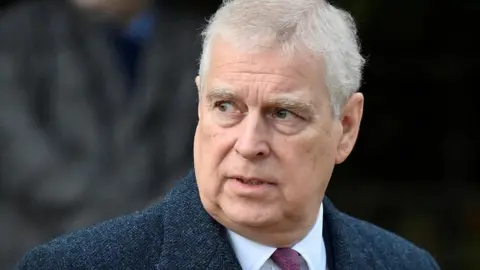 Reuters
MPs on the Business and Trade Committee will meet on Tuesday to discuss launching an inquiry into the role of UK trade envoys following Andrew Mountbatten-Windsor's arrest.
The former prince was arrested by Thames Valley Police on Thursday, on suspicion of misconduct in public office, and released under investigation 11 hours later.
Andrew held the role of the UK's trade envoy from 2001 to 2011, giving him privileged access to senior government and business contacts around the world.
The cross-party committee will discuss options after allegations Andrew shared confidential government files while he was in the role, but will avoid focusing on him while he is involved in a police investigation.
It comes as the government confirmed it is considering legislation to remove Andrew from the royal line of succession - he is currently eighth in line for the throne - amid pressure over his ties to convicted sex offender Jeffrey Epstein.
Andrew has previously denied any wrongdoing in relation to Epstein; and he has not responded to the BBC's requests for comment on specific allegations that have emerged after the US release of millions of files in January connected to the late financier's case.
On Saturday, several unmarked police cars were again seen at Andrew's former Windsor mansion Royal Lodge, where he lived for many years.
Thames Valley Police is expected to continue searching the 30-room property, until Monday, the BBC understands.
The discussions by MPs on the Business and Trade Committee will also look into the appointment and accountability of UK trade envoys.
It is understood that any inquiry would start with a focus on possible governance issues within the wider system.
There are currently 32 envoys across six continents, who play "a crucial role in supporting the Department for Business and Trade's growth priorities", according to the government website.
Duties include engaging with host governments, leading trade delegations, and meeting businesses in the UK.
Liam Byrne, chair of the committee, said earlier in the week that the MPs will also discuss a potential investigation into Andrew for his conduct in the role.
MPs are taking the allegations "acutely seriously", Byrne said.
Emails released in the latest tranche of files related to Epstein include claims that he have forwarded government reports from visits to Vietnam, Singapore and China to Epstein in 2010.
Elsewhere in the documents, Andrew is also alleged to have forwarded information on investment opportunities in gold and uranium in Afghanistan to Epstein.
Asked how the scandal would impact the Royal Family, former Prime Minister Boris Johnson said it was an "amazingly resilient institution".
Speaking exclusively to Sunday with Laura Kuenssberg, he said: "It has an unshakable place in the hearts of British people. It will go on, it will recover from all of this."
Speaking on BBC Radio 4's Any Questions programme, Defence Minister Luke Pollard said removing Andrew Mountbatten-Windsor from the line of royal succession - which would prevent him from ever becoming King - was the "right thing to do," regardless of the outcome of the police investigation.
Pollard said the government had been working with Buckingham Palace on the plans, and hopes it will gain cross party support.
Any action would require an act of Parliament, which would have to be approved by MPs and peers and would come into effect when given royal assent by the King.
It would also need to be supported by the 14 Commonwealth countries where the King is head of state.
The last time someone was removed from the line of succession by an act of Parliament was in 1936, when the former Edward VIII and his descendants were removed due to his abdication.
The Liberal Democrats and the SNP say they would support government legislation to remove Andrew from the line of Royal succession.
However, some Labour MPs told the BBC they were less convinced the move was required - in part because it is so unlikely Andrew would ever get near to the throne.
Andrew was stripped of his prince title in October 2025 after King Charles initiated a formal process to do so.
Following the latest revelations, historian David Olusoga told BBC Newsnight there is now "a desperate desire within government and within the palace to draw a firewall… between this crisis and the wider monarchy".
