How much snow will the North West get this month?

 PA Media
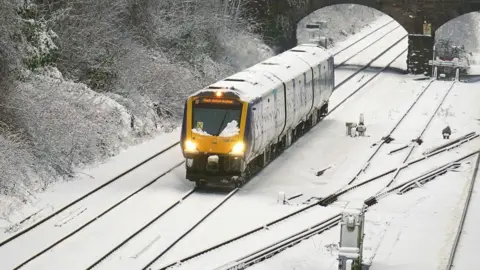
Multiple snow and ice warnings were issued for the North West over the weekend, and more could be on the way this week, the Met Office has said.
The forecaster told the BBC one of its weather models had predicted a level of snow which would be "very disruptive", although not on the level of 2018's 'Beast from the East'.
However, it did stress the model was one of several used, with others suggesting a "battle" between the current cold air and an incoming mild front will decide whether we see rain, sleet or snow.
Days after the first snowfall of 2026, and exactly a year on from when the North West was battered by an icy blast just days after widespread flooding, could it happen again?
How likely is snow this January?
Of all the winter months snow is most likely to fall in January, said BBC meteorologist Simon King.
"During the winter months, January is the coldest month with an average maximum air temperature in the North West of 6.6C," he said.
Even though the North West was hit by a disruptive cold snap last January, the whole winter season is set to get increasingly mild and wet as the climate warms.
"The chances of snow will decrease in the future," said Simon.
"But even though the average temperature over a whole season will get milder, there could still be occasional cold snaps and potential for heavy snowfall at times, even with climate change."
What is the forecast this year?
Last year, schools across Greater Manchester, Merseyside, Lancashire, and Cheshire were closed due to the snow and ice.
Liverpool's John Lennon Airport also closed its runway for several hours while Manchester Airport's runways temporarily closed overnight on 4 January.
This time, the Met Office has said several models are predicting different outcomes over the coming week, and at the moment it is "on edge".
"We might end up in a battleground between the cold air that's currently here and something milder that wants to come in from the west," said Alex Burkill, a Met Office meteorologist.
"When you have milder air hitting against the cold air you often get rain but also sleet and snow.
"It's very on edge as to whether it could be wintry."
He told the BBC that rainfall would "probably not be enough" to cause significant flooding, but snow would be a problem.
"If that came off then that would be very disruptive," said Alex.
"It won't be on the level of the Beast from the East, but there would be a significant amount of snow across many parts of England and Wales."
How is everyone preparing?
National Highways said it had 39 designated gritting routes across motorways and larger roads in the North West.
Likewise, council authorities have also been preparing for the cold.
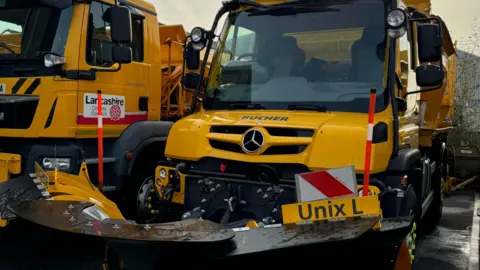
"Our staff have been busy over the Christmas and New Year period ensuring Lancashire's roads remain safe even in the cold weather," said a Lancashire County Council spokesperson.
 Lancashire County Council
"With the continuing cold snap our fleet of gritters, and snow ploughs if required, will be on duty working hard to keep the county's roads moving."
Transport for Greater Manchester echoed that sentiment, and advised people "plan their journey in advance and check for the latest travel advice".
How can drivers stay safe?
"It's all about preparation," Dee Murray, from National Highways, told BBC Radio Merseyside.
"Make sure your car has fuel, make sure you've charged your phone, and make sure you fill your screen wash bottle."
"You need warm coats in the car in case you do get stuck, and familiarise yourself with your recovery company," said Mr Murray.
He added: "It might seem like common sense but let people know where you're travelling, so somebody knows if you've not made it to your destination."
Read more stories from Cheshire, Lancashire, Greater Manchester and Merseyside on the BBC, watch BBC North West Tonight on BBC iPlayer and follow BBC North West on X.
