Parents' daily walk for son's arthritis awareness

 Dean Ranyard
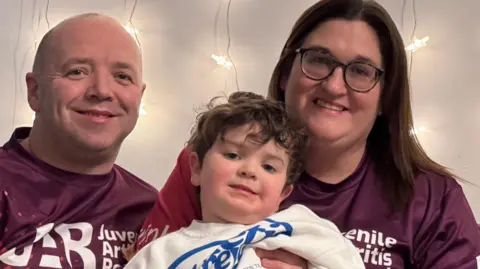
A couple who walked and ran two miles every day for a month to raise awareness of child arthritis say it was a challenge to get their son diagnosed.
Dean and Becki Ranyard from Spennymoor, County Durham, took on the challenge last month and raised more than £1,500 for Juvenile Arthritis Research.
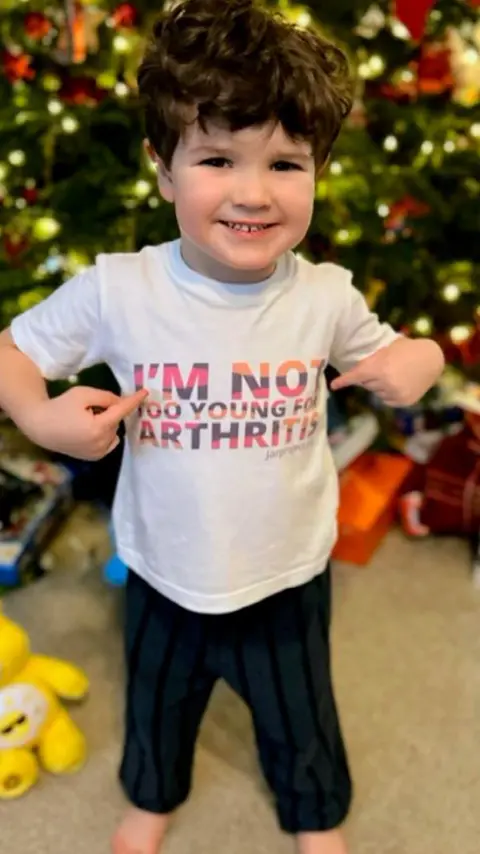
Their four-year-old son was diagnosed with juvenile idiopathic arthritis in April, an auto-immune condition where the body attacks the joints causing inflammation, pain and reduced mobility.
Dean said: "It was a bit of a puzzle to [doctors] because there was no visible swelling which they would normally need to see to diagnose arthritis."
 Dean Ranyard
Dean said at nine months old their son "wasn't developing as we thought he should be".
"He didn't want to put any weight on his knees, and he was in a lot of pain. He was crying a lot and wouldn't sleep."
Becki, who was diagnosed with the same condition aged two, said it was "the first thing" she thought of when his movements changed.
Dean said it took "some time" to get a diagnosis after a number of tests to rule out other conditions.
He said "no physical signs" showed up on his son's MRI scan and ultrasound.
After regular check-ups, he was eventually diagnosed with the condition, which his father said "came as a little bit of a shock".
"We thought things were getting better," he said.
'Don't want pain'
Becki said she had been "quite lucky" with her condition and received "good care", and her symptoms had not stopped her from doing the things she wanted to.
"But it does cause pain and discomfort," she said, adding: "It was something I really didn't want for him."
She said her son liked to play games and attend school but there were times when his condition flared up.
"You don't want them to have pain. It's just not something you want for them".
Becki said her son had to take medication, do stretches every day and come down the stairs on his side.
"I find that really sad and it takes him like a good while to get warmed up," she said.
The couple, who had already raised £2,200 for charity last year by walking 10,000 steps a day, said the money could help raise awareness of the condition and fund research into a cure, as well as support families affected.
