Wigeon behaviour to be tracked at reservoir

 Thinkstock
Wildlife experts have started tracking European wigeons to better understand their behaviour.
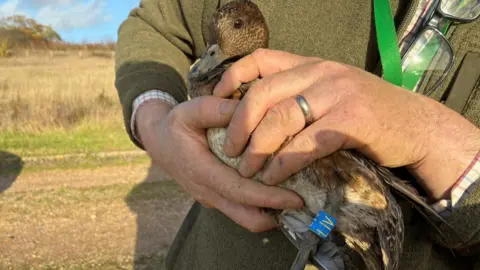
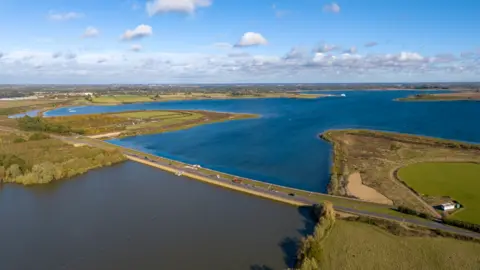
The birds, which are a breed of duck, were tagged with rings at Abberton Reservoir, near Colchester, so their movement could be traced.
Researchers want to determine how wildlife use the landscapes around them for feeding, roosting and escaping threats.
Charlotte Bradley, a conservation specialist at Essex and Suffolk Water, said the first day of ringing had been "incredibly successful".
 Essex & Suffolk Water
European wigeons may have travelled up to 4,000km (2,500 miles) before coming to roost at Abberton, the water company said.
They generally have wingspans of up to 86cm (34in), according to the Royal Society for the Protection of Birds.
The feathered animals are also being studied by academics from the University of Essex, as well as volunteer groups.
 Getty Images
Colour ringing involves catching birds and placing an individually coded, brightly coloured tag on their leg that is visible from distance.
When spotted and reported, the wigeon's movement can be recorded.
Abberton Reservoir is a site of special scientific interest and the European Wigeon is one of its designated species. Abberton has a visitor centre, hides, trails and a play area run by the Essex Wildlife Trust.
Bradley said: "We're very pleased to be part of this collaborative project to understand more about the movements of this beautiful bird.
"The first day of ringing was incredibly successful and we will now be able to track those birds and start to get data back about their movements."
Prof Tom Cameron, from the University of Essex, added the study would also look at how the production of safe drinking water could be balanced with maintaining the ecological status of reservoirs.
Follow Essex news on BBC Sounds, Facebook, Instagram and X.
