College staff 'worried for health' after welding fumes safety breach

 Getty Images
City of Glasgow College staff say they are anxious about their health after a report found welding demonstrations had taken place without the correct use of ventilation equipment.
The Health and Safety Executive (HSE) also found lecturers at the college's Riverside campus had not been trained on using the ventilation system, which is designed to protect people from dangerous fumes.
The HSE report on the breach said these fumes carried "acute and chronic" health risks - most commonly lung cancer, as well as eye and skin conditions.
City of Glasgow College said it had co-operated fully with the HSE, was now fully compliant on all matters raised and the investigation was over.
The HSE confirmed to BBC Scotland News that the college had now taken the required actions and the matter was closed.
BBC Scotland News also understands that all welding activity at the Riverside campus has currently stopped, despite forming part of students' SQA qualification.
What was the health and safety breach?
The college had provided local exhaust ventilation (LEV) systems to protect those working around welding fumes.
During its unannounced inspection in December, the HSE said it "became apparent" in discussions with staff that they had not been trained on how to correctly use or position the system's hood in order to capture the fumes at their source.
Demonstrations of welding had been carried out in the middle of a workshop without the use of LEV, which college management was unaware of and this was noted in the report.
The HSE also noted that lecturers were unaware this practice was incorrect and that "welding should only have been carried out in the dedicated welding booths with LEV in use".
A letter to City of Glasgow College from the HSE, seen by BBC Scotland News, said: "You have therefore failed to provide employees with suitable and sufficient information, instruction and training, namely in the relation to the measures that require to be in place to control the health and safety risks from welding."
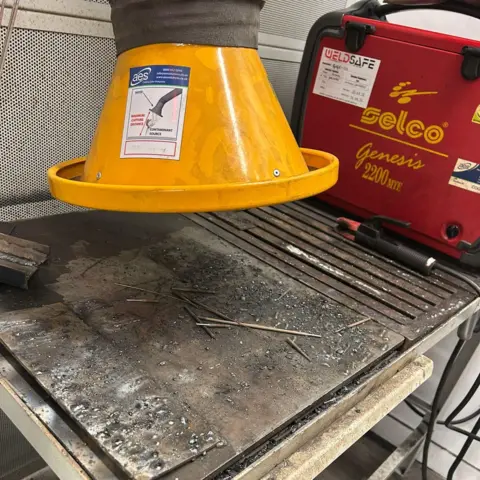
Staff members have told the BBC they are now worried about their long-term health. Several said they had reported health concerns to the college.
Although they cannot prove a link between health concerns and any exposure to welding fumes, they remain anxious about the long-term impact it could have on their own health as well as their students.
We have kept sources anonymous by using pseudonyms.
One source, who we are calling Rebecca, said: "There's a massive guilt over the team for our students' sake, that we've essentially allowed them to work in an environment like that without knowing what the potential repercussions were going to be for later on in their life, never mind our own.
"At the moment, they still don't know what's going on. They've still not been spoken to about it."
 Getty Images
Staff said they were struggling to cope with not knowing if they could face serious health issues in the future.
Rebecca added: "You're not going to find that out now, it's going to be down the line when you're settled, happy. And the potential of being hit with something so serious is frightening to say the least.
"All we want to do is go in and do our jobs and go home. But I want to do it safely. I want to make sure that I'm not ending up ill, and I've not got the students' health on my shoulders."
Another source, who we are calling Lewis', added: "And some of us have got kids and things like that to worry about as well."
The EIS teaching union and the Further Education Lecturers' Association (EIS-Fela) are in formal dispute with the college over the health and safety concerns raised.
"We are extremely worried and concerned for our members," said EIS representative Leah Stalker.
"We don't believe the employer is controlling health and safety standards enough."

Among other measures, the union is calling for respiratory protective equipment (RPE) to be provided for all staff and students in the workspace.
This safety measure is not required by law, but is used by many in the welding industry.
The HSE report found that "based on the evidence and type of frequency of welding" the use of LEV alone is sufficient "if used correctly".
But it adds: "You must consider providing supplementary respiratory protective equipment".
Lecturers in the Fabrication and Welding department have industry experience but the majority do not have a specialist welding background.
The HSE went on to make a series of recommendations around updating risk assessments to identify welding fume as a carcinogen and use of PPE, as well as ensuring that brushes are disposed of to ensure that no-one "dry sweeps" dust.
A spokesperson for the college said it contacted HSE as soon as issues were formally raised at the end of November and that an internal investigation was launched.
They said: "The college has received a clean bill of health and been given the green light to resume all welding and fabrication training from Scotland's health and safety body, but disappointedly and without any justification, EIS-Fela is refusing to accept the findings of HSE and, concerningly, are instructing some of their members not to engage at all with the college.
"It is important to note that all independent, external bodies who have examined this matter have concluded that any exposure levels to individuals from welding are significantly under regulatory thresholds.
"We remain fully open to constructive relations with EIS-Fela on this or any other matter."
