Health study volunteers go from sofa to scanner

 BBC
BBC"Everyone knows physical activity is good for you. What we don't know is why."
The University of Nottingham's Prof Paul Greenhaff says the collaborative work his team are doing to answer that question is unique.
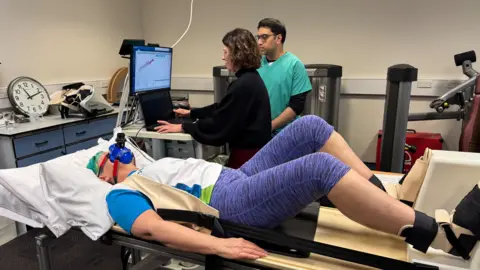
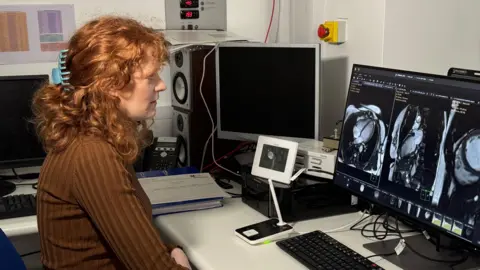
The CHAIN study looks at the impact of both exercise and inactivity, and includes test subjects working out while inside an MRI scanner so researchers can see the effects on the whole body.
"We can now study someone inside a magnet while they are exercising," said Greenhaff. "That, until very recently, was not possible... the human has become the ultimate experimental animal."
The "experimental animals" in this case are a dedicated group of volunteers aged between 50 and 65.
In one of this study's unusual elements a group were recruited because they were already active - doing between 8,000 and 12,000 steps a day - and they were asked to do less rather than more.
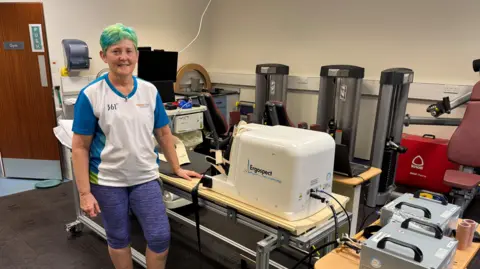
Some found having to stay on the sofa tricky. Julie Gray, 63, had to complete six months of what researchers called deconditioning.
"By the end of it I was feeling sluggish and tired and was really grateful for the three months of retraining afterwards," she said.
A second group started the study with what the government classifies as a sedentary lifestyle - doing less than 4,500 steps a day - and had to gradually ramp up the amount of exercise they did.
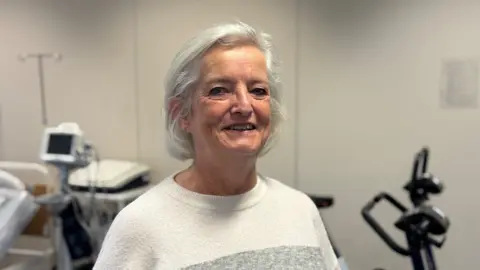
Anne Smith, 64, said she found she could push her body much harder than she realised and loved being able to measure the benefit.
"My fitness age was going down, my resting heart rate dropped, my blood pressure dropped - all because I was exercising," she said.
The CHAIN study is particularly focussed on improving the lives of older people with many spending their final years in poor health.
Teams worked across the University of Nottingham's Schools of Life Sciences, Medicine and Physics. That allowed volunteers to spend hours at a time inside the huge MRI scanner and will give researchers a new view on how exercise affects people.
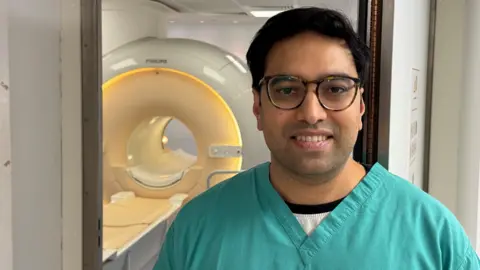
"The journey of discovery is going to be so exciting for us," said Dr Abhishek Sheth. "We'll be able to know what happens in response to the changing activity levels to the brain, the heart, the muscle, how the body is changing in its make-up.
"All of this is going to provide us with really good information in order to potentially inform health policy in the future."
Sheth praised volunteers for their commitment and how excited they'd been to be part of the study. He's still asking more people to take part.
For Julie Gray it's meant a collection of unusual images on her phone.
"I took a video of my heart beating away," she said, proudly showing off the scan of her body working.
"Not many people get to see that. It's pretty neat."
Anne Smith has left the study which a much more active lifestyle.
"Helping other people in the future while also making myself exercise and helping me was just the ideal combination," she said.
Follow BBC Nottingham on Facebook, on X, or on Instagram. Send your story ideas to [email protected] or via WhatsApp on 0808 100 2210.
