What happens to sites on the heritage at-risk register?

 Historic England
Every year the Historic England's heritage at-risk register reveals the health of England's most valued historical buildings and places.
Buildings can end up on the register if they have been neglected and the organisation published its updated list on Thursday.
Twenty-one sites in the East of England were included in the register this year, while St John the Baptist Church in Royston, Hertfordshire, and Long Shop Museum in Leiston, Suffolk, were removed from the list.
Natalie Gates, national lead for Historic England, said: "The heritage at-risk register is a snapshot of the most significant historic buildings and places that are really suffering from neglect and decay."
What is the heritage at-risk register?
 Historic England
Every year Historic England updates the heritage at-risk register for buildings across the country.
The process identifies the buildings and sites that are in danger of being lost as a result of neglect, decay or inappropriate development.
Of all listed buildings across the country Historic England assesses:
- Grade I
- Grade II
- Grade II listed places of worship across England
- Grade II listed buildings in London
Ms Gates, said: "For a listed building, a site is saved when it is actually being repaired and is back in use, but for a monument it is when it has been consolidated and it is safe."
A spokesperson from Historic England said assessing the sites for the register helps the body understand the overall state of the country's archaic sites.
What happens when a building is put on the register?
Once a building is on the register it should receive funding to help resolve the problems it has.
Ms Gates said: "Being on the register is actually a really positive thing because it draws attention to those places most in need and the communities rallying out trying to support them.
"The grants we give can encourage other funders coming onboard."
Historic England carries out surveys on the buildings' condition and management and undertakes social and economic research to understand the value of heritage.
The organisation said its local teams work with owners, friends groups, developers and other stakeholders to find solutions for historic places and sites at risk across the country.
How is the money distributed?
 Historic England
Historic England gave £847,000 in grants in the East of England for support and repairs to 22 sites, including conservation areas, which were on the Heritage at-risk register during 2024 and 2025.
Local teams work with National Lottery Heritage Fund and Natural England to support the site's owners with funding to carry out research to what repair or conversation works were needed.
They may also supply funding for the works themselves.
Sites stay on the heritage risk register until they are put back into use or are demolished.
What about the East of England?
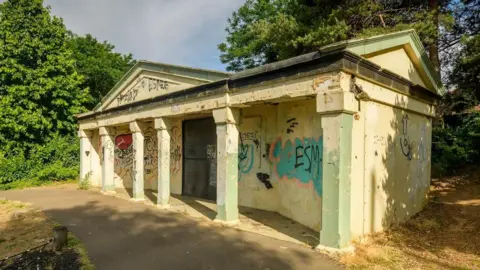
In Norwich, the Mile Cross Gardens' pavilions and Wensum Park's fountain have been added to the list due to structural deterioration.
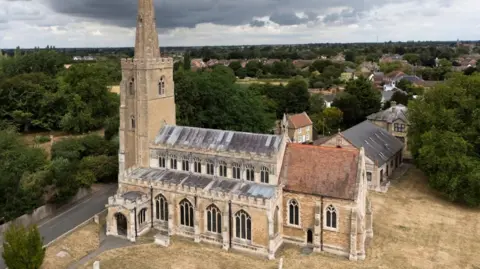
The church of St Wendreda in March, Cambridgeshire, has been added due to "severe structural issues that threaten its survival".
St Mark's Church in Friday Bridge, near Wisbech, Cambridgeshire, was also newly listed as at risk after problems with its tower.
Baroness Fiona Twycross, minister for museums and heritage, said: "We are determined to protect the heritage at the heart of our communities.
"It is fantastic to see so many historical sites saved for communities up and down the country."
 Historic England
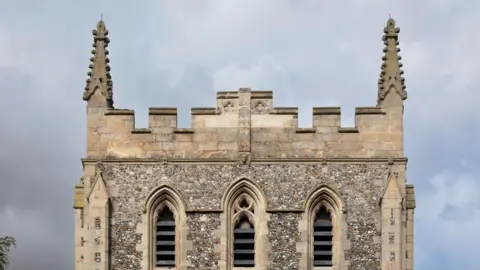
The bell tower and roof of St John the Baptist Church in Royston, Hertfordshire, was badly damaged in December 2018.
The Grade I listed building required major repairs including partial rebuilding and the recasting of its cracked bells, but it is now no longer deemed at risk.
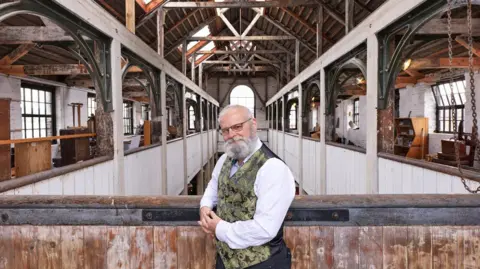
Meanwhile, the Grade II listed Long Shop Museum in Leiston, Suffolk, has also been removed from the heritage at-risk register following repairs to its roof lights and window frames.
Follow East of England news on X, Instagram and Facebook: BBC Beds, Herts & Bucks, BBC Cambridgeshire, BBC Essex, BBC Norfolk, BBC Northamptonshire or BBC Suffolk.
