Iran's women calling for support, says Djalili

 BBC
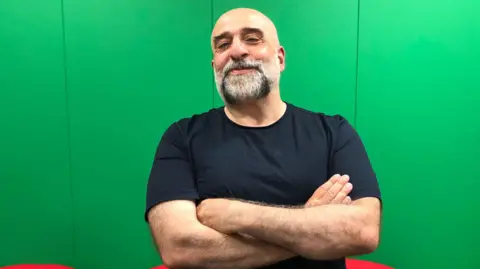
BBCIranians and people of Iranian heritage - including actor and comedian Omid Djalili - have spoken of the difficulty of watching events unfold from the UK.
Djalili, from Ipswich, said the situation had changed because "mothers in Iran" were now no longer simply resisting, but had been "calling for outside support".
Also concerned was Mozhdeh Shoja, who lives on the Suffolk/Norfolk border. She said she had constantly checked news reports every day, while longing for contact with absent loved ones.
"We are not asking for conflict. We are asking for freedom and safety," Shoja said, following a demonstration in Norwich city centre.
Djalili, whose parents are Iranian, said the wave of protests in Iran had felt different.
"Mothers in Iran have been standing up to the regime and getting killed for it for the last 47 years," he said. "But this time it's different."
He said that women — particularly mothers — had not been simply resisting, but had been actively calling for outside support.
"It is mothers who are calling for intervention. Not as war: as a rescue mission."
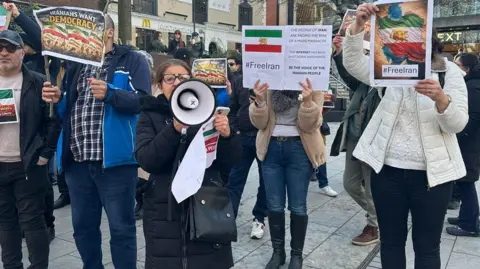
Meanwhile, Shoja said it had been important to attend recent protests against the Iranian government, because she believed it had been the only way absent Iranians could "stand up" for those back home.
She described Iran as her "entire world" and said taking part had helped her feel she had been making a difference.
"It truly felt as though Iranians abroad were standing up for those inside the country whose voices are being suppressed," she added.
'Heart-breaking'
Shoja said being regularly disconnected during conversations with relatives in Iran was common.
During an interrupted call recently, she said she had learnt a friend's nephew had been detained for 40 days. She has a son of similar age.
"Hearing this was heart-breaking for us," she said.
"Above all, people are longing for peace, security, and a future where families no longer have to live in fear."
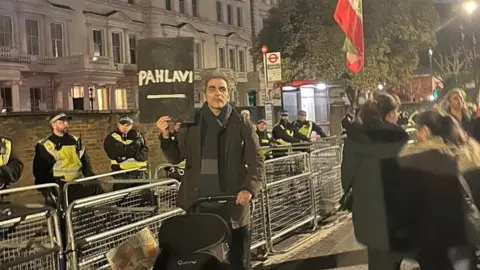
Omidreza, who lives in Ipswich but is originally from Tehran, explained why he had gone to a protest in London.
"Most of my family is still in Iran," he said.
"We try to support our fellow citizens in any way we can. Sometimes, this is the only thing we can do."
Iranians have described how difficult it has been to get hold of those close to them.
Iran's internet is not fully accessible and can only be used intermittently.
Tracking social media
Omidreza said: "At the moment, there is no real trust.
"We can only briefly check in with each other. We cannot talk much more than that because we are unsure if communications are being monitored."
He said there was a sense among UK-based Iranians that those inside the country had wanted their help more than ever before.
Another East Anglian-based Iranian, Meisam, said his day was spent following numerous social media channels.
"I spend between three and five hours a day tracking what is happening," he said.
Follow Suffolk news on BBC Sounds, Facebook, Instagram and X.
