Oil and gas prices jump as conflict escalates

 Reuters
Oil and gas prices have surged as Iran continues to launch strikes across the Middle East in response to ongoing attacks by the US and Israel.
Natural gas prices spiked on Monday after QatarEnergy, one of the world's biggest exporters, halted production following "military attacks" on its facilities.
Oil prices also jumped, with the global benchmark Brent crude briefly hitting $82 (£61) a barrel on Monday, after at least three ships were attacked near the Strait of Hormuz at the weekend.
Iran warned vessels not to pass through the crucial waterway in the south of the country, through which about 20% of the world's oil and gas is shipped.
In the US, the Nasdaq and S&P 500 stock market indexes opened down but regained those losses during Monday's trading and closed marginally higher.
In London, the FTSE 100 share index closed down 1.2%, with the owner of British Airways recording the biggest fall in the index following the disruption to Middle East airspace.
Banks such as Barclays, Standard Chartered, and HSBC also saw their share prices slide amid concerns that a sustained rise in energy prices risks fuelling inflation which, in turn, could lead to fewer interest rate cuts by central banks.
Oil and defence firms were the biggest risers on the FTSE 100.
In France, the CAC-40 index closed down 2.2%, while Germany's Dax extended earlier declines to close 2.6% lower.
QatarEnergy, which is owned by the state, said that it had suspended producing liquefied natural gas (LNG) after the country's Ministry of Defence (MoD) said a drone launched from Iran targeted a facility in Ras Laffan Industrial City.
Qatar's MoD also said a drone went after a water tank belonging to a power plant in Mesaieed, south of the capital Doha.
Europe's benchmark gas price jumped 50% on Monday before closing 39% higher.
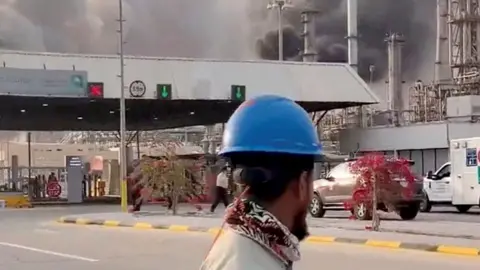
Meanwhile in neighbouring Saudi Arabia, Aramco temporarily shut its major oil refinery at Ras Tanura on the coast after being hit by a drone.
International shipping has almost come to a standstill at the entrance to the Strait of Hormuz, with analysts warning that a prolonged conflict could push energy prices even higher.
The UK Maritime Trade Operations Centre (UKMTO) said that two vessels had been struck, and an "unknown projectile" was reported to have "exploded in very close proximity" to a third.
"The market isn't panicking", Saul Kavonic, head of energy research at MST Marquee told the BBC. "There is more clarity that so far, oil transport and production infrastructure hasn't been a primary target by any side," he added.
"The market will be watching for signs that traffic through the Strait of Hormuz returns, which would see oil prices subside again."
But some analysts have warned it could go over $100 in the event of a prolonged conflict which could have a knock-on effect on inflation and interest rates.
Robin Mills, chief executive at Dubai-based consultancy Qamar Energy and a former executive at oil giant Shell, said: "The jump in prices will feed through almost immediately because the oil traders are very much following the news too.
"At the moment, oil prices are not particularly high, they are still below where they were even two years ago so we're not in full-blown oil crisis mode yet."
On Sunday, the Opec+ group of oil producing nations agreed to increase their output by 206,000 barrels a day to help cushion any price rises, but some experts doubt this would help much.
Edmund King, president of the AA, warned the disruption could drive up petrol prices around the world.
"The turmoil and bombing across the Middle East will surely be a catalyst to disrupt oil distribution globally, which will inevitably lead to price hikes," he said.
"The magnitude and duration of pump price increases depends on how long the conflict goes on."
Subitha Subramaniam, chief economist and head of investment strategy at Sarasin & Partners, said if oil prices remained high for a sustained period: "It will start to cascade into other prices such as food, agriculture, industrial commodities and that's just going to really bleed into inflation."
The pace of inflation has been easing in the UK, leading to the Bank of England cutting interests.
Subramaniam suggested that the Bank may choose to leave interest rates unchanged at 3.75% for the moment despite recently signalling further cuts could be made.
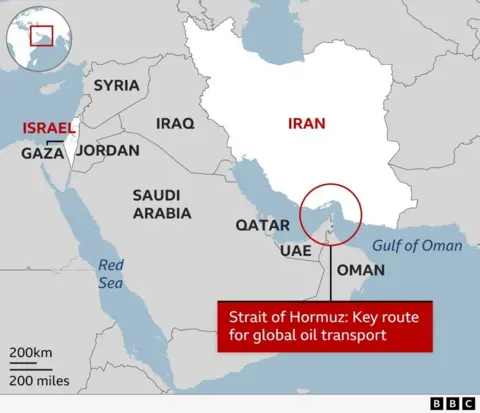
On Sunday, Iran's Islamic Revolutionary Guards Corps (IRGC) said three tankers from the UK and US had been "struck by missiles and are burning". The UK and the US have not commented.
The UKMTO said "multiple security incidents" had been reported across the Arabian Gulf and Gulf of Oman, and it had advised ships to "transit with caution".
At least 150 tankers have dropped anchor in open Gulf waters beyond the Strait of Hormuz, although a handful of Iranian and Chinese vessels have passed through today, according to ship-tracking platform Kpler.
"Because of Iran's threats, the strait is effectively closed," Homayoun Falakshahi from Kpler told BBC News.
Danish container shipping group Maersk said in a statement on Sunday that it would pause sailings through the Bab el-Mandeb Strait and the Suez Canal and reroute ships around the Cape of Good Hope.
