Council set to lose £800k on bank site regeneration

 John Devine/BBC
The regeneration of a Fenland town has been a "catalogue of errors" after a council apparently lost £800,000 on the purchase and demolition of a prominent building.
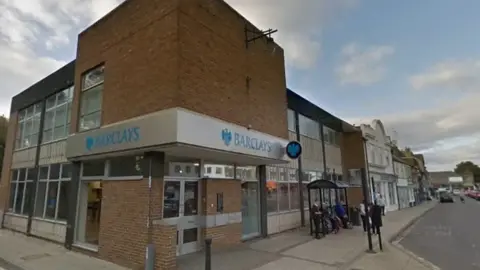
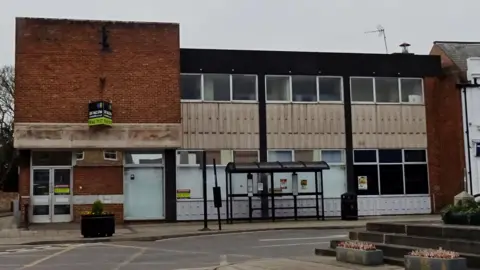
Fenland District Council (FDC) bought the former Barclays bank on Broad Street in March, Cambridgeshire, for £750,000, paid a further £371,000 for its removal - and is now selling the site for £295,000.
The council said the development of the site was never about generating a profit or income but was a "regeneration intervention, fully funded by the government".
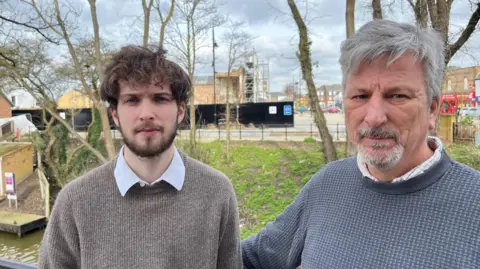
Nigel Lambert, who runs Greetings card shop, said he feared "they are going to sell the land at a huge loss".
"When FDC bought the building, plans were to knock the building down and build new shops with flats above, but they are not doing that now," he said.
His son Nick said the bank demolition had been "one of a catalogue of errors" during £8.4m regeneration work in March, with a lack of provision for parking and cycle lanes also proving a bugbear.
 Google
 John Devine/BBC
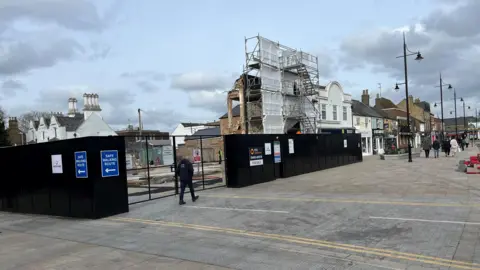
He added that he believed the demolition work would "be even more costly" after seeing the effects on other buildings.
"I was getting my lunch and was watching the demolition, workmen were just about to remove the last part of the building when I saw the adjoining shop front move, almost vibrate, the people inside were noticeably distressed, it was an amazing moment to witness", he said.
He said demolition work stopped immediately, and the site was closed for about a month.
A shop worker, who wanted to remain anonymous, added; "It was like a scene from Jurassic Park, when a walking dinosaur made a glass of water vibrate with its footsteps, the whole place was shaking like an earthquake."
 John Devine/BBC
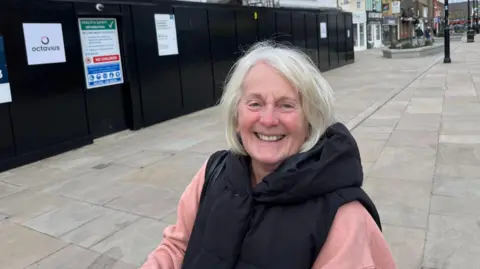
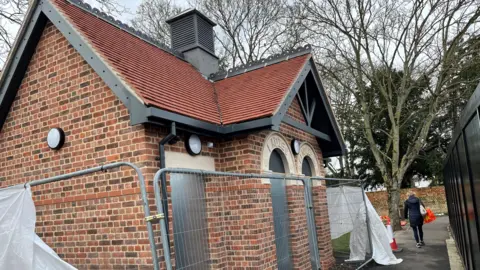
Kate Isaacs, who lives in March, says the worst thing about the delay with the demolition work is that it is holding up the opening of new public toilet facilities.
"We have been promised the new loos for ages, and have to nip into cafes and pubs and its not very convenient really," she said.
She said she thought she might like to see a community banking hub or a health centre built on the site with perhaps some disabled parking bays.
 John Devine/BBC
Councillor Chris Seaton, lead member of the March Future High Streets steering group, said the development of the site was never about generating a profit or income for the authority.
"It is a regeneration intervention, fully funded by the government, designed to address what residents had called an 'eyesore' of a building and to unlock a key town centre site where the market had previously failed," he said.
"By their very nature, regeneration schemes do not often create income, which is why they are often grant funded. It is accepted that the wider economic and societal benefits they bring outweigh the capital outlay."
Seaton added that the purchase and demolition of the building formed part of the government's Future High Streets Fund programme, designed to support town centres by funding interventions that the private sector was unable to deliver alone.
 Jennifer Lawler/The March Society
Follow Cambridgeshire news on BBC Sounds, Facebook, Instagram and X.
