'Funding will help future generations stargaze'

 G Woodburn
A £227,000 grant will "ensure that we don't lose our stars to light pollution", an organisation has said.
Northumberland Coast National Landscape (NCNL) said it would use National Lottery Heritage funding to protect dark skies on its coastline.
Some of the money will be used to create accessible Dark Sky Discovery sites on the coast at Warkworth, Alnmouth, Bamburgh, Cocklawburn and near Dunstanburgh Castle, with tilted benches for a better view of the night sky.
It will also fund education outreach, pollution monitoring and the retrofitting of motion-sensor "dark sky friendly lighting" on farms.
NCNL said the coastline from the coquet estuary at Amble to Berwick-upon-Tweed was already "intrinsically dark" because of the North Sea, but that artificial light had been steadily growing.
Project officer of the NCNL's Dark Skies Project Theia Batchelor said on a clear night people could see the Milky Way with the naked eye.
"We've got really good habitats already for insects, birds, bats - but it's being able to improve on them even more" she said.
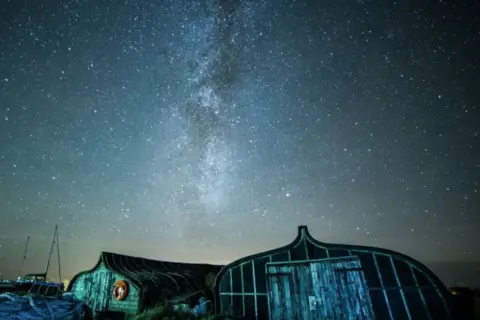 Dru Dodd
Light pollution is excessive outdoor light which can come from things like street lights and advertising and can affect wildlife.
Batchelor said NCNL was setting up surveys to measure night level pollution in the area.
It was also working on groundworks to make the new Dark Sky Discovery sites suitable for wheelchair access and installing angled posts for people to take pictures on their mobile phones.
"The angle of the post will get you a really nice picture of the night sky with a bit of the coast in as well," she said.
Batchelor said the project would build on work already started by "passionate community members".
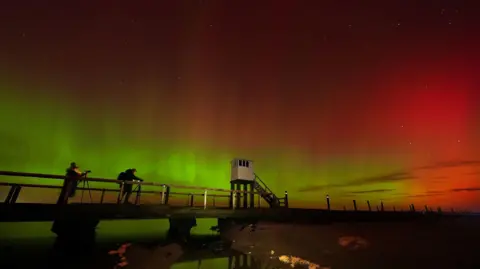 PA Media
NCNL is funded by Defra and Northumberland County Council.
Partnership chair Patrick Norris said: "This project will ensure that we don't lose our stars to light pollution and that night-time tranquillity can be experienced for generations to come."
