'People should never forget the Holocaust'

 BBC
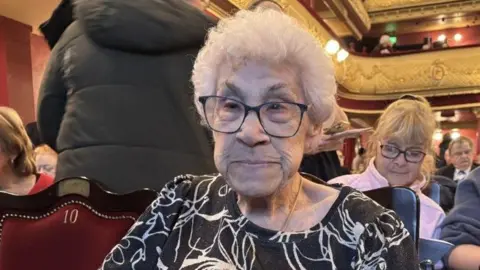
BBC"It wasn't until I got a lot older that I realised that most of my family had been murdered," says 90-year-old Holocaust survivor Liesel Carter.
Liesel was just four years old when she travelled alone across Europe in 1939 to escape Nazi Germany - and to mark this year's Holocaust Memorial Day, which is marked on 27 January, she is sharing her story.
"Children are very amiable, they do as they're told," Liesel explains as she recounts her journey away from Germany, which finally ended in Leeds.
She says she carried a travel document for stateless refugees and travelled through several countries before reaching England.
It was there where she was finally reunited with her mother, who had arrived earlier to work as a domestic servant.
"I did as I was told, till I got to Leeds," she says.
Liesel later moved to live with a foster family.
"They wanted to adopt me, but my mother always hoped she would get me back," she says.
Liesel lost more than 200 members of her family in the Holocaust, including close relatives who never made it out of Germany.
Growing up, she knew little about what had happened to them.
"I was so young, I didn't really understand what was happening. It wasn't until the 1950s that I realised what had happened to my family," she says.
"I only found out in the 1980s what had happened to my father. We reckon he was beaten to death."
Sharing her story at Leeds City Varieties, she was joined by hundreds of people gathered for a special event ahead of this year's Holocaust Memorial Day.
The day remembers the six million Jewish people murdered under the Nazi regime, along with millions of others who were persecuted.
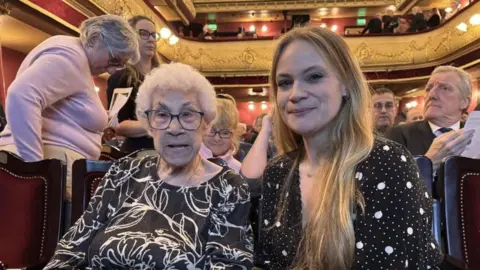
This year's theme for Holocaust Memorial Day is "bridging the generations".
For Liesel's family, that idea feels very real. Her granddaughter, Lauren, stands with her at the event.
"Nan is very real. She's part of our family," Lauren says.
"But for lots and lots of young people today, the world wars are such a distant memory."
Lauren says her grandmother's story has shaped their whole family, and that her work in sharing her experiences has been recognised nationally.
Liesel was awarded a British Empire Medal in the 2025 New Year Honours for her service to Holocaust education and remembrance.
She says that hearing Liesel speak helps younger people understand the human side of history.
Lauren explains: "Having somebody who you've known your whole life, who talks about, 'this was my experience', this wasn't just Nan's experience, this was her family, her friends, her culture - and the culture of so many people out there.
"It really humanises the six million, and also the people who are continuing to face persecution today."
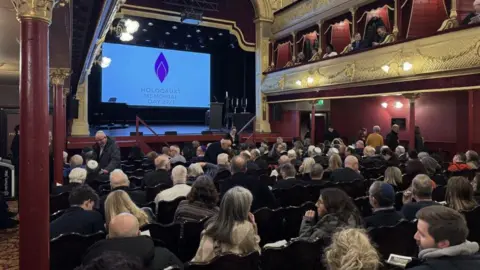
The event in Leeds is one of many taking place across the country to mark Holocaust Memorial Day.
Another will take place on Tuesday evening at the Holocaust Centre North, based at the University of Huddersfield.
The centre was set up to highlight the importance of passing stories from one generation to the next.
The centre cares for collections from more than 150 families who experienced persecution under the Nazi regime, and its Through Our Eyes exhibition is created from the testimonies of survivors and refugees who rebuilt their lives in the north of England.
In Leeds, candles have been lit to remember the Jewish people murdered in the Holocaust, as well as Roma and Sinti people, LGBTQ+ people, disabled people and others targeted by the Nazi regime.
The commemoration also recognises victims of later genocides around the world.
Local school pupils and community groups took part in the ceremony in Leeds, reflecting the theme of different generations coming together to remember.
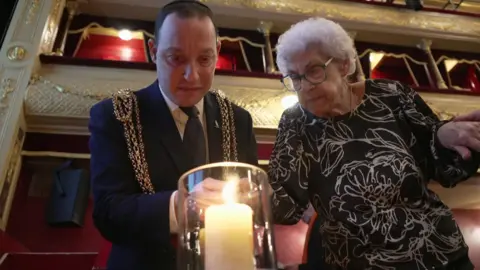
Dan Cohen, Lord Mayor of Leeds, says the theme of Holocaust Memorial Day 2026 has an important message.
"The theme for this year is bridging the generations, and that really speaks to the importance of recognising that as we move further in time away from these tragic events of history, there is a risk of collective memories starting to fade."
For Liesel and her family, remembrance is something they continue to share.
It is a story carried forward within the family and supported by the wider community's efforts to keep these memories alive.
"Holocaust Memorial Day is very important. People should never forget what happened because of their race, colour or creed," says Liesel.
Listen to highlights from West Yorkshire on BBC Sounds, catch up with the latest episode of Look North.
