Canada's Carney stresses unity in the face of challenges at home

 Reuters
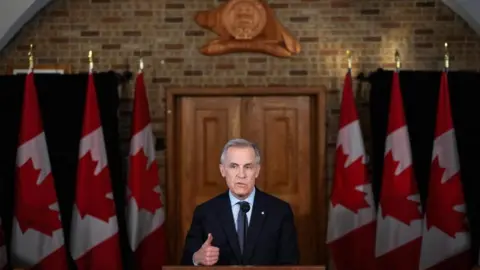
Canadian Prime Minister Mark Carney has called for national unity in his first address on home soil after making waves in Davos with his warning of a "rupture" in the postwar international order.
In remarks directed to Canadians, Carney said his government intends to move quickly to implement "ambitious" plans to bolster the economy in the face of global turmoil.
He delivered the speech ahead of a meeting with his federal cabinet retreat at La Citadelle, a military fortress in Quebec City built to secure Canada from invasion in the 19th Century.
Carney also took a swipe at President Donald Trump, who said in his own Davos address that "Canada lives because of the United States".
The prime minister on Thursday said that Canada and the US "have built a remarkable partnership" over many decades.
"But Canada doesn't live because of the United States," he said. "Canada thrives because we are Canadians."
He vowed to fight for Canadian values in a "divided" world.
"There are long periods of history when these values can prosper unchallenged," he said. "Ours is not one of them."
The speech builds on themes Carney touched on in Davos, where he warned that the old rules-based international order "is not coming back", and urged other "middle powers" to reject economic coercion by "greater powers".
Carney did not mention Trump by name, but said the "bargain" that included American hegemony no longer works.
His Davos remarks came as European leaders were scrambling to respond to the president, who had threatened to tariff allies that had opposed his plans for America to acquire Greenland.
Trump has since backed off the threat, saying on Wednesday that a "framework" of a potential agreement on the island has been reached.
Carney's Davos speech has received praised in Canada and abroad. Mexican President Claudia Sheinbaum said on Wednesday it was "in tune with current times".
But there are concerns it could affect Canada's relationship with the Trump administration.
Canada has yet to secure a trade deal with the US and will soon enter renegotiations with the Americans on USMCA, the North American free trade agreement - an agreement Trump has said is not "relevant" to the US.
On Thursday, US Commerce Secretary Howard Lutnick accused Canada of being "arrogant" and said Carney is pandering to a domestic audience by adopting an anti-US stance.
"What that is, is political marketing," Lutnick said in an interview with Bloomberg.
He added that Canada has "the second best deal" with the US due to USMCA, which has kept the bulk of US-Canada trade tariff free.
"They are playing with a set of rules that they haven't really thought through," Lutnick said.
"They've given a roadmap of saying: 'I guess we should change the whole deal'. You want to be like the rest of the world, you don't want to be a favoured neighbour."
In Canada, Carney's political opposition has pushed the prime minister to follow his Davos address with concrete action.
"Mark Carney cannot simply return to Parliament and expect, as he has for the past year, that re-announcing projects or creating new bureaucracies will suffice", said Conservative MP Michelle Rempel Garner in an online post.
Carney acknowledged in his speech that his government needs to act quickly to solve pressing economic and cost-of-living issues.
"Now we need to execute, fairly and fast," he said, laying out his plan to break down domestic barriers to trade, fast-track major projects and secure trade deals with non-US allies.
The speech comes after an eight-day trip that included stops in Qatar and China, where Carney said he secured deals to lower tariffs and boost investments in Canada.
Polling suggest that Carney is viewed favourably by roughly half of Canadians, with 47% saying they approve of his government.
