A Canadian town says it's the 'birthplace' of ice hockey. Some historians aren't so sure

 Getty Images
Historians are calling for a time-out on a law seeking to declare a small Canadian town in Nova Scotia as the "birthplace" of modern ice hockey, with critics saying the puck was first dropped elsewhere decades prior.
Melissa Sheehy-Richard, a lawmaker in Nova Scotia's legislature, put forward the bill in late February, citing documentation that the sport was played in Windsor, Nova Scotia, as early as 1810.
But some historians disagree, saying it was first played in the British Isles. Others criticised the bill for not mentioning indigenous contributions to the modern form of the sport.
In a statement, Sheehy-Richard told the BBC that the bill was "not intended to be exclusionary".
The proposed law mentions written texts describing the playing of "hurley on the ice" in Windsor, Nova Scotia, in the 1800s — a reference to hurling, an ancient Irish sport with sticks that is played on a grass pitch.
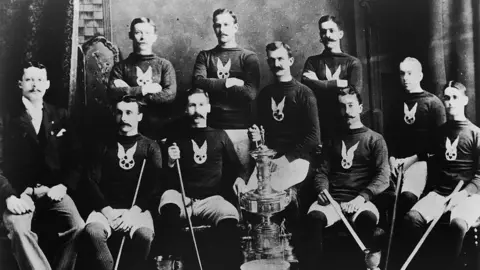
It states that the sport then made its way to Halifax, Nova Scotia, where an ice hockey game was played by British soldiers stationed there in the mid-1850s, before the sport took off in Montreal in 1875 and became the modern version played today.
Because of this history, the proposed law asks that Windsor be formally declared as "the birthplace of ice hockey".
In a public submission this week to Nova Scotia lawmakers, Jean-Patrice Martel, who co-wrote a book titled On the Origin of Hockey, disputed the claim, saying that there are references to the sport being played earlier in Manhattan, New York.
Still, Martel's research did not conclude that New York was the origin for the sport.
Rather, he wrote that ice hockey likely dates back to the British Isles, where shinty was played on ice as early as 1607 in Scotland during The Great Frost.
"Granted, they were probably not wearing skates," Martel added, but he noted the "hurley on the ice" reference in Windsor does not mention skates either.
Another historian, Mi'kmaw matriach Cheryl Maloney, told Nova Scotia lawmakers this week that the proposed bill fails to note the modern sport's indigenous roots.
The Mi'kmaw, an indigenous group that has inhabited the land covering Canada's Atlantic provinces for thousands of years, played the sport on ice prior to the Windsor claim of 1810, Maloney said.
"We went back to 1749 where it was found that the Mi'kmaq were playing a game on ice with the roots of trees in Tufts Cove, Dartmouth, Nova Scotia," she told lawmakers.
Local historian David Jones, who has studied hockey history for decades, also disputed the proposed law, and said the Mi'kmaq played an important role in the "evolution of hockey" in Nova Scotia.
Jones said that the modern version of the sport could be traced back to Dartmouth, Nova Scotia, instead, a municipality east of Halifax.
He contended that the confusion is likely because Windsor has had "better PR" over the years.
"I truly think this bill was written with ChatGPT," Jones told lawmakers, adding that he believes it should be scrapped.
In her statement to the BBC, Sheehy-Richard, the lawmaker behind the proposed bill, said that discussion is "ongoing" and that she has taken the feedback provided by the public.
She added that her intention was to celebrate the history of ice hockey in her province and "give Nova Scotians something to be proud of".
"It is not intended to be exclusionary in any sense, and the broader story of hockey's development involves many people and communities," Sheehy-Richard said.
Ice hockey's origin is not the only historical dispute amongst Canadians.
Several rural towns and restaurants in Quebec have laid claim to poutine, the popular dish consisting of French fries, cheese curds and gravy. While no one knows where exactly the dish was born, its French-Canadian roots are undisputed.
The butter tart, an iconic Canadian dessert, also has a conflicting history.
The first recipe was published in an Ontario cookbook in 1900, though some say it was developed by French Canadians as an iteration of the French sugar pie. Others trace it back to border tarts brought to Canada by Scottish immigrants.
