Carney says old world order 'is not coming back'

 EPA
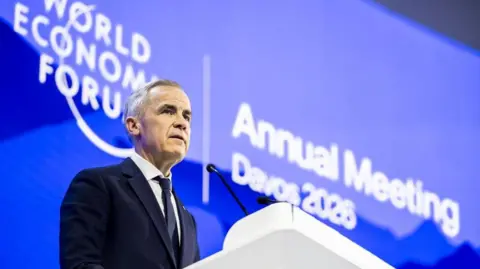
EPACanadian Prime Minister Mark Carney said the "old order is not coming back" and urged fellow middle powers to come together in a speech at the World Economic Forum in Davos, Switzerland.
"Middle powers must act together because if we're not at the table, we're on the menu," Carney said on Tuesday, adding that he believed powerful nations were using economic coercion to get what they want.
He also affirmed Canada's support for Greenland, Denmark and the Nato alliance, drawing applause.
Carney did not mention Donald Trump by name, but some of his remarks seemed aimed at the US president, who is threatening to tariff European allies and the UK unless Greenland is surrendered to the US.
"Great powers" are often defined as countries with permanent seats on United Nations Security Council - China, France, Russia, the United Kingdom and the United States - which shows their economic and military dominance in the world.
Middle powers, such as Canada, Australia, Argentina, South Korea and Brazil, are nations that still exert large influence in global politics, even though their economies are smaller.
In his speech, Carney said the world is "in the midst of a rupture, not a transition".
"Great powers have begun using economic integration as weapons, tariffs as leverage, financial infrastructure as coercion, supply chains as vulnerabilities to be exploited," he said.
He also said "Canada was amongst the first to hear the wake-up call" that geography and historic alliances no longer guaranteed security or prosperity.
When Trump returned to office, he frequently referred to Canada as the "51st state" and threatened to join Canada and the US through "economic force." The US then hit its northern neighbour and major trading partner with steep tariffs.
Recently, Trump added Canada to his push to take control of the partly sovereign territory of Greenland, which has grown stronger and more overt in recent days, by posting on social media a map of the US, Canada and Greenland with an image of the American flag laid over it.
As a member of the North Atlantic Treaty Organisation (Nato), Canada stands firmly with Greenland and Denmark and supports "their unique right to determine Greenland's future", Carney said in his speech.
"Our commitment to Article Five is unwavering," the prime minister added, referring to a clause in the Nato agreement that states an attack against one member state is considered an attack on all.
Canadian media outlets reported earlier this week that Canada was considering sending a small contingent of troops to Greenland to join Danish and other European troops for military exercises in the region.
Asked about it in Davos, Canadian Foreign Minister Anita Anand said "we regularly participate in Nato exercises, and we participate in exercises that the Canadian Armed Forces itself leads". She added that the Minister of National Defence and the chief of defence staff make decisions on future deployments.
The BBC has reached out to the Canada's Department of National Defence for comment.
Carney said in his speech that to adapt to shifting geopolitics, Canada is now focused on engaging with other countries and building "different coalitions for different issues based on common values and interests".
The prime minister pitched Canada as a "stable and reliable" partner, and noted recent trade and investment deals that were struck with China and Qatar, as well as a defence procurement pact Canada signed with the EU earlier last year.
Carney is among several world leaders at the World Economic Forum this week. Trump is scheduled to deliver his own speech on Wednesday.
