'Wait for aneurysm surgery felt like a time bomb'

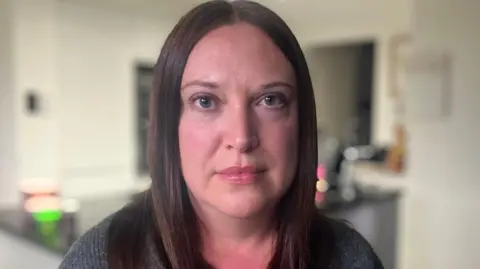 BBC/Elizabeth Baines
"It just felt like a ticking time bomb, always on my mind."
Back in 2020, 45-year-old Angela Langlois suffered a bleed on her brain.
She had no idea she was living with an aneurysm until it haemorrhaged and she was taken to hospital for surgery.
Since then, Angela has had six years of monitoring scans and last June, she discovered her aneurysm had returned and the mum-of-two was told she would need an operation within four weeks.
But 35 weeks on, she has only just had the surgery, after living in constant fear her aneurysm could rupture at any moment.
"It has been simply hideous living like this," she said.
A brain aneurysm is a swelling in a blood vessel in the brain, according to the NHS.
If the aneurysm bursts it can cause a bleed on the brain, called a subarachnoid haemorrhage.
Angela was walking up the stairs when her first haemorrhage happened during the coronavirus lockdown.
"I had absolutely no symptoms, I did not even have a headache on the day it happened," she said.
"As I started to run up the stairs, I heard a pop in my head and within a quarter of a second, it was like a vice grip crushing me and I had gone completely blind."
Angela received a life-saving treatment, called endovascular coiling, which is a procedure that threads tiny platinum coils through a catheter to seal off the aneurysm by forming a blood clot.
'Massive shock'
Six years later, Angela said discovering the aneurysm had returned was "a massive shock."
She was initially told she would be treated as soon as possible, but was later informed there was a waiting list.
"I thought, 'how am I going to cope?' I do not know when it is going to rupture," she said.
She has now just had another coiling treatment, having waited 35 weeks since her diagnosis that the aneurysm had come back.
"It is simply a capacity issue - that is what I have been told - they simply have not the neurosurgeons to do it."
 Graphixel / Getty
According to a report by The Association of British Neurologists, the UK has a neurology consultant workforce of 1.1-1.6 consultants per 100,000 of the population.
By comparison, neighbouring countries in Europe have 6.6 neurologists per 100,000 of the population.
More consultants are also choosing to work part time and the proportion increased from one in 12 consultants in 2004, to one in five in 2022.
In The Royal College of Physicians 2022 census, neurology consultants reported on average 1.8 full time vacancies in their department.
The BBC has contacted the Department of Health for a response.
Dr Magnus Harrison, chief medical officer at Leeds Teaching Hospitals NHS Trust, apologised for the delay to Angela's surgery and the anxiety caused by the wait.
"Patients are scheduled for surgery based on clinical need," he said.
"Unfortunately, limited theatre capacity and the number of patients waiting can mean some people are waiting longer than is ideal, which is something we are working hard to improve," he said.
Listen to highlights from West Yorkshire on BBC Sounds, catch up with the latest episode of Look North.
