Speech-to-text AI 'could save doctors' time'

 BBC
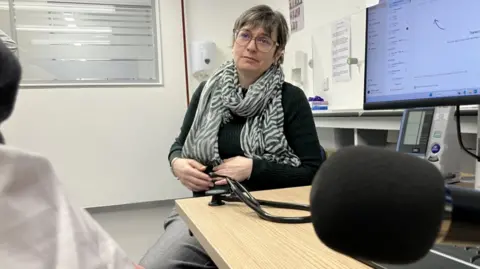
BBCScientists are developing AI (artificial intelligence) technology to help doctors record patient consultations.
Developed by the University of the West of England (UWE) in Bristol, the voice technology uses specialist speech-to-text AI to record consultations, creating notes and letters for clinicians to review and approve.
Aimed at improving patient care, the technology is being created to help clinicians have more face-to-face time with patients as they can save time on writing up notes.
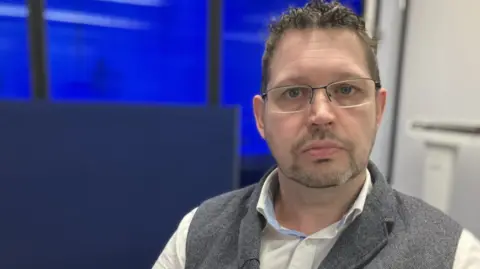
Dr John Mccormick, chief clinical information officer at NHS England South West, said the system allowed more eye contact with patients, rather than staff spending time "staring at a computer screen".
McCormick, who is also a GP in Devon, said because the technology captures "the important bits" it would allow doctors to "concentrate and engage more fully with the patient".
He said it could also reduces the need for GPs to stay behind working into the evening.
"For me, it's about the level of stress that I have to experience in terms of all the administration we've got - which is huge - and this really reduces it for me," he added.
On average, GP consultations take about 10 minutes.
Scientists evaluating the ambient voice technology (AVT) have found it could save up to three minutes per session, allowing doctors more time to get to the bottom of a patient's problems.
The technology is being tested using volunteer patients at UWE's mock GP surgery.
Scientists from its Health Tech Hub are evaluating different AI audio consultation models, including how they cope with different accents, with the long-term aim of introducing the best to the NHS.
As a safeguard in the proposed use of this AI, doctors would have a duty to read the final report, correcting any mistakes.
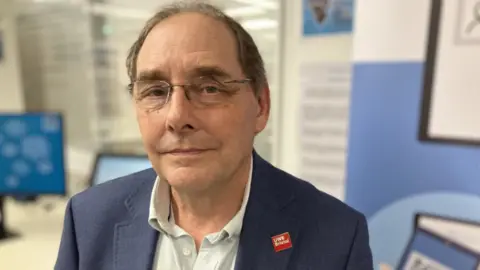
Professor of bioscience and technology at UWE, Richard Luxton, said while the AI technology could be an issue for "really broad" accents, it can be trained to understand different voices.
Working with the university, the Royal Devon University Healthcare NHS Foundation Trust has already used AVT - the first trust in the UK to integrate AI with patient records - in more than 2,700 consultations since it launched a pilot in September.
The hospital said it hoped to roll out AVT to all outpatient clinics by the end of the year, with the trust also exploring whether the technology could be used to improve emergency care.
Once fully rolled out, it is expected to create about 15,000 additional appointments across the trust annually.
Paul Mitchell, the first RD&E patient to have AVT used in their appointment, said: "The clinician gave me eye-to-eye contact throughout our appointment, which made me feel very comfortable, and made the appointment feel much more personable, especially when hearing some difficult news."
Staff are similarly impressed.
Consultant gynaecologist Ben Peyton-Jones said: "It captured some very complex consultations accurately with excellent documentation.
"This will save me time and allow me to focus more attention on my patients."
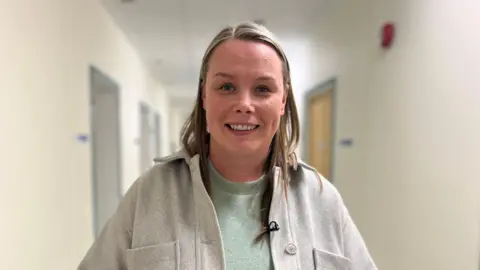
Patient Vickie Underhill said of her appointment: "When he [her doctor] said it's going to be recorded with AI, I thought: 'How is this going to work?'
"But then I actually found that he focused on me rather than the computer, which was really lovely.
"So it's like having a chat, and it just felt a bit more personal. There were no distractions."
The UWE project team said it was working closely with clinicians to listen to feedback and continuously improve how the system worked, including reviewing and improving the letter template to make sure information was appropriately detailed.
The trust is also working with the National Institute for Health and Care Research (NIHR), the HealthTech Research Centre (HRC) in Sustainable Innovation and the University of Exeter to thoroughly evaluate the impact of AVT.
Professor Adrian Harris, chief medical officer for digital and research at NHS Royal Devon, said the trust was "leading the way in how we use this technology".
"This is about using innovation to improve care for patients," he added.
Follow BBC Bristol on Facebook, X and Instagram. Send your story ideas to us on email or via WhatsApp on 0800 313 4630.
