'We started an environmentally friendly TV production firm'

 Factual Fiction
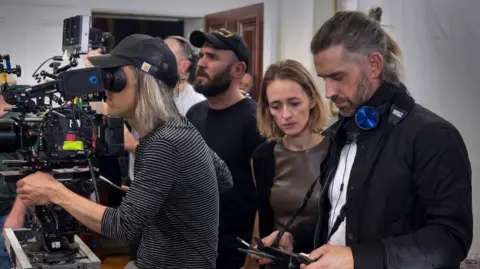
A post-production party at film company Factual Fiction is quite not the glitzy, wild celebration many might imagine.
"We're actually going to get the crew of this last show over to do a tree-planting session," says co-founder Emily Dalton.
Making film and television is not always an environmentally friendly venture.
According to Bafta's sustainability organisation albert, a feature film produces thousands of tonnes of carbon dioxide through travel, power, use of textiles, food and other waste.
Emily and her husband Tom, who have worked on series including The Greatest Show Never Made and The Fake Sheikh, and film Agatha and the Truth of Murder, claim their firm is the UK's first off-grid production company.
"We're off-grid for water, waste and now power," says Emily.
The couple set up the company near Masham in North Yorkshire in May 2020.
However, the Covid-19 lockdown meant they had to install more systems and equipment than they had originally planned.
Emily says: "On the post production - the editing, the colouring, the sound, all of that - you'd normally go to a place physically to do that.
"We had to do it remotely from here, which meant a lot of power use."
Being based "up in the hills, really in the middle of nowhere", Tom adds, meant power cuts were common.
 Factual Fiction
Tom began to research the possibilities of a more reliable - and sustainable - energy source.
"We looked at wind generation initially, but because of where we're situated, we would have to put a turbine up so high to avoid the turbulent air, that it becomes impractical," he says.
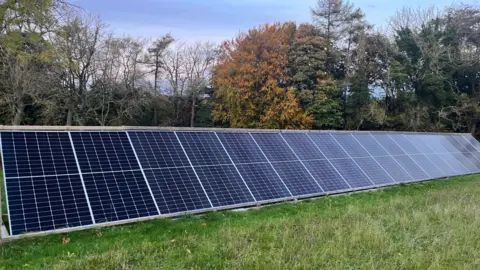
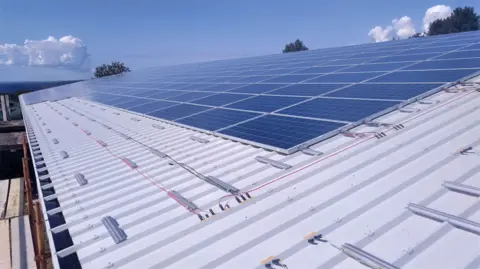
They settled on solar power, spending about £11,500 to install 18 solar panels, alongside 126 recycled Nissan Leaf electric car batteries, providing 98 kilowatt hours-worth of capacity.
"It means that we can ride out the inconsistencies of Yorkshire sunshine for the most part," Tom says, adding that the setup also helped them avoid rising energy bills.
 Factual Fiction
According to Emily, it forms part of a wider focus on sustainability in the company and she highlights the tree-planting efforts of crews.
They identify areas of land where trees need planting, often because they have been damaged by wind during storms, and help to plant new ones.
Tom says this side of the business is not focused on driving profit, adding: "It's purely a means for us to make a difference in an industry which is unbelievably wasteful in areas."
'Call to action'
Major companies involved in the TV and film industry have pledged to make a transition to clean temporary power by 2030 in partnership with Bafta's albert organisation.
In 2024, UK productions burned more than three million litres of fossil fuels in generators and more than half of all productions relied almost entirely of fossil fuels, according to data from the group.
The organisation's head of industry sustainability, April Sotomayor, says: "The climate crisis demands urgent action, and our industry has both the responsibility and the opportunity to lead."
As well as stopping the use of fossil fuel generators to power productions, Bafta albert has previously called for changes to travel and transport, encouraging the use of trains instead of short-haul flights, and switching road journeys to electric vehicles.
A spokesperson said travel and transport were responsible for 65% of the carbon footprint of UK film and TV productions in 2024.
 Factual Fiction
At Factual Fiction, the "ripple effect" of the company's switch to solar power has “done away with the need to travel", Emily says.
On previous productions, she says she travelled every day to a post-production facility in Leeds.
This added to the firm's carbon footprint record.
"We then took that in-house and it's meant zero travel," she says.
On the company's first in-house production, she worked with editors in Bristol, Leeds and Wakefield, but says "none of us have had to get in the car once for that whole process".
Tom says the focus on keeping productions local, to make them more environmentally friendly, also means more jobs in the area.
"Our ability to get out, find people, work with them and grow them, these are all core principles of the business," he says.
He says the availability of work outside London helps to tackle a "diversity issue" which has "always" been present in the industry.
 BBC/Seb Cheer
Working in different communities can also lead filmmakers to tell new stories, Emily says.
"If everyone was spread across the country, you'd have proper representation on and off screen," she says.
"We didn't want to live in the middle of nowhere as a lifestyle choice and then just make all our programmes in the same way that we used to make them when we lived in central London."
However, Tom says challenges remain - including in pitching to television executives.
"A lot of the decisions about what gets put on screen get made in London," he says.
The couple now plan to start producing their own original material to fit with their sustainable philosophy.
"If we offer out the ability to take all your post production to a sustainable company, are people interested in that?" Emily asks.
"It's going to be very interesting year, isn't it?"
Listen to highlights from North Yorkshire on BBC Sounds, catch up with the latest episode of Look North.
