Countryside 'industrialisation' fears taken to Holyrood

 BBC
BBCA round table meeting has taken place at the Scottish Parliament between community council campaigners and MSPs over what has been described as the industrialisation of the countryside.
Representatives from the Highlands, north-east Scotland, Perth and Kinross and the south of Scotland are among those seeking a pause in all major renewable energy applications until a national policy is adopted.
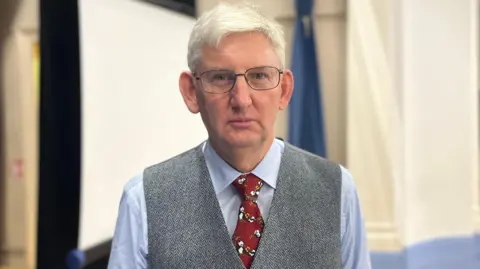
Bob Hope, from Leitholm, Birgham and Eccles Community Council in the Borders, said people living in the areas affected felt their concerns were not being heard.
The Scottish government said that potential impacts on communities were important considerations in the decision-making process.
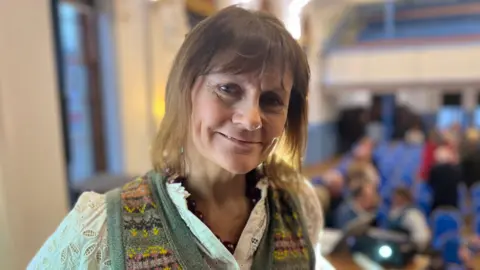
The talks with Energy Secretary Gillian Martin and MSPs were organised by Highland councillor Helen Crawford in response to issues being faced across much of rural Scotland.
She began a push back which led to a unified statement on behalf of 50 community councils in her area being sent to Holyrood.
There have been repeated calls to take action to address the number of wind farms, battery storage sites and new pylon lines being approved and built in the countryside.
Hope believes the discussions with MSPs might help to get their message across.
"They are prepared to wreck our rural heritage just on the basis of not having any plans or any structure to the move to renewables," he said.
"Communities understand climate change and the need to play their part.
"However, with not having a strategic plan the current situation is untenable to our countryside and environment."
The campaigner warned major renewable projects risked "destroying our country in an effort to save the planet".
Hope added that in his own area there was ongoing construction on an area equivalent to the size of 75 football pitches around the Eccles sub-station with "more and more applications" coming through.
He said the impact was "very real" but momentum was building to do something about it.
"We are not against the move to renewables it is the fact that it being done to us rather than with us," Hope added.
He also repeated his calls for a strategic national plan looking at where such projects should take place rather than allowing a "gold rush" of developers.
The Scottish government aims to generate about half of the country's overall energy consumption from renewable sources by 2030.
It said any impact on communities, nature and cultural heritage - including cumulative effects - were considered before deciding the fate of any development.
It said that all applications were subject to "site-specific assessments".
The government has also said it is "vital" that communities see direct benefits from developments including through "shared ownership and community benefit schemes".
