Are MSPs undermining the rule of law in Scotland?

 PA Media
It has been a truly remarkable week in politics and the law in Scotland.
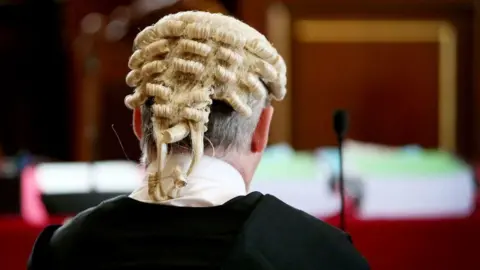
MSPs have been debating a live criminal court case at Holyrood. Questions have been raised about a judge's decision to postpone a hearing, and the lord advocate has faced accusations of corruption.
In return she and senior colleagues in the legal profession warned MSPs they risk undermining the rule of law.
Whatever happened to the firewall between the justice system and politicians - the separation of powers between those who make the law and those who enforce it?
How did we get here - and has it all gone a bit far?
Perhaps it's natural that a very political court case has dragged the legal system into the muddy arena of politics.
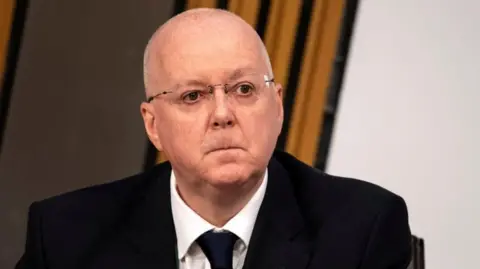
Peter Murrell was the chief executive of the SNP for 22 years. He was married to the party leader and first minister, Nicola Sturgeon.
Now he stands accused of embezzling money from that party. He has not yet made any plea.
But of course people in parliament were going to take an interest when the details of the charge against him became public.
 Getty Images
Murrell was due for a preliminary court hearing on Friday, accused of embezzling almost £460,000 from the SNP.
The hearing was delayed to 25 May, and some politicians raised an eyebrow at the fact it would now take place after the election.
Former Tory leader Douglas Ross tabled a question at Holyrood asking whether any discussions had taken place between the government and the courts about the move.
The answer was a very direct "no", but Ross took the chance to opine that "this stinks".
The court has stated that there was a joint application from both sides in the case for a delay, which was granted by judge Lord Young.
It is not unusual for the defence or the prosecution to request more time - and there is a 17-month deadline for Murrell to make his next court appearance.
Counting up from his first appearance in March 2025, that runs through to August - so it was never guaranteed to be before the election.
Because Lord Young made the decision and politicians would hesitate to accuse a judge of anything, what Ross presented was a hint, an implication of governmental meddling.
It felt more like an attempt to make an opponent deny something and generate some headlines than actually make an open accusation.
But what followed on Wednesday was far more direct, and serious.
 PA Media
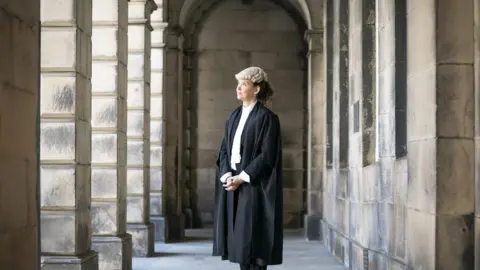
It emerged that the lord advocate, Dorothy Bain - head of the prosecution service and a government minister and legal adviser - had written a memo to John Swinney in January.
She said this was to flag up the fact Murrell had been served with an indictment, warning ministers that the case was live and that they should not comment on it.
But the memo included two titbits of extra information - the precise figure allegedly involved in the case, and a rough outline of how long cases were taking to come to court.
Again, eyebrows were raised among the opposition.
Why was Swinney privy to details that would not become public for more than a month?
It led to remarkable scenes at Holyrood, with the lord advocate called to answer an urgent question.
Normally law officers are treated a bit differently by MSPs. They are not directly elected politicians, so they are afforded a measure of respect.
There was little of that here.
Labour's Michael Marra opened by pressing Bain repeatedly about whether Swinney had been given an advantage - asking "on what planet is it not political interference?"
Then Tory leader Russell Findlay upped the ante in jaw-dropping fashion, saying the move "smacks of corruption" and urging Bain to consider her position.
The law officer pushed back, insisting it was a standard move to inform the government of a development in a major case - that it had been to protect the integrity of the process, not influence it.
Bain has been an advocate for over 30 years, and led the prosecution of murders, paedophile rings and drug gangs.
She has argued in the Supreme Court and the European Court of Human Rights.
She is used to tough questions - but nothing quite so savage and personal as this.
The legal profession rallied in her defence, with Roddy Dunlop KC, Dean of the Faculty of Advocates, saying allegations of corruption were "very serious, and on the evidence available, entirely baseless".
He said MSPs "should take care not to denigrate or damage the rule of law".
Swinney then joined the defence, putting his "absolute confidence" in Bain and calling the accusations "contemptible rubbish".
Was there really a political advantage?
The opposition insist Swinney benefited from seeing the alleged figure from the charge and a hint about timescales because it allowed him to plan his response while everyone else was still in the dark about those details.
The government dismiss this.
To start with, a ballpark figure for the sum involved in the police investigation of SNP finances had been kicking around for years.
It's also arguable that the party would have a better idea of it than anyone, given the money was allegedly embezzled from their own coffers.
And it's well known how long things take to come to court - the idea it could take over a year was no surprise.
Where there actually could be some consensus between parties is about the broader issue of the lord advocate's dual role.
Not about Bain herself - the end of the Holyrood term is weeks away and the office has changed hands after the last three elections - but about the job itself.
Does giving the head of the prosecution service a seat in the cabinet create a risk of conflicts of interest, when cases become political?
Would it be simpler to just split up the roles, so there is a clear separation of powers and we don't need to rely on the judgement of the lord advocate to recuse themselves from cases or decide when they should or shouldn't inform fellow ministers about them?
The government commissioned a report about it in 2024, and as of this month it is under "active ministerial consideration".
It would be a complicated move, because this ancient office - which dates back to 1478 - is knitted into the devolution settlement itself.
Westminster would need to be involved in amending the Scotland Act.
Any change may well require the kind of cross-party working that is a distant prospect amid the current sound and fury.
 Getty Images
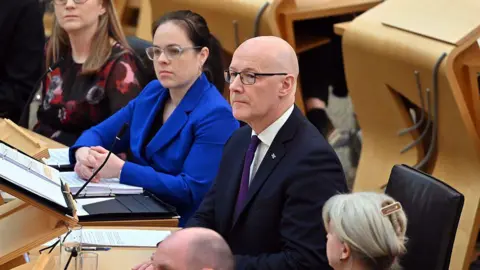
Right now, everyone has political advantage on the brain with an election looming.
Swinney suggested it was "desperation" which drove his opponents to make such serious claims.
The first minister was genuinely angry about Russell Findlay's position.
And the lord advocate was clearly upset too, as can be seen from the letter she sent to Anas Sarwar warning that his claims risked undermining the rule of law.
This is a dangerous moment for institutions, and not just in Scotland.
Trust is at rock bottom, and many seem to be of the opinion that systems need to be shaken up if not torn up entirely.
And MSPs are playing into this fevered atmosphere, while blaming each other for it.
Labour and the Tories insist the government is endangering the neutrality of the legal system, while the SNP hits back that they are trashing the rule of law itself.
Is there a political advantage for any of them here?
This seems like a debate which might chiefly benefit other, more anti-establishment movements.
But it's just the latest point in a long curve of enmity and partisanship in Scottish politics.
It's not just that people don't trust politicians any more - politicians don't trust each other.
Some of them don't even trust the word of the head of the prosecution service.
What does that say to the public about who they should trust?
Politics has of course always had a mucky and brutal side to it, as well as one of public service which works earnestly to improve people's lives.
But at a time when people increasingly feel alienated from politics, the rush to agree with them rather than change their minds creates a vicious cycle.
Politicians across the piece should be careful when sowing seeds of distrust that ultimately have to be harvested by all of them.
