Man with fatal illness in 36-hour corridor wait

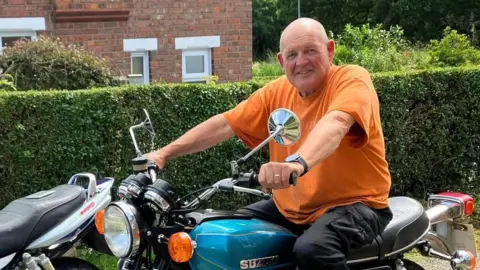 Family handout
The widow of a man who died from encephalitis said he had to wait seven hours for a doctor even though medics thought he could be having a stroke.
Tom Frith, 66, from Knutsford, died on 27 July, of the brain swelling condition more than a month after being admitted with flu-like symptoms and confusion to A&E at Leighton Hospital in Crewe, Cheshire.
He was in a corridor bed for 36 hours, and his wife Julia has asked lawyers to investigate her concerns about the hospital's care.
Dr Clare Hammell, chief medical officer of Mid Cheshire NHS Trust, said patient safety concerns were taken "extremely seriously" and the trust was "very sorry" for any distress caused.
"As a legal claim has now been issued, it would not be appropriate for the trust to comment on the specific circumstances of Mr Frith's care or the allegations that have been raised," she said.
She also said the trust remained "committed to learning and improvement" whenever concerns were raised.
Tom had travelled to the Isle of Man TT Races a week before his illness and had an active lifestyle.
On 14 June 2025, he attended A&E at the hospital with a temperature and was unsteady on his feet.
His condition deteriorated and his wife was told he possibly had delirium caused by an infection.
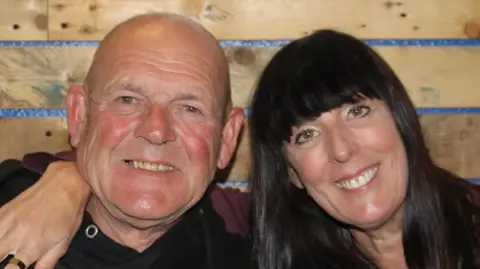 Family handout
As he became more unwell overnight, staff said he could be having a stroke but there was a wait of more than seven hours for a doctor.
Julia said: "What is concerning is that even though the hospital staff were discussing Tom as a potential stroke patient, he was still left on the corridor for 36 hours."
She added that workers apologised for delays and said a new computer system was being introduced that day.
Her husband was only treated with paracetamol and fluids overnight.
Medics said he need an MRI scan but they could only take place on week days.
Julia said she asked if he could be taken to the neurology department at the Royal Stoke University Hospital, but was told it was full.
The doctor prescribed antibiotics for a suspected infection, while he was in the corridor bed.
"The A&E department was overwhelmed," Julia said, "and I believe Tom was failed by the system."
Stressed condition
She said she briefly left the hospital and asked nurses to keep an eye on him.
However, when she returned, she found him standing up with his ID bracelet ripped off and in a stressed condition.
After he had been cleaned and changed, Julia said his space in the corridor had been taken.
He was eventually moved to a cubicle and a day later an X-ray confirmed he had a chest infection.
He was moved to ICU a day later - six days after being admitted - and had a test for encephalitis.
Julia said: "If you put the symptoms that Tom presented into a search engine, the AI response is potential life threatening, possibly encephalitis, swelling of brain or meningitis."
He was given treatment but the family said medics told them he was unlikely to recover.
A month later, he was put on palliative care and died a few days later.
Increasing awareness
Law firm Leigh Day is investigating a medical negligence claim.
Hammell said: "We are cooperating fully with the legal process and are committed to making sure that any learning is carefully considered and shared in the right way.
"We continually review learning from incidents, complaints and claims to help us improve care, including ongoing education and training for staff to support the recognition and management of rare but serious conditions."
Julia said: "I intend to continue to raise awareness of this virus and its symptoms so hopefully someone else could be saved and not have to go through what Tom did."
Dr Ava Easton, chief executive of the charity Encephalitis International, said: "Cases of mis and late diagnoses are why we continue to promote better awareness and healthcare professional education on this condition."
Read more stories from Cheshire on the BBC, watch BBC North West Tonight on BBC iPlayer and follow BBC North West on X.
