Alterations specialist urges shoppers to avoid fast fashion

 Martin Giles/BBC
A clothing alterations specialist has urged people to think about the environment when choosing what to buy and avoid fast fashion garments.
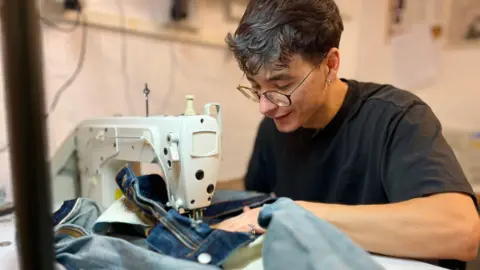
Cosmin Diaconu, who set up Repair my Denim in Cambridge in 2024, said a high-quality pair of jeans made of 100% cotton were easy to repair, but often fast-fashion jeans contained elastane, making the fabric thinner and more difficult to fix.
The term "fast fashion" describes the quick turnover of clothing trends and the move towards cheap, mass-produced garments - with new lines constantly released.
"Most of the fabric [of higher-quality jeans] can be recycled and is biodegradable... and it doesn't have plastic in it," he added.
The UN said fast fashion was fuelling a global waste crisis and the industry was one of the world's most polluting sectors, using up large amounts of water and chemicals.
"Think about the consequences [of what you buy]. How long will you wear it for? Or look for the alternatives that are a bit more sustainable," Diaconu said.
The Waste and Resources Action Programme said that almost half the textiles used in the UK end up in household waste.
 Martin Giles/BBC
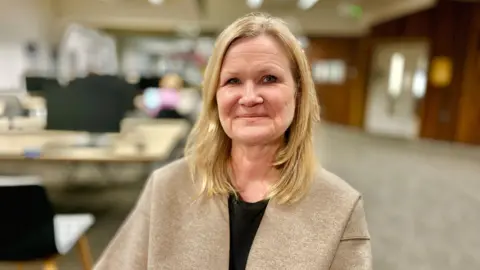
Cathrine Jansson-Boyd, a professor of consumer psychology at Anglia Ruskin University, said it was the pressure of being fashionable, especially for teenagers and young adults, that was fuelling fast fashion.
"For them it is often a statement on who they are, a representation of the social groups they belong to," said Jansson-Boyd.
"We have even moved on from talking about fast fashion to talking about ultra-fast fashion, because the turnover of the collections is so rapid that people want to renew their wardrobe essentially every week," she added.
 Martin Giles/BBC
Despite the prominence of fast fashion, some charity shops said the second-hand clothing market has grown and donations have been thriving.
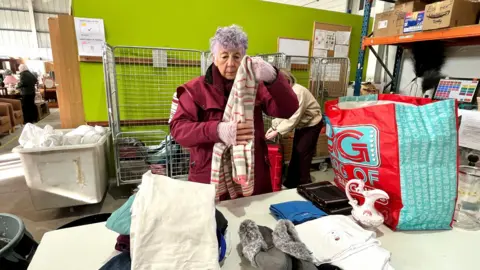
In Pampisford, Cambridgeshire, the donation hub for the Arthur Rank Hospice was full, volunteers said.
The higher-quality items would be sold in the charity's High Street shops, which provided an important revenue stream for the organisation.
 Martin Giles
Items that were not good enough to be stocked in the shops were put in "rag bins", which would be sold on for recycling.
Sharon Allen, the CEO of Arthur Rank Hospice Charity, said selling rag bins was becoming more difficult.
"The price of rag has really dropped. Five years ago we'd get about 50p per kilo. Now we're getting 14p.
"The cost of all that engagement and the transportation is starting to make it not viable," she said.
 Martin Giles/BBC
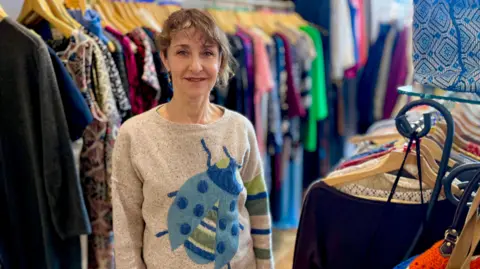
Janine, who did not want to provide her surname, said she regularly shops at charity shops in Great Shelford, Cambridge, and said she was wearing a jumper she had bought on a previous visit.
"It was three sizes too big for me and I liked it so much I took it in," she said.
"[Upcycling] gives you a good feeling to think that something hasn't been wasted and it's been recycled.
"I think that's part of the fun as well as the enjoyment of finding a treasure," she added.
 Martin Giles/BBC
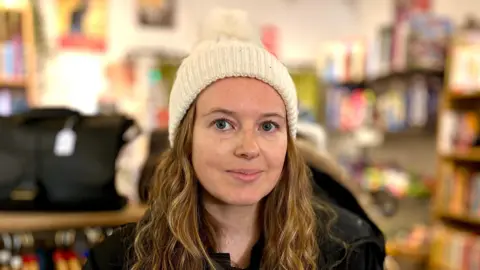
Kirsty, who did not want to provide her surname, said she liked going into charity shops as she enjoyed the mystery of not knowing what you could find.
"Once you get used to charity shop prices it's difficult to go back to high street prices," she said.
She said she enjoyed regularly refreshing her wardrobe, but would "re-donate quickly" back to charity shops.
"I'm quite one-in-one-out, otherwise my wardrobe will get out of hand," she said
Follow Cambridgeshire news on BBC Sounds, Facebook, Instagram and X.
