National Highways urges patience as getaway looms

 Sam Read/BBC
As the Christmas getaway approaches, the organisation responsible for major roads in the East of England is urging drivers to be patient.
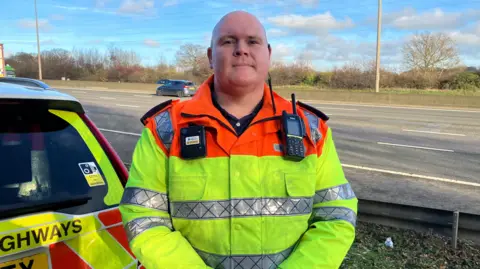
National Highways traffic officer Robert Oates said he understood their frustrations when roads had to be closed.
"We, in essence, are stopping them from going where they need to go," he said.
"I think the more people see us on the job, they understand why… we don't just stop it for no reason."
 Sam Read/BBC
 Sam Read/BBC
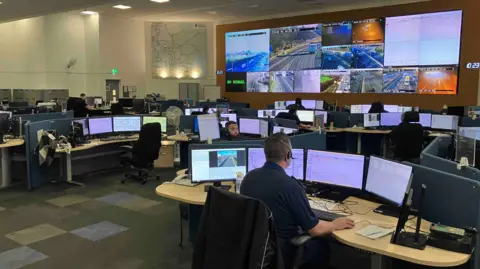
The National Highways control room in South Mimms, Hertfordshire, co-ordinates traffic officers and is responsible for A roads including the A11 and the A14, and motorways including the M1, the M11 and a section of the M25.
In the year to October, more than 28,000 incidents were reported to it, an average of 77 a day.
Calls come in from the public, the emergency services or a detection system within the road network that highlights any stationary vehicles.
Such incidents include collisions and pedestrians and animals on the road, although the most common are vehicle breakdowns.
Each time, a decision has to be made about whether a lane or the whole road needs to be closed, which will have an effect on other drivers who may not understand why there are closures.
Mr Oates, who covers junction six to junction 14 of the M1, between Bricket Wood in Hertfordshire and Milton Keynes, said: "The immediate thing is to make sure the person who had just had an incident is safe and the people coming up to it are as well.
"We do try to clear the road as quickly but as safely as we can."
 Sam Read/BBC
Network operations manager Andy Gower said: "Safety is our number one priority.
"We try to avoid road closures as much as possible because of the impact it has, but sometimes it's unavoidable."
The East region's head of service delivery, Heather Openshaw, said National Highways also had a maintenance programme and regularly assessed its assets to make sure roads were up to scratch.
She said she was happy that the main road network was maintained to a good standard.
"We do work overnight for minimum disruption," she said.
"We publish closures in advance and work with other organisations, such as Royal Mail, to understand which days will impact them less."
National Highways also carries out weekly inspections to find any defects, which are then programmed for repair in seven, 14 or 28 days.
"There are always difficult balances with any kind of budgets we may receive but the teams have full knowledge of their network, they know where the hotspots are," said Ms Openshaw.
"We could do more but with the funding that we've got, the roads are good."
A Department for Transport spokesman said: "We are on the side of drivers – which is why we've committed £25bn over the next five years towards improving our roads, and £4.8bn this year alone."
Follow East of England news on X, Instagram and Facebook: BBC Beds, Herts & Bucks, BBC Cambridgeshire, BBC Essex, BBC Norfolk, BBC Northamptonshire or BBC Suffolk.
