Researchers track climate change in Arctic Circle

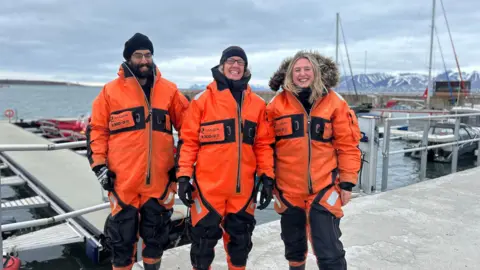 University of Leicester / Abigail Waring
Equipment to help monitor climate change has been set up in the Arctic Circle by researchers from the University of Leicester.
The team from the National Centre for Earth Observation travelled to the Norwegian archipelago of Svalbard to install thermal radiometers which will collect "precise, on-the-spot" temperature data.
The data is used to validate measurements taken by orbiting satellites and helps scientists understand how the region is being affected by climate change.
Research associate Abigail Waring said the station was one of the first of its kind in the arctic.

"My first thought flying over the fjords and seeing the ice shelves, I genuinely welled up because it was just so stunning," she said.
"It really put into perspective that even though I sit behind a desk and look at data and we see these trends, it is really happening and it is really affecting people."
Climate scientists say the Arctic is warming four times faster than the global average, so accurately tracking temperature changes is essential.
Dr Jasdeep Singh Anand said taking continuous measurements was "very challenging".
"We're talking about a region that is 5.5 million square miles and a mixture of open ocean, sea ice, tundra, so satellites offer our best method of viewing this area over a very very long timescale," he said.
"However, because we're measuring the temperature indirectly from space, we need assurance that these measurements are correct."

The team learned how one of the glaciers they hiked up - the Kongsbreen glacier - had receded by 2,625 ft (800m) in six weeks and has not recovered.
They also observed how summer sea ice disappears earlier in the year.
Sea ice acts like a giant mirror by reflecting much of the Sun's energy back into space, but as rising temperatures cause it to shrink, the dark ocean below can absorb more heat, warming the planet further.
Ms Waring also said the trip was not without its dangers, as polar bears "roam freely".
"You have a polar bear designated safe zone but you're not allowed to go out of it unless you're with someone who's trained with a rifle," she said.
"They can walk onto the research centre and they have alerts for that, but it is quite scary to think you could just see a polar bear across the fjord."
Follow BBC Leicester on Facebook, on X, or on Instagram. Send your story ideas to [email protected] or via WhatsApp on 0808 100 2210.
