Highways spends £50m buying Thames Crossing houses

 Stuart Woodward/BBC
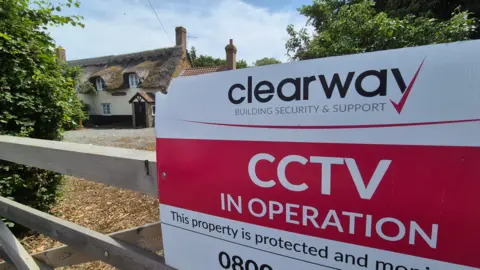
National Highways has spent more than £50m purchasing properties affected by one of the biggest UK road projects in living memory, the BBC can reveal.
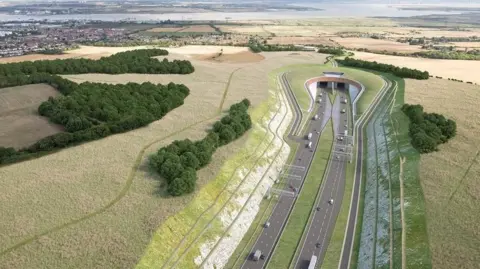
Work is due to start on the largest road tunnel in the UK - the Lower Thames Crossing (LTC) between Essex and Kent - next year.
Data released under the Freedom of Information [FOI] Act showed that 71 properties had been purchased, with 57 of them being rented out to tenants.
Residents have complained about their lives being upended, but National Highways says it has reduced the number of properties affected by almost 70% since it started planning the scheme.
The figures also reveal that National Highways has received more than £5m in rental payments, from properties it now owns, since 2018.
The £10.6bn crossing plan was approved by government in March 2025 and National Highways says the 14-mile (23km) road is due to open in the early 2030s.
It has described the scheme as "the most significant road project in a generation".
The route will feature two tunnels underneath the River Thames between Tilbury and Gravesend, as well as link roads which will meet up with the M25 in Essex between junctions 29 and 30, and with the A2 near Thong in Kent.
 National Highways
The FOI, submitted by the BBC, revealed the extent of National Highways' purchasing operation:
- There were 76 properties located within the route corridor of the LTC
- Fifty-one were in Essex, 14 in Havering and 11 in Kent
- Of these properties, 51 have so far been purchased for £37.6m
- Four more are in the process of being purchased, with the remaining 21 properties subject to compulsory purchase powers in due course
Owners whose properties fall outside the order limits of the LTC - but are still negatively impacted by its construction - are eligible to apply to National Highways to ask for their property to be considered for purchase.
The FOI revealed there were 23 properties which had applied for this, of which National Highways had purchased 20 for a total of £12.8m.
National Highways has committed to buying the other three properties as well.
The data also shows the government agency has received £5.1m from the properties it has rented out.
The Thames Crossing Action Group - made up of campaigners opposed to the project - said the FOI showed "homes were being bought up and rented out long before the scheme had legal consent, creating a sense that the decision was already made".
"While National Highways may say these purchases were voluntary, the scale and timing raise serious questions about fairness, transparency and respect for the planning process," a spokesman said.
"There is no evidence of illegality, but there is growing evidence of a system that places intolerable pressure on communities long before Parliament has had its say."
Purchasing properties affected by large-scale construction projects is common practice, and is often carried out well in advance of work taking place.
A spokesperson for National Highways said the LTC would "improve journeys and bring significant benefits to people and businesses across the region", but acknowledged there would be "an impact on properties along the route of the new road".
"Through a comprehensive programme of consultation we have been able to significantly reduce the number affected by almost 70%, and reached voluntary agreements with many," they said.
The spokesperson added that National Highways had been in touch "with all people with an interest in land affected by the project for almost a decade", and was "committed to paying a fair market value to property owners."
Follow Essex news on BBC Sounds, Facebook, Instagram and X.
