'I slapped her and that was the final straw. I needed help'

 PA Media
"At first it was the shouting, the swearing, the calling of names. And then it got physical after not long into the relationship."
Twelve months ago, James, who is in his late 30s, would have struggled to admit this.
After eight years his relationship was over and he was in prison for 12 weeks having "kicked off the front door" of his ex-partner's home.
"I back handed her, slapped her. That was the final straw really. I decided I do need some help. You shouldn't do it in the first place let alone in front of your children".
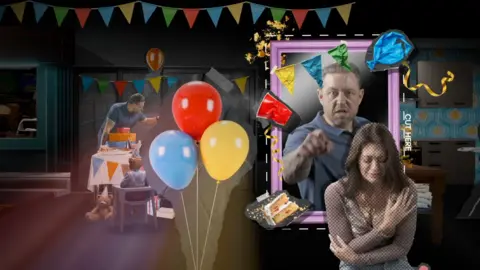
James, which is not his real name, has shared his story as part of Essex Police's latest Reflect campaign.
He attends a course for two hours a week which helps domestic abusers come to terms with the worst of their behaviour and experiences.
There has been scepticism over whether abusers really can alter their behaviour, although one survivor told the BBC this week that people in James's position can truly change if they want to.
 Essex Police
"I slapped, punched, kicked. You name it, I [have] done it," James admitted.
He was asked why he became abusive and violent: "My insecurity about things.
"A lot of anger issues. I'd have a bad day at work and take it out on my ex-partner. I would start moaning and banging things. Whatever was going on at work or wherever, I always seem to go home and take it out on her.
"As soon as I [had] done it, it was regret and sorrow.
"But to be honest it was mainly - probably being sorry for myself. Which is very selfish. I was always thinking about me."
James told the BBC he has reflected on his actions: "I can imagine what my ex-partner was going through. She must have been really scared every time I came home.
"The kids were probably thinking: Are dad and mum going to argue again tonight? So they were probably anxious all day wondering what mood I was going to be in when I got home.
"I feel sick - the way I treated my ex-partner, the way the kids had to see everything. That's why enough was enough and I decided I need to sort this out. I don't want my kids to end up like I've been, because that would be awful."
In November 2024, James was jailed after pleading guilty to causing criminal damage, assaulting an emergency worker, assault by beating and use of violence to secure entry to a premises.
For six months, he has been on the ReSET course in Essex provided by Cranstoun, which is a charity that also helps people overcome alcohol and drug addiction.
Its three course modules are themed around coercion, control and consequences.
Kate Grindley, from Cranstoun, said: "Working with people who use harmful behaviour is essential if we want to stop domestic abuse at its source.
"These interventions hold individuals accountable while helping them understand and change the patterns that put victim-survivors at risk."
James's attack on his partner was one of nearly 31,000 domestic abuse incidents that Essex Police said it responded to in 2025.
There were six deaths in the county last year that were domestic abuse related, the force said.
A survey recently published by the Office for National Statistics suggested one in eight women were victims of sexual assault, domestic abuse or stalking within the space of a year.
 John Fairhall/BBC
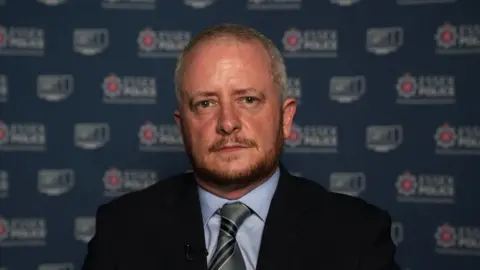
"Sorry doesn't cut it anymore," says Det Supt Dan Morrissey, who is Essex Police's lead for domestic abuse and stalking.
"We want people to reflect on their behaviour and take personal responsibility.
"If you are gaslighting your partner, committing financial abuse; if you are controlling their every move, isolating them and stopping them from going out - then you are a domestic abuser.
"You need to reflect on that and stop it.
"If your partner calls us or a member of your family calls us, Essex Police will take that report and we will arrest you."
 John Fairhall/BBC
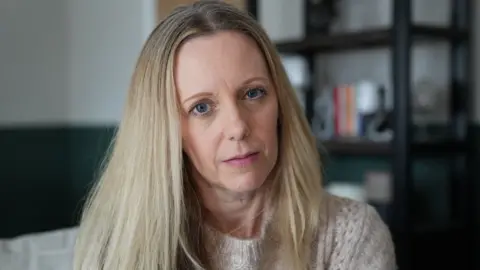
Cheryl Sharp, 45, from Essex, was in an abusive relationship.
But the qualified accountant went on to set up her own practice, which specialises in helping other women with financial independence so they can break away from harmful relationships.
She believes domestic abusers can change.
"I think that willingness has got to be there from them to recognise what they were doing or what they are doing and want to change.
"If they don't want to change then I don't think they could. But I think if they want to then definitely."
Beverley Jones, the chief executive of Next Chapter, is not so sure.
The charity works with 5,000 victims of domestic abuse across mid and north Essex.
Jones said: "I struggle to see how a person who has perpetrated such a heinous crime and has been willing to create so much pain and anguish and destroy someone's life can be rehabilitated. But that is my personal view."
She said she hoped that the Cranstoun programme would at least "catch people before they get into the worst end [of the abuse]".
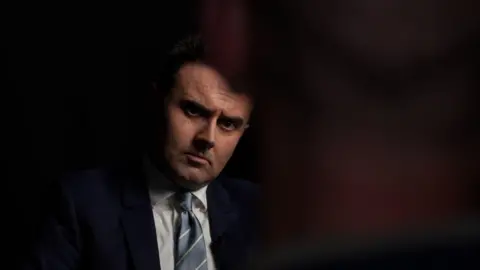
"It's a long journey," James told the BBC.
"It's a bit like being addicted to drink or drugs. There's a process you have got to go through. It's not just: You do a course and you are fixed.
"I could say sorry to her now but it would be like the eight years of saying sorry. It would just be lip service really. Actions speak louder than words."
James does not live with his ex-partner and children but sees them regularly.
"I do believe everyone can change, but it will take a while and you need to put the work in."
If you have been affected by this story or would like support then you can find organisations which offer help and information at the BBC Action Line.
Follow Essex news on BBC Sounds, Facebook, Instagram and X.
