What a mess – why does clearing fly-tips take so long?

 Kate Bradbrook/BBC
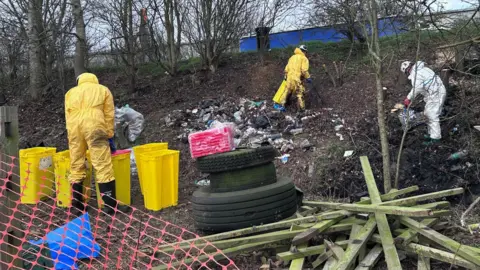
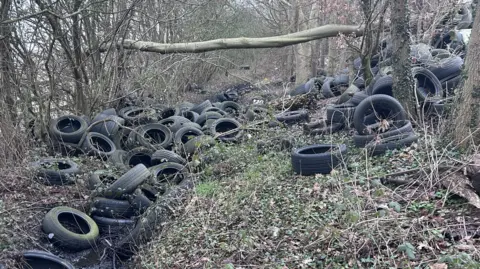
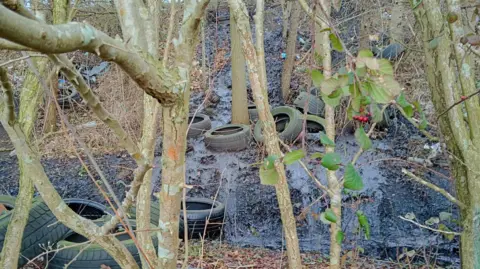
Hundreds of tyres and the equivalent of 1,000 bathtubs of oil were dumped close to the A14 in Northamptonshire in December.
It sparked fears the hazardous waste could spill into the nearby River Nene, threatening fish and wildlife.
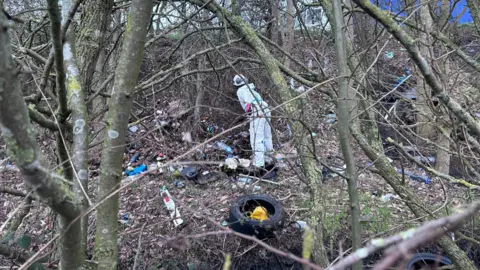
Despite a major clean-up operation, masses of unsightly waste remain at the scene north of Woodford.
What goes into clearing mass fly-tips – and why does it take so long?
 Kate Bradbrook/BBC
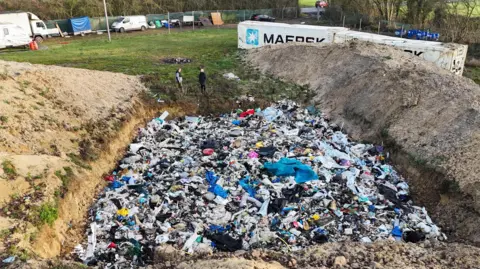
The illegal dumping near Woodford is just one of a string of incidents across the East of England.
A farmer near St Albans in Hertfordshire was left with a £40,000 bill when 200 tonnes of toxic waste was dumped on his land in summer 2025.
And earlier this month, it emerged three arrests were made after 1,200 tonnes of rubbish was offloaded in Stockton, close to the Norfolk and Suffolk Broads.
Further afield, a mountain of waste fly-tipped in Oxfordshire made national headlines in November.
 Shaun Whitmore/BBC
Speaking to the BBC at the Woodford site, environmental crime lawyer Dr Anna Willetts says: "It does take time to deal with these sites and, of course, you can't just instruct a clean-up overnight – but it is frustrating.
"It's not a quick operation. You can't just send in a tanker and clean everything up; you have to identify what the waste is.
"But I think the public's frustration is if these investigations started sooner, the clean-up process is dealt with sooner."
 Kate Bradbrook/BBC
Figures from the Department for Environment, Food and Rural Affairs (Defra) show fly-tipping across England is on the rise.
Local authorities dealt with 1,257,863 incidents in 2024-25, up by 9% year on year.
Enforcement action was taken on less than half of those occasions: about 572,000 times.
'Shameless'
Willetts says people are frustrated by a perceived lack of speed by the Environment Agency (EA) in responding to fly-tips, but she does believe it is getting better.
"It is a difficult and big problem because in any type of crime, not just waste crime, criminals will always be looking to get around the rules," she says.
The EA announced a major crackdown on waste crime on 20 February, led by a 33-strong drone squad to trace illegal dumps from the air.
It says officials "share the public's anger" on fly-tipping by "shameless" offenders.
The cost of the clean-up in Woodford is estimated at upwards of £500,000.
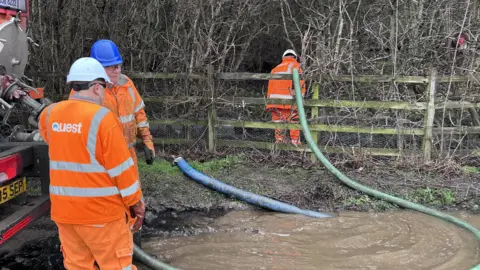
Absorbent floating tubes have been in the water to reduce the impact of oil moving downstream but need to be regularly emptied.
Specialist contractors are also pumping out the oil pollution, of which about 264,000 litres have been extracted so far – as well as 42 tonnes of contaminated soil and vegetation.
Ian Doust, programme development manager at National Highways, says agencies are trying to avoid their "worst fear" of the spill causing structural damage to the A14.
If this happens, a lane on the westbound carriageway may need to be shut while it is made safe.
"It's disgusting. How anybody could think this is an acceptable way to behave... I just can't get my head around it at all," Doust says of the fly-tip.
"Every pound we spend here clearing up after this person [fly-tipper] is money we can't spend on potholes, grass cutting, litter clearing and all of the other work we have to do."
 Kate Bradbrook/BBC
Authorities fear it could be months, if not years, before wildlife at the Woodford site recovers.
Richard Johnstone, who owns the affected land, tells the BBC he wants the EA to send a strong message in its response to the incident.
"Unless they do something about it, it's just going to continue elsewhere," he says.
"It's not just this bit of countryside; it [could be] anyone's bit of countryside."
In 2025, a House of Lords inquiry into large-scale organised fly-tipping ended with calls for an urgent review into the government's response to waste crime.
One of the areas it criticised was the landfill tax, which was introduced in 1996 to discourage disposing of waste in landfill sites.
The inquiry found the tax risked increasing waste crime and leading to the abandonment of landfill sites.
Dr Tom Roberts, from the University of Surrey, has also said the tax created a "black market" in the waste industry, by allowing criminals to profit from dodging it and dumping their rubbish.
Responding to the inquiry, a Defra spokesperson said the government was "taking action to clean up Britain and tackle waste gangs" and would be responding to the report "in due course".
Phil Langford, whose BK Waste Management company clears fly-tips across England, says it has created an "absolutely farcical" situation.
He says it is now cheaper for him to recycle some of his waste in Sweden, rather than in the UK.
"If the EA was more rigorous on checking up on people, you'd see fewer fly-tips," says Langford, from Essex.
He also highlights the environmental impact of fly-tips, adding: "You'll have animals come by that get it on their paws, lick them and then it's in their system.
"If they breed then this damage will last for generations to come."
 Richard Johnstone
The EA says it has completed the first phase of its cleaning operation in Woodford, and is now working to remove contaminated soil, vegetation and tyres from the scene.
A spokesman continues: "While we are unable to comment on the details of our ongoing investigation, we will not hesitate to prosecute waste crime offenders where evidence allows."
It has vowed to claim any money back from offenders if they are brought before the courts.
Follow East of England news on X, Instagram and Facebook: BBC Beds, Herts & Bucks, BBC Cambridgeshire, BBC Essex, BBC Norfolk, BBC Northamptonshire or BBC Suffolk.
