The North West troops training to fight with Nato

 BBC
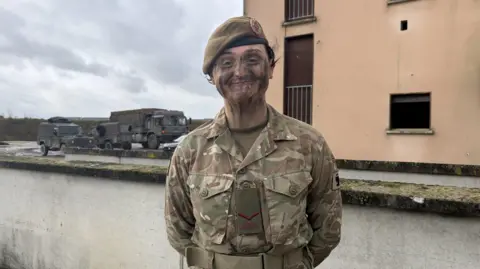
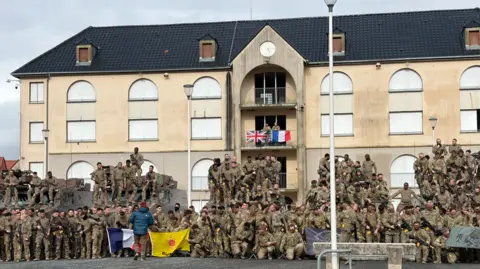
BBCSome 120 soldiers from the 1st Battalion of the Duke of Lancaster's Regiment are training in one of the most advanced urban training grounds in Europe.
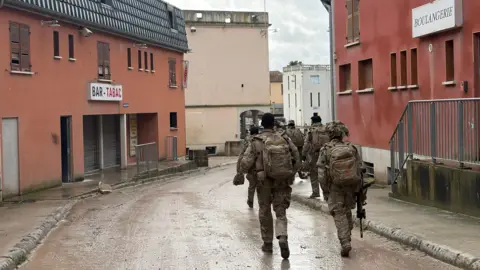
At 46 sq miles (119 sq km), CENZUB, which is around 160 miles (257km) north east of Paris, is larger than the town of Burnley.
There are makeshift villages, subterranean training grounds and even a disused railway.
Meet the troops from the north-west of England fighting alongside Nato in the event of Russian aggression.
'I'm not scared of war'
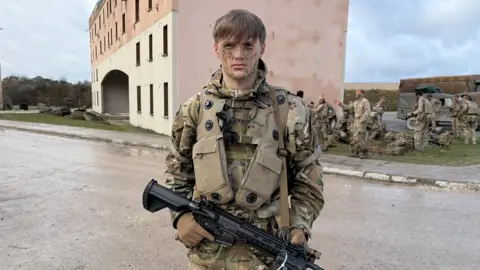
Kingsman Oscar Bolton, 19, said: "When I got here it hit me. The size of the ground we're in right now.
"I thought it's going to be nails. "It's going to be hard."
Bolton was a carpenter in Lancaster before joining the Army.
"I felt like I was worth more, he said.
"There was something else I could be doing. I didn't want to waste away on a work site doing the same job my whole life.
"I wanted to actually do something."
Last July, the First Battalion of the Duke of Lancaster's Regiment assumed high readiness deploy under NATO's Forward Land Forces programme.
That is a critical deterrence measure intended to reinforce the alliance's eastern flank in the event of Russian aggression.
Once training has been completed, the Lancashire soldiers could be deployed 35 miles to the Russian border if needed.
"I wouldn't be much of a soldier if I was scared of war or dying really." Bolton said.
"It's made very clear from day one in training. This is a job where you will probably die.
"I will go to war at some point inevitably.
"It does stay on your mind, but if it means I die and innocent people then don't have to then I'd rather do that."
Some of the troops from the regiment are already on the ground in Estonia, where British troops have command of NATO defences.
It comes as the UK government has pledged to increase its military presence in Norway over the next three years, as part of efforts to combat Russian threats in the region.
Tensions between Washington and European Allies had intensified after US President Donald Trump threatened to take over Greenland, a semi-autonomous Danish territory, for its national security, and said that not enough was being done to protect it from Russia and China.
He has since appeared to back down from those plans.
"The NATO partnership and any force working together is what makes us stronger," said Major Lance Morris.
"There is no chance that we are going to tackle any challenge in isolation and so we recognise the strength that comes with working in partnership and our French partners are absolutely critical to that."
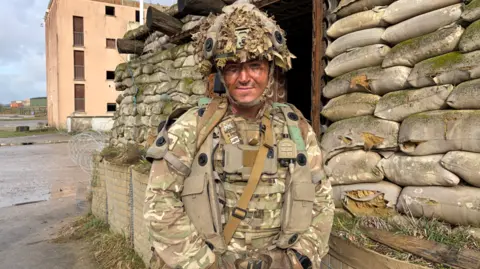
Ninety percent of the First Battalion of the Duke of Lancaster's Regiment are from the North West, with some as young as 17 years old.
Lance Corporal Amelia McCauley, 19, was promoted in January.
"I'm buzzing." she said excitedly.
"I couldn't wait to pick up my phone to my dad and tell him.
"I really wanted to follow in my dad's footsteps, so that was a massive drive for me."
McCauley's father served in the armed forces in Afghanistan. She said conditions and demands for the British Army had changed since then.
"He tells me things and I tell him things. He's not as good with the new technology. " she laughed.
Every soldier in the 1Lancs regiment is taught cutting edge communication systems and has be trained in how to operate a drone.
"The weather conditions are also vastly different," CS GT Lewis Young told me, adding it was -10°C at the Estonian base last week.
Exercise GAULISH is an integration with French forces, where the British Army learn French tactics.
"It's the same for us. We learn different procedures and see how the other works" said Captain Pierre, 152nd Infantry Division, France.
"For sure it works. You look at what's good in the other army and you take it back home."
Read more stories from Cheshire, Lancashire, Greater Manchester and Merseyside on the BBC, watch BBC North West Tonight on BBC iPlayer and follow BBC North West on X.
