Europe must act urgently and stop outsourcing defence, says EU's Kallas

 EEAS
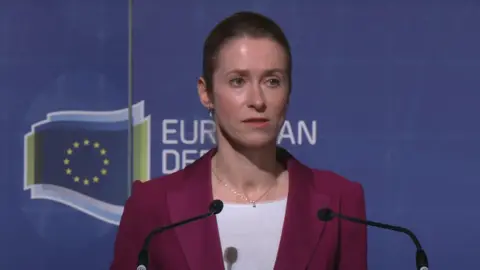
EEASEurope must step up urgently to improve its defence and make Nato "more European to maintain its strength", because the US has shaken the transatlantic relationship to its foundation, the EU's foreign policy chief has warned.
The US would continue to be Europe's partner and ally, Kaja Kallas told a defence conference, but no great power had ever "outsourced its survival and survived".
Tensions with the US flared when President Donald Trump threatened to take over Greenland, a semi-autonomous Danish territory.
Kallas's remarks came after Nato leader Mark Rutte prompted a backlash when he said European lawmakers should "keep on dreaming" if they thought Europe could defend itself without the US.
French Foreign Minister Jean-Noël Barrot reacted to the secretary general's comments on Tuesday by saying: "No, dear Mark Rutte. Europeans can and must take control of their security. Even the United States agrees. It's the European pillar of Nato."
Kaja Kallas said that under the Trump administration Europe was "no longer Washington's primary centre of gravity", and the continent needed to change the culture away from thinking as nations, and towards acting jointly as Europeans.
Washington's transition away from Europe "has been ongoing for a while", the EU foreign policy chief said, adding that it was structural, not temporary.
The 23 nations that were members of both the EU and Nato had a special responsibility to "sync our efforts, together with Nato". Like Barrot, she highlighted the importance of showing how a "distinct European pillar" would add value.
The recent US-European rift over Greenland has highlighted the "tectonic shift" in the relationship that Kallas referred to in her speech, with Trump threatening to impose tariffs on some of his closest European allies after they opposed his plans to take over the Arctic island.
Mark Rutte was credited last week with calming tensions between Trump and European leaders, when the US president dropped his threat during talks with the Nato chief on the fringes of Davos. Trump said he was exploring a potential deal on Greenland, although no details have yet emerged.
Last year, under pressure from Trump, Nato member states promised to increase their overall spending to 5% of GDP by 2035, although part of that could go towards national infrastructure.
Rutte told the European Parliament on Monday that if Europe really wanted to "go it alone" on defence it would have to spend 10% of economic output (GDP) and create its own nuclear capability.
A move away from the US would, in Rutte's view, "lose the ultimate guarantor of our freedom, which is the US nuclear umbrella".
Addressing the same conference in Brussels as Kaja Kallas, EU Defence Commissioner Andrius Kubilius said on Wednesday that the US now expected Europeans to take responsibility for their defence as the Americans were going to "diminish their presence on the continent".
Europe was "a giant, but a sleeping giant" that needed waking up. "We must very rapidly build our independence. Independence in defence: without delays and without excuses," he added.
Nato's primary purpose when it was founded in Washington in 1949 was to ensure the security and freedom of its members in the face of a hostile Soviet Union - a Russia-dominated Communist empire that collapsed in 1991.
Russian President Vladimir Putin has long accused Nato of expanding eastwards, creating a security threat to Moscow, and he framed Russia's full-scale invasion of Ukraine in 2022 as a response to that.
However, an increasingly belligerent Russian state has prompted two more members of the EU - Sweden and Finland - to join the Nato alliance since the full-scale invasion.
The Kremlin has demanded that under a future peace deal Ukraine must be barred from joining Nato.
Although it is part of Ukraine's constitution to join the European Union and Nato, the chances of Kyiv becoming a Nato member any time soon are considered remote.
