Trump's world order hangs over Europe on eve of key defence conference

 EPA
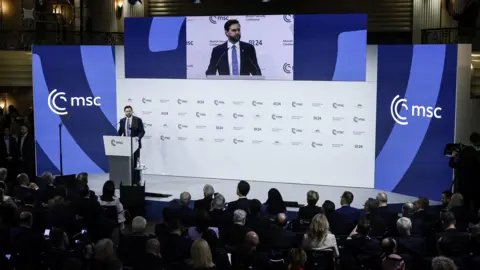
EPAIt is one year since US Vice-President JD Vance delivered a bombshell speech at the Munich Security Conference, castigating Europe for its policies on migration and free speech, and claiming the greatest threat the continent faces comes from within.
The audience were visibly stunned. Since then, the Trump White House has tipped the world order upside down.
Allies and foes alike have been slapped with punitive tariffs, there was the extraordinarily brazen raid on Venezuela, Washington's uneven pursuit of peace in Ukraine on terms favourable to Moscow and a bizarre demand that Canada should become the "51st state" of the US.
This year, the conference - which begins later this week - once again looks set to be decisive. US Secretary of State and National Security Adviser Marco Rubio leads the US delegation, while more than 50 other world leaders have been invited. It comes as the security of Europe looks increasingly precarious.
The latest US National Security Strategy (NSS), published late last year, called on Europe to "stand on its own feet" and take "primary responsibility for its own defence," adding to fears that the US is increasingly unwilling to underpin Europe's defence.
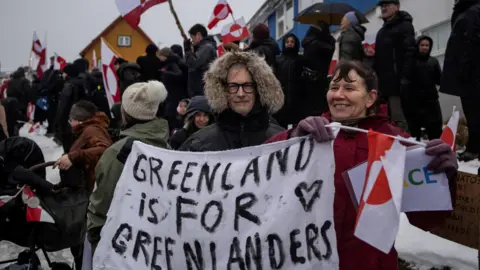
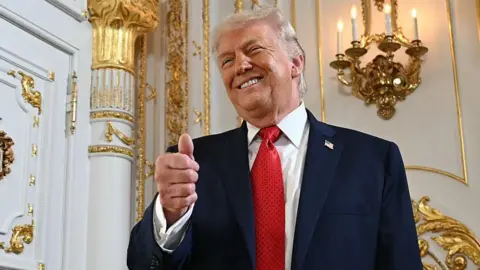
But it is the crisis over Greenland that has really tugged at the fabric of the entire transatlantic alliance between the US and Europe. Donald Trump has said on numerous occasions that he "needs to own" Greenland for the sake of US and global security, and for a while he did not rule out the use of force.
 Reuters
Greenland is a self-governing territory belonging to the Kingdom of Denmark, so it was hardly surprising when Denmark's prime minister said that a hostile US military takeover would spell the end of the Nato alliance that has underpinned Europe's security for the past 77 years.
The Greenland crisis has been averted for now – the White House has been distracted by other priorities – but it leaves an uncomfortable question hanging over the Munich Security Conference: Are Europe-US security ties damaged beyond repair?
They have changed, there's no question about that, but they have not disintegrated.
Sir Alex Younger, who was chief of the UK's Secret Intelligence Service, MI6, from 2014-2020, tells the BBC that while the transatlantic alliance is not going to go back to the way it was, it isn't broken.
"We still benefit enormously from our security and military and intelligence relationship with America," he says. He also believes, as many do, that Trump was right to make Europe shoulder more of the burden for its own defence.
"You've got a continent of 500 million [Europe], asking a continent of 300 million [US] to deal with a continent of 140 million [Russia]. It's the wrong way around. So I believe that Europe should take more responsibility for its own defence," Sir Alex said.
This imbalance, whereby the US taxpayer has been effectively subsidising Europe's defence needs for decades, has underpinned much of the Trump White House's resentment of Europe.
 Getty Images
But the splits in the transatlantic alliance go well beyond troop numbers and irritation at those Nato countries, such as Spain, that have been failing to meet even the minimum 2% of GDP on defence (Russia currently spends more than 7% on defence while Britain is just under 2.5%).
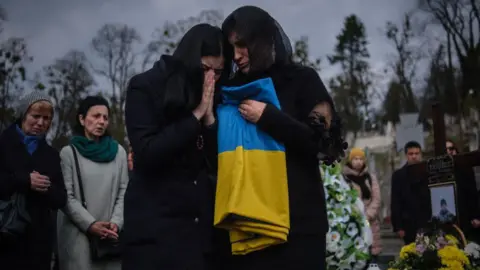
On trade, migration and free speech Team Trump have sharp differences with Europe. Meanwhile, democratically elected European governments have been alarmed by Trump's relationship with Vladimir Putin and his propensity for blaming Ukraine for getting invaded by Russia.
The Munich Security Conference organisers have published a report ahead of the event in which Tobias Bunde, the director of research & policy, says there has now been a fundamental break with US post-WW2 strategy.
This strategy, he argues, broadly rested on three pillars: a belief in the benefit of multilateral institutions, economic integration and a belief that democracy and human rights are not just values, but strategic assets.
"Under the Trump administration," says Bunde, "all three of these pillars have been weakened or openly questioned".
'A shocking wake-up call for Europe'
Much of the Trump White House's thinking can be found in the US National Security Strategy. The Washington-based Centre for Strategic and International Studies (CSIS) describes the document as "a real, painful, shocking wake-up call for Europe", and "a moment of cavernous divergence between Europe's view of itself and Trump's vision for Europe".
 AFP via Getty Images
The strategy states as a priority a new policy of supporting groups hostile to those very European governments that are supposed to be Washington's allies. It promotes "cultivating resistance to Europe's current trajectory within European nations", and says Europe's migration policies risk "civilizational erasure".
However, the document maintains that "Europe remains strategically and culturally vital to the United States".
"The majority of Europe's reaction to this NSS", says the CSIS, "is likely to be the same aghast shock as met Vice President JD Vance's Munich speech" in February 2025.
"We are currently seeing the rise of political actors who do not promise reform or repair," says Sophie Eisentraut of the Munich Security Conference, "but who are very explicit about wanting to tear down existing institutions, and we call them the demolition men".
The Narva test
But the ultimate question in all of this is "does Article 5 still work?".
Article 5 is the part of Nato's charter that stipulates that an attack on one country shall be deemed an attack on all. From 1949 until a year ago it was taken as read that should the Soviet Union, or more latterly Russia, invade a Nato state such as Lithuania then the full force of the alliance, backed by US military might, would come to its aid.
Although Nato officials have insisted that Article 5 is still very much alive and well, Trump's unpredictability coupled with the disdain his administration has for Europe inevitably calls it into question.
This is what I call "the Narva Test". Narva is a majority Russian-speaking town in Estonia that sits on the River Narva, right on the border with Russia. If, hypothetically, Russia were to make a grab for it under the pretext, say, of "coming to the help of its fellow Russians", would this US administration ride to the rescue of Estonia?
 PA Media
The same question can equally be applied to a future, and still hypothetical, Russian move on the Suwalki Gap which separates Belarus from the Russian exclave of Kaliningrad on the Baltic. Or, for that matter, the Norwegian-administered Arctic archipelago of Svalbard where Russia already has a colony at Barentsburg.
Given President Trump's recent territorial ambitions to seize Greenland from fellow Nato member Denmark, no one can predict for certain how President Trump would react. And that, in a time when Russia is waging a full-scale war against a European country in Ukraine, can lead to dangerous miscalculations.
This week's Munich Security Conference should provide some answers on where the transatlantic alliance is heading. They just may not necessarily be what Europe wants to hear.
