India's high-growth economy gets a Middle East oil shock

 Getty Images
It wasn't too long ago that India's central bank, the Reserve Bank of India (RBI), described the country's high growth-low inflation environment as a "Goldilocks" moment.
But that optimism has proved ephemeral as the ongoing war in the Middle East and the accompanying disruption to oil markets gives its world-beating growth story an unexpected jolt.
The impact is most starkly visible on the Indian currency, which has hit record lows and is down nearly 10% against the US dollar in the last year.
There's been some relief in the rupee's slide after the central bank intervened to curb speculation, but that is likely to be temporary. Many experts are pencilling in sharper declines ahead, depending on how long the conflict lasts.
In a worst-case scenario where the war persists for much of 2026, the repercussions could be "catastrophic" for the rupee, which could plunge beyond 110 to the dollar, according to Bernstein, a global equity research firm. But even if it ends much quicker, there's further pain ahead.
Persistent weakness in the currency can negatively impact everything, feeding into higher prices for consumers, lower corporate margins, bigger government deficits and thinner capital flows into the stock market.
India's benchmark equity indices are down some 12% already since the beginning of the year amid an outflow of foreign money, eroding the wealth effect - the behavioural tendency to spend more with a rise in the value of assets - that was prodding the rich to keep the consumption engine running.
 AFP via Getty Images
The global tensions have also begun to negatively weigh on the country's inflation and growth outlook.
Higher import and logistics costs and a possible decline in remittances from the 10 million Indians who live in the Gulf could end up having a "significant" impact on some of these metrics, India's finance ministry said in its latest monthly review. It added that the recent shocks are being transmitted through "supply constraints, and pressures across sectors, with early indications of some moderation in economic activity".
Gross domestic product (GDP) was previously forecast to expand at 7% levels in financial year 2026-27. But the crisis in the Gulf could shave off growth by as much as 1%, as per various brokerages.
Given that this comes in the backdrop of recent downgrades to India's GDP (following changes to the statistical base year), India's ambitions to cross Japan to become the world's fourth largest economy will most certainly be further pushed back.
As for inflation, food costs have begun to spike but the conflict has not driven up prices at the pumps so far, with the government absorbing the price shock. India has cut excise duties on petrol and diesel to protect consumers ahead of key state elections, and also imposed windfall taxes on exports.
The energy shock, however, is multifaceted.
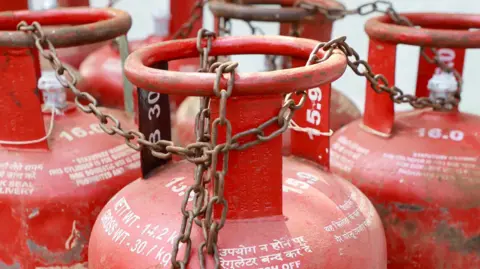
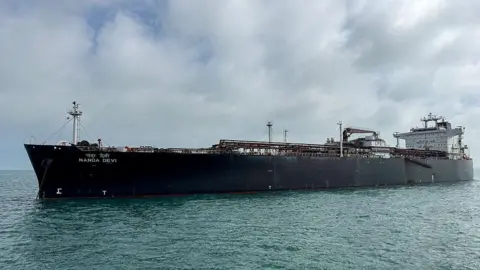
India is the world's third-largest importer of crude, but 60% of its natural gas and over 90% of LPG imports (it is the world's second largest consumer) also originate from the region, which makes this crisis potentially severe for Delhi.
A quarter of its fertiliser imports are also from Middle Eastern countries and supply disruptions could pose problems for its vast agrarian economy, particularly in the upcoming sowing season amid the rising probability of the El Niño weather phenomenon, Care Edge Ratings said in a note.
"The bigger concern for India's economy is outright shortage," say Shilan Shah and Mark Williams of Capital Economics. "[They] have already triggered partial or full closures of restaurants and hotels and are reportedly also hitting food processing factories, the ceramics industry and even funeral services."
The result could be a "stagflationary shock of pretty large magnitude" - where inflation goes up and growth stagnates, Arvind Subramanian, India's former chief economic adviser, told India Today TV channel.
"The stag part of the stagflation is already being felt in terms of restaurants closing down and households having less natural gas," Subramanian said.
There are also early signs of something worse. In scenes strikingly reminiscent of Covid-era lockdowns, the LPG supply hit seems to be prodding a return of some migrant workers from big cities such as Mumbai.
Economists worry it could trigger supply-side problems for the economy if labour starts becoming unavailable and wages begin to rise.
The government has responded to the crisis by proposing a $6.2bn "economic stabilisation fund" and sought approvals for additional spending on food and fertiliser subsidies.
This comes at a cost - the resources have been freed by rationalising expenditure, potentially to allocations for roads and railways infrastructure, and yet the funds are "modest relative to the scale of the challenge", according to Bernstein.
 AFP via Getty Images
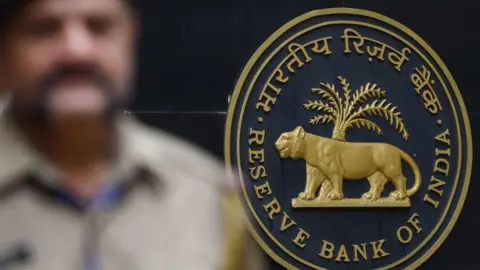
Given the uncertainty around when the conflict will end and hence the scale of its impact, the central bank is likely to keep interest rates steady when it announces its decision later this week.
"The 'wait and watch' strategy will enable the RBI to preserve flexibility to gauge the emerging risks to growth and inflation dynamics and take a calibrated call on future rate actions," Care Edge Ratings said.
Amid the challenges, there is hope for optimism.
A lower rupee could well help bump up India's exports competitiveness and in comparison to past crises, Delhi's comfortable forex cover gives it adequate cushion to tide over the crisis, experts say.
But just like Trump's tariffs prodded the government to undertake trade reform, this is a wake-up call, says Subramanian, for India to build an immediate-to-long-term strategy for its energy sector vulnerabilities.
That includes expanding stockpiles, diversifying reserves and, in the longer run, a quicker transition to renewables.
