Fuel and remittances: How Iran conflict hits India at home

 NurPhoto via Getty Images
As the US and Israel wage war with Iran, India is beginning to feel the tremors at home.
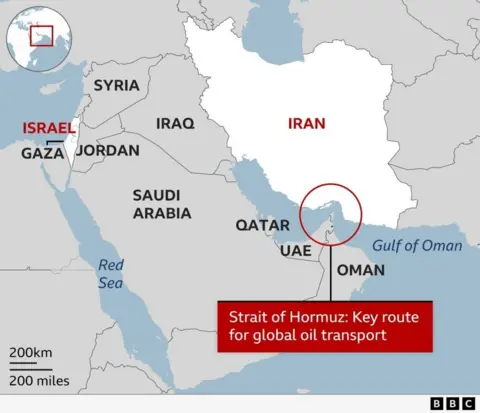
Nearly half of India's crude oil imports - along with a large share of its liquefied natural gas (LNG) and liquefied petroleum gas (LPG) shipments - normally pass through the Strait of Hormuz, the narrow Gulf chokepoint now effectively closed by the conflict.
India's ties to the region run deeper than energy. About 10 million Indians live and work across the Gulf, sending home record remittances that support millions of families and help finance a large slice of India's external accounts.
More broadly, India's economic links with the Middle East run deep: the region accounts for 17% of India's exports, supplies 55% of its crude oil and generates 38% of its remittances, according to Jefferies, a brokerage firm.
A widening war in the Gulf could therefore hit India on several fronts: energy supplies, remittance flows from the diaspora and Delhi's delicate diplomatic balancing act between Washington, Tehran and the Arab Gulf states.
For now, Delhi is cautious.
India is "waiting and watching" amid mounting uncertainty, says Harsh V Pant of the think tank Observer Research Foundation.
Iran's targeting of Arab Gulf states has sharpened Delhi's concerns. India's equities in the Arab world - diaspora, remittances, energy, trade and institutional ties - are far deeper, Pant notes. That explains why India has been more vocal about the "damage and destruction" there.
If the crisis drags on, Pant warns, it could prove "more damaging in terms of the long-term engagement of India with the region".
For all the rhetoric around India-Iran ties, Pant argues, they have long been constrained - most notably by Iran's marginalisation in the global economy. That reality has pushed India to deepen partnerships with key Gulf states, which means instability there will be viewed in Delhi with far greater urgency.
But India could stand to lose diplomatically as well, according to KC Singh, a former Indian ambassador to Iran.
"Prime Minister Narendra Modi's unwillingness to criticise Israel during his recent visit, days before the attacks, has robbed India of its neutrality. Iran is unlikely to forget it," Singh wrote in The Tribune.
The fallout for India could show up in four places: energy, remittances, its Gulf diaspora and a strategic port in Iran.
Oil and gas
 AFP via Getty Images
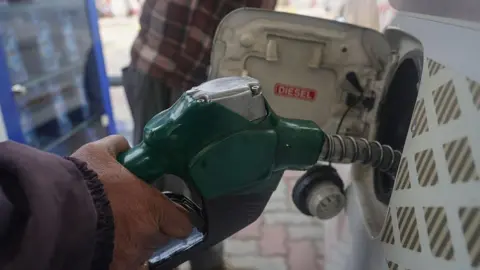
Is India heading for fuel shortages? Not yet.
But the war around the Strait of Hormuz has exposed how tightly the country's energy security is tied to a narrow stretch of water.
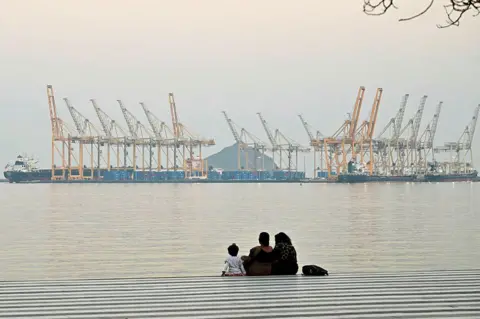
Roughly a fifth of the world's oil and gas normally passes through Hormuz. In recent days, attacks on vessels and warnings from Iran that ships attempting to transit the strait could be targeted have effectively halted traffic through one of the world's most important energy arteries.
For India, which imports 90% of its oil, the exposure is substantial.
Around half of its crude oil imports - about 2.5 to 2.7 million barrels a day - travel through the strait, largely from Iraq, Saudi Arabia, the United Arab Emirates and Kuwait.
Every $10 a barrel rise in oil prices could push up inflation by about 0.2-0.25 percentage points if passed on to consumers, according to Jefferies. If the government cuts fuel taxes to soften the blow, the fiscal deficit - the gap between a government's total spending and its revenues - would take a similar hit instead.
Yet, crude oil may not be the most immediate concern.
"The risks around Hormuz are worrisome," says Sumit Ritolia, an analyst at maritime intelligence firm Kpler. "I'm not that worried about crude oil, but about LPG and LNG."
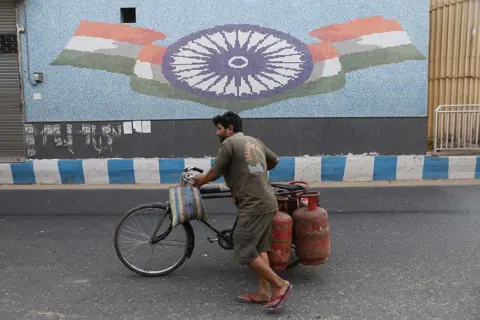
This reflects a structural shift in India's energy use. Government programmes have rapidly expanded LPG for cooking, displacing traditional biomass fuels and sharply lifting demand.
Today India imports 80-85% of the LPG it consumes, making it the world's second-largest LPG importer after China.
Almost all those shipments come from Gulf producers - mainly Qatar, Saudi Arabia, the UAE and Kuwait - and nearly all pass through Hormuz.
LNG tells a similar story.
India's domestic gas output covers only a fraction of demand in an economy that increasingly relies on gas for electricity generation, fertilisers, city distribution, transport and industry.
India imported about 25 million tonnes of LNG last year, roughly 14 million tonnes of it via Hormuz, placing it among the world's largest LNG buyers alongside China, Japan and South Korea.
 NurPhoto via Getty Images
What makes LPG particularly vulnerable is the lack of buffers.
Unlike crude oil, India holds no meaningful strategic LPG reserves and storage capacity is limited. Stocks held by refiners and distributors could cover only two-to-three weeks of demand if imports stall.
Crude oil, by contrast, is more manageable.
India holds roughly 100 million barrels in refinery and commercial inventories, about 80% of which is usable - enough to provide around "30 to 35 days" of cover, according to Ritola.
As a major exporter of refined fuels such as diesel and jet fuel, the country could also curb product exports to preserve supplies if necessary.
Alternative sources exist. India could step up purchases from Russia or from the Atlantic Basin - the US, western Africa and Latin America.
But those barrels take 25-45 days to arrive, compared with five-to-seven days from the Gulf, lengthening supply chains and raising freight costs, according to Kpler.
If push comes to shove, India can pivot back to Russian crude, experts say.
"Around 25-30 million Russian oil barrels are currently floating on ships in the Indian Ocean and, with only India and China as major buyers, those barrels remain a ready fallback," says Ritola.
For now, markets expect the first shock to be financial rather than physical. Brent crude prices, shipping rates and war-risk insurance premiums are likely to climb, pushing up India's import bill even if actual supply remains intact in the near term.
Kpler does not expect a prolonged, full closure of Hormuz. "More likely are temporary slowdowns, rerouting of vessels or heightened maritime security checks," the firm said in a note.
Analysts at Jefferies expect oil and LNG prices to "jump sharply" in the short term, but believe any blockade will be temporary.
If the crisis drags on, however, the pressure points will become clearer.
Oil may remain available. But LPG cylinders in kitchens and LNG supplies to power plants could tighten far more quickly if the world's most critical energy chokepoint stays shut.
The diaspora
 Getty Images
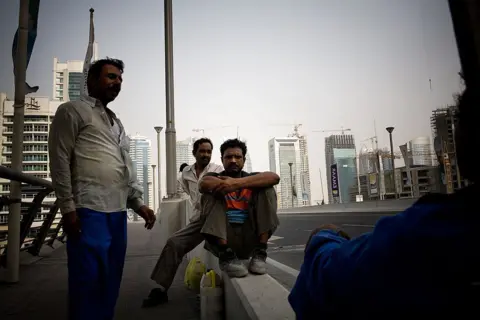
India's diaspora has grown both quietly and dramatically.
From about 6.6 million in 1990, the number of Indians living abroad has swelled to roughly 18.5 million today - the world's largest overseas population.
Some 10 million Indians live and work across the six states of the Gulf Co-operation Council - Saudi Arabia, the United Arab Emirates, Qatar, Kuwait, Oman and Bahrain.
That is roughly half of India's global migrant stock.
What began decades ago as a wave of temporary labour migration has evolved into something more settled.
In 2025, the UAE alone enrolled over 247,000 Indian school students, with sizeable numbers also in Saudi Arabia, Qatar and Kuwait - evidence that many families are putting down roots rather than rotating in and out as short-term workers.
For the Indian government, the safety of this community has become a strategic concern.
"There are almost 10 million Indian citizens who live and work in the Gulf region. Their safety and well-being is of utmost priority," officials said this week as tensions in the region mounted.
The economic stakes are substantial.
India received a record $135bn in remittances in 2024- 2025, keeping its position as the world's largest recipient.
These flows finance nearly half of India's merchandise trade deficit, quietly underpinning the country's external accounts.
Workers in the Gulf generate a large share of those inflows.
They dominate sectors such as construction, services, energy and increasingly skilled professions, sending billions of dollars back to households across India.
The southern state of Kerala alone receives around a fifth of India's total remittances, underscoring how deeply parts of the country depend on Gulf migration.
A prolonged crisis in the region could force evacuations, disrupt schooling and employment for expatriates and slow the flow of money home.
For Delhi, the Gulf is not just about oil imports; it is about livelihoods, household incomes and the stability of India's external finances.
"The idea of the Gulf as a safe haven has been shaken," says S Irudaya Rajan of the International Institute for Migration and Development, based in the southern city of Thiruvananthapuram.
"That has social as well as economic consequences. Parents worrying about children abroad and migrants contemplating returning home."
Chabahar port
 Anadolu Agency/Getty Images
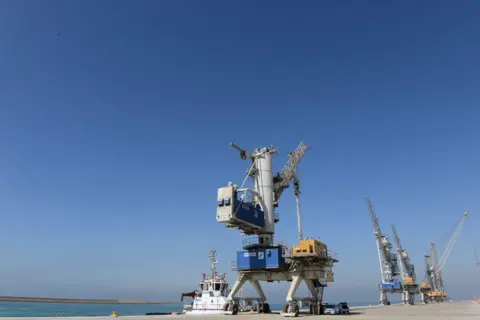
India's decade-long bet on Iran's Chabahar port - a strategic gateway to Afghanistan and Central Asia that bypasses Pakistan - has collided with Washington's sanctions regime.
Since signing a development deal in 2016, Delhi has viewed the port as a cornerstone of its regional connectivity strategy and a rare overland corridor into landlocked Afghanistan and beyond.
In recent years, India has used the port to ship wheat and humanitarian supplies to Afghanistan while investing in the development of the port's Shahid Beheshti terminal.
But that strategy became precarious after the US revoked a longstanding sanctions waiver in September 2025 as part of renewed pressure on Iran.
In a diplomatic reprieve, Washington later granted India a conditional six-month waiver, allowing operations at the terminal to continue until 26 April 2026 while negotiations continue. The arrangement provides breathing space - but little certainty.
The war has complicated matters.
For now, caution prevails.
Only once tensions around Iran ease will India be able to revisit Chabahar with confidence. As long as the Washington-Tehran confrontation persists, Delhi's engagement with the port is likely to remain limited by practical and operational constraints, according to Pant.
India will continue to call for dialogue and de-escalation. But in practice, says Pant, Delhi is "much more worried about what is happening in the Arab world than anything else right now".
To be sure India's dependence on Middle East runs far beyond oil and remittances.
In 2025 it imported nearly $100bn of goods from the region - from fertilisers and petrochemicals to industrial minerals - leaving sectors from farming and plastics to construction and diamond cutting exposed to supply shocks.
"If disruptions to shipping through the Strait of Hormuz continue beyond a week, the effects could quickly spread from energy markets to fertiliser supplies, manufacturing inputs, construction materials and export industries such as diamonds," says Ajay Srivastava, a former Indian trade official and head of the think tank Global Trade Research Initiative (GTRI).
"What begins as a regional conflict could rapidly evolve into a broader supply shock for the Indian economy."
