Big challenges lurk behind India's world-beating growth

 NurPhoto via Getty Images
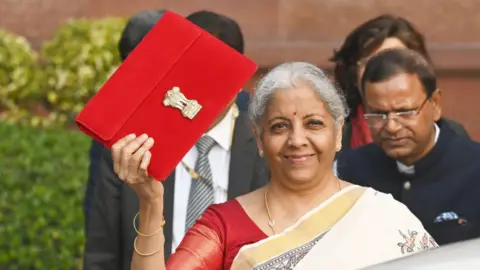
As India's Finance Minister, Nirmala Sitharaman, gets ready to present the annual budget this Sunday, the country's economy, on the face of it, appears to be doing well.
India is on track to end the financial year with growth of 7.3%, cross $4tn (£2.97tn) in gross domestic product (GDP) and overtake Japan as Asia's second-largest economy.
Retail inflation is below 2% and expected to remain under the central bank's target in the coming months. Agriculture output, which supports about half the population, has been strong, cereal production is robust and government granaries are well stocked - boosting rural incomes.
Last year's income tax cuts and the rationalisation of the goods and services tax (GST) - a levy on consumption - have also lifted consumer demand and stimulated spending. India's central bank, Reserve Bank of India (RBI), has described this combination of high growth and low inflation as a "Goldilocks" phase - a term coined by US economist David Shulman to describe an economy expanding at just the right pace, with good jobs growth.
But the strong headline numbers conceal some of the deeper challenges.
The government says unemployment is falling, yet demand for unstable gig work remains high. India's five largest IT companies - which for decades created tens of thousands of jobs every quarter - added a net total of just 17 employees in the first nine months of 2025.These are tell-tale signs of labour market weakness.
The hiring freeze in the software sector, which birthed India's middle class from the 1990s, highlights the growing disruption caused by AI in the country's vast back-office economy.
 AFP via Getty Images
The slowdown in white-collar hiring accompanies the continuing crisis at India's labour-intensive exports units.
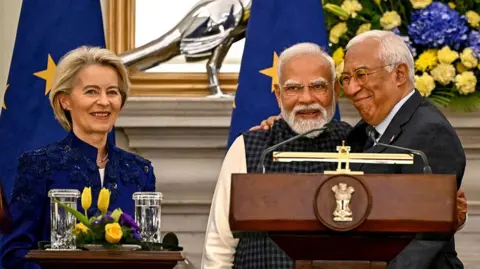
India has entered 2026 with the looming shadow of Trump's 50% tariffs – a deadlock that's lasted far longer than expected. While Prime Minister Narendra Modi's government has displayed great expediency for trade diversification by inking a string of free trade deals or FTAs - most recently with the European Union this week – the drag on exports has begun to show.
"Exports to the US weakened sequentially since the implementation of the 50% US tariff, while to the rest of the world it has picked up only marginally," according to HSBC Research.
FTAs will help in the longer run, but whether India can compete with countries like Vietnam and Bangladesh in selling to non-US geographies would depend on many other things like quality, price and scale, say analysts.
While tariffs have dominated trade debates, economists continue to worry about another long-term trend India has struggled to reverse despite rapid growth: weak private investment.
JP Morgan's Jehangir Aziz recently told How India's Economy Works podcast that corporate investment had "flatlined since 2012" and remained at around 12% of GDP. "The question that the government isn't asking is: how come for 13 straight years, corporate India has not invested?" he said.
According to Aziz, fresh investments have stalled because factories continue to have excess capacity since demand isn't strong enough, which is preventing new capacity from coming up.
This, combined with other trends such as foreign investors pulling money out of India, is a sign that high reported GDP growth masks underlying weaknesses, says Ruchir Sharma, chair of Rockefeller International.
"India has long attracted only modest capital from abroad, thanks in large measure to the lingering 'Licence Raj', which can make it prohibitively expensive to acquire land or hire and fire workers," Sharma wrote in a recent piece for the Financial Times.
"Asian economies that have sustained rapid growth - such as China and Vietnam more recently - saw net foreign direct investment surge above 4% of GDP during their boom phases. That figure never surpassed 1.5% in India, and it is now just 0.1%."
To be fair, the government recently updated its labour codes which, it says, will ease up the climate of doing business. Whether that's enough to draw foreign capital back, however, remains an open question.
 Hindustan Times via Getty Images
Against this backdrop, the finance minister is likely to emphasise on two key pillars in the budget: more reforms and fiscal restraint, according to HSBC Research.
"Potential focus areas could include expanding the production-linked incentive scheme [incentives designed to boost domestic manufacturing] and support for MSMEs [medium and small sized enterprises] and exporters," according to Sonal Verma and Aurodeep Nandi, analysts at Japan's Nomura.
There could also be larger capital outlays for defence and a lowering of customs duty slabs as India tries to push exports.
The Modi government has spent more than $100bn annually on building new infrastructure like roads, railways and telecom equipment in the last four years. That trend is likely to continue – with capital expenditure expected to remain stable at 3% of GDP, according to ICICI Bank Global Markets.
But given last year's budget focused on easing pressures on the middle class - with income tax and GST cuts amounting to about 0.9% of GDP - the government's tax shortfalls are expected to widen.
As a result the thrust will be on ensuring that the deficit is brought down, or at least maintained.
"While fiscal expansion is unlikely, we forecast the finance minister would refrain from further consolidation," Nuvama Securities said in a note.
"A big stimulus is unlikely as the exchequer remains committed to reducing the debt-to-GDP ratio by 1% annually until FY31 [financial year 2030-31], implying a continued focus on deleveraging."
