What next for people at centre of water crisis?

 PA Media
South East Water (SEW) has said supplies are back for most properties affected by recent problems, but what lies ahead for its customers?
The company has apologised and said a number of issues, including Storm Goretti and cold weather, were to blame for the failures.
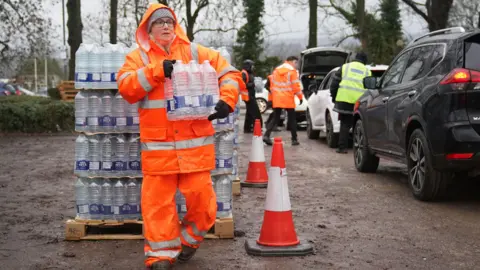
About 30,000 properties in Kent and Sussex had no water at the height of the crisis, some for well over a week.
With the company's chief executive, David Hinton, facing calls to resign and regulatory investigations on the horizon, here is how people coped without water, and what might happen next.
'Very relieved'
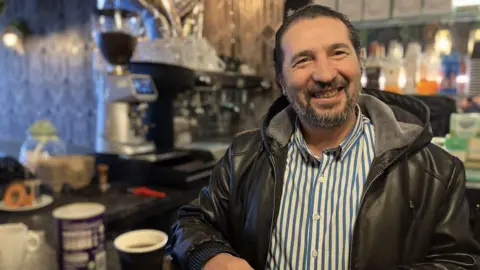
Ekrem Agveve, manager of Twenty Nine Kitchen in East Grinstead, West Sussex, told the BBC he was "very relieved" after supply returned to the restaurant on Wednesday.
"It will take minimum three months to recover from this. We're down six or seven thousand pounds minimum.
"Saturday and Sunday are our busiest days and we were closed."
During the supply failures, the BBC heard from several residents collecting bottles to drink and using water butts for flushing their toilets.
Jamie Endrizzi-Faulkes, from Blean in Kent, told the BBC she was relying on neighbours to help her after the village's water went off while her 10-month-old daughter had a stomach bug.
Emma Wiseman, from Tunbridge Wells, said her husband worked in healthcare and "not being able to wash in your home or clean your uniform when you get home is really tricky, putting things mildly".
Shirley Garnett, also in Tunbridge Wells, had a disrupted supply for more than nine days, which made keeping her leg clean after an operation tricky.
"This is very difficult when we have no tap water and I worry it will become infected," she said.
Her husband Bob said: "We are elderly people and carrying boiling water upstairs to wash with is dangerous, just slip and we could be scolded."
One visually impaired woman from East Grinstead, whose water returned on Tuesday, told the BBC it had been an "awful week" after the problem coincided with with electricity, broadband and mobile signal issues.
Why did the water supply stop working?
SEW blamed Storm Goretti and a power supply failure at its pumping station when issues began in Tunbridge Wells and East Grinstead on Saturday.
However, it said it had completed its "new plan" to deal with low storage tank levels in Tunbridge Wells.
Temperatures caused water to freeze and thaw, resulting in burst water mains and localised supply problems in other parts of Kent throughout the week.
This follows a previous crisis in less than two months ago, when about 24,000 properties lost supply for around six days in the Tunbridge Wells area.
That supply failure was caused by a disinfection problem at a water treatment works.
SEW said it had requested an additional £300m of funding to address problems on its network.
Water Minister Emma Hardy said she was "very concerned" about the latest supply disruption and said the government was "prioritising investment in infrastructure to improve the resilience of our water system".
What's next?
There are now four ongoing investigations by regulators into SEW.
The Drinking Water Inspectorate is investigating the period of disruption before Christmas and the loss of supply this week.
It could decide the company should face criminal prosecution.
Meanwhile, Ofwat is looking into whether the company failed to comply with the law around supplying water and whether it has breached its licence around customer care.
It can fine SEW up to 10% of its turnover.
The firm said it would "always fully co-operate with any investigation by regulators and provide any information required".
Prime Minister Keir Starmer said the situation was "clearly totally unacceptable" on Wednesday.
Meanwhile, local MPs have been calling for chief executive David Hinton to resign.
Mims Davies, MP for East Grinstead and Uckfield, said Hinton had "lost the room" and that the water company had given a "repeated, shambolic, failing performance".
Can I get compensation?
SEW said its customers who have no mains supply are entitled to £50 for each continuous 12-hour period.
Its said this compensation should be paid automatically.
Follow BBC Kent on Facebook, on X, and on Instagram. Send your story ideas to southeasttoday@bbc.co.uk or WhatsApp us on 08081 002250.
