Trail goes cold for conspiracy theorist gunman six months on

 Getty Images
Moments after allegedly shooting dead two police officers on his property last August, Dezi Freeman took off into the bush and vanished.
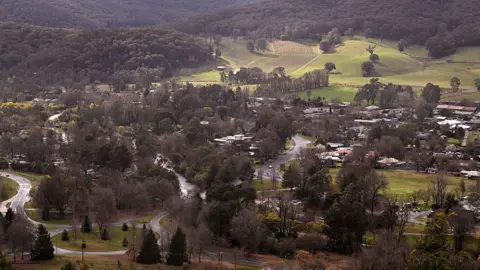
Half a year on from the fatal shooting, search parties are still scouring the mountainous ranges surrounding the small Australian town of Porepunkah to find him.
But there have been no successful leads, despite authorities offering the largest-ever reward money in the region for tips about the well-known conspiracy theorist.
And in the meantime, the self-described "tight-knit" residents of the small town have been left to pick up the pieces of a crime that has shattered their community.
Tourist town taken over by manhunt
Usually a hub for tourists wine-tasting and hiking, Porepunkah bills itself as a "favourite place for families to escape". There are river swims and pub visits to be enjoyed beneath Mount Buffalo, where in the colder months, tobogganing and skiing are popular.
Last winter, though, was an atypical season.
Police were at Freeman's home with a warrant to search it as part of a child sex abuse investigation when the 56-year-old allegedly gunned down Detective Senior Constable Neal Thompson - a local from the region - and Senior Constable Vadim de Waart.
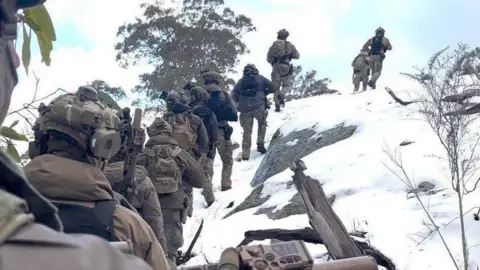
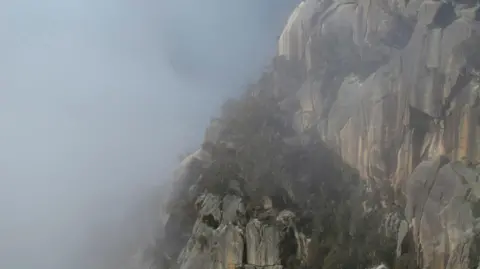
The entire mountain was shut down to search for the escapee, with hundreds of state officers scouring its steep rock faces, which were at times layered with thick snow.
International and specialist teams have since aided in the search that has stretched down caves, across rivers and into old mining huts. Police say they have investigated more than 2,000 pieces of information from the public, and have offered a A$1m (£525,000, $709,000) reward, but no trace of Freeman has been found.
 Victoria Police
Early on in the investigation, they suggested he was being helped.
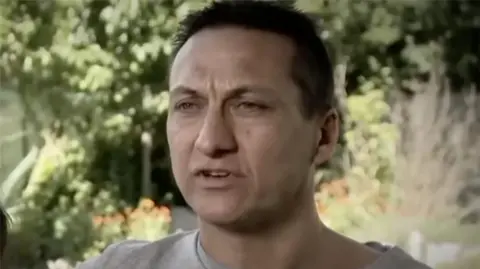
Australian media have widely reported that Freeman - whose real name is Desmond Filby - was part of the sovereign citizen movement, characterised by a distrust of authority and rejection of the law.
Locals have told the BBC his fringe beliefs were well-known within Porepunkah, which is host to a cluster of people with similar views, several of whom lived on Freeman's property.
Police did not specify how many people they suspected were aiding Freeman, or whether they lived in the local area - and the accusation left a bitter taste for many in Porepunkah.
Then, at the start of this month, Victoria Police announced they were starting another five-day search in the area beneath Mount Buffalo.
They declared they now "strongly believe" Freeman is dead - and possibly has been since the day he disappeared - but acknowledged they had no actual evidence one way or another.
A member of the public had come forward saying they thought they had heard a gunshot just under two hours after the officers were killed, police revealed.
After corroborating these reports, investigators later combed through an area equivalent to 35 Melbourne Cricket Grounds.
No updates on the case have been made public since that search and police did not agree to an interview for this story.
In that vacuum, theories have abounded.
 Nine/A Current Affair
Survival expert Gordon Dedman said it is possible he could have escaped the local area quickly and is now "long gone".
Police noted early on that he would "know that area better than us" and had strong bush survival skills.
"[He] could be up in Queensland by now, for all we know," Dedman, who leads a bushcraft school, told the BBC.
The snow that made the search so challenging, would have been his "best ally", covering any tracks he left behind. It also would have been one of the greatest threats to his survival, since without adequate cold weather gear, Freeman could have frozen to death.
If Freeman was in the local area, Dedman said: "I'm sure he would've been found now." Even if he was dead, there would be a scent to follow.
The alpine country Freeman disappeared into is the same one that harboured Ned Kelly and his infamous gang of bushrangers in the 1870s.
And killers who have fled into Australia's dense bush have often evaded capture for long stretches of time. Malcolm Naden, at the time the country's most-wanted man, was on the run for seven years before he was detained in 2012. Father-and-son fugitives Gino and Marco Stocco were at large for eight.
 Getty Images
But criminologist and forensics expert Xanthe Mallett told the BBC there would likely have been sightings of Freeman by now if he were alive.
Typically, people running from the law would be seen breaking and entering into shops or homes for provisions, she said.
But even if Freeman is dead, police are unlikely to end their search until there are answers, Mallett continued: "If he's still alive, he's still a risk."
The added fact that "we did see police harmed in this case" will make authorities all the more unrelenting.
'We’re done talking about it'
Resident Marcus Warner says the latest police search has "upset a few people", because it is a reminder that this ordeal "obviously isn't over".
There's doubt it ever really will be.
A long-time search and rescue volunteer in the area, Warner says you could practically walk right past a missing person and not see them, as the terrain is so "rugged".
He recalls hearing sirens break the quiet at the base of Mount Buffalo on the day of the shooting. "It became very clear that something tragic had occurred," he said.
When Warner reached Porepunkah, desperate to help, it was silent but for the whirring of helicopters above, he said.
Details were still murky and locals worried. He remembers seeing officers he'd worked with on previous searches, and the competing feels of relief - that they were safe - and dread.
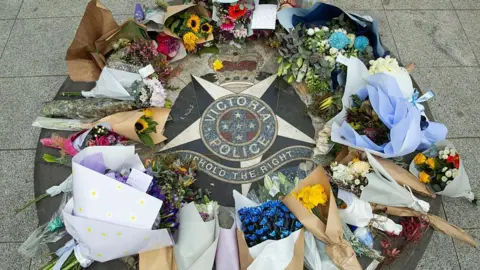 Getty Images
"The next phase of feelings were just numb," he says of the days after Freeman fled.
That later morphed into "anger and frustration".
For many locals, their initial fear was quietened by the knowledge that the missing man's ire was directed at authorities, Alpine Shire Deputy Mayor Sarah Nicholas told the BBC.
"It'd be nice for us to just be able to put it behind us," Nicholas adds.
But the fallout from the crime - and the attention it garnered - has been harder to get past.
The locals the BBC contacted were reluctant to talk. One said people hide in their homes when reporters come by. Another said the town had been "ruined" by the spotlight.
Some towns get a grim boost from high-profile crimes, but the opposite happened in Porepunkah. Victoria Police had warned tourists to stay away, saying Freeman was armed and dangerous.
"Suddenly bills became tight and businesses were laying off staff really rapidly," says Warner, who is also president of the local chamber of commerce.
His own seed and nut farm - which had managed to stay open during bushfires and the pandemic - couldn't afford keep its usually popular artisan shop open, even at the weekend.
Government grants have helped in the short term, but "anyone would want more if it was coming", said Nicholas.
In an effort to move on, locals have organised community events, including a street party and market. But the questions still swirling around the case make it hard for the town to lay it to rest.
The coroner's inquest - that would conclusively lay out the details of the officers' deaths - is also expected to be delayed indefinitely, according to national paper The Australian.
"Every single tourist who visits wants to talk about the incident," said Warner. "I think we're done talking about it."
