'Out of control' diesel prices threaten Australia's crucial freight industry

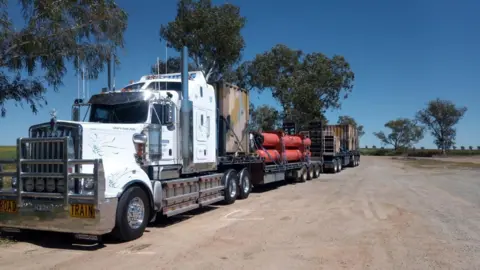 Aaron Fischer
Australia, like many countries around the world, is in the grip of a fuel crisis.
The nation has experienced some of its biggest ever spikes in petrol and diesel prices - and the lorry industry has been among the hardest hit.
Operators are reliant on diesel, often to power heavy long-haul road trains, and many say costs have more than doubled since war broke out in Iran, sending oil prices to record highs across the globe.
In a rare national address, Australia's prime minister recently made a three-and-a-half minute plea about the country's fuel supplies.
"These are uncertain times," Anthony Albanese said during the prime-time televised address.
"But I am absolutely certain of this: we will deal with these global challenges, the Australian way."
He asked everyone to "think of others" when using fuel and opt for public transport where possible, so that supplies could be saved for "people who have no choice but to drive".
But for Aaron Fischer, an owner-operator of a lorry company, Albanese's words brought little relief as he spent another sleepless night trying to keep his business afloat.
"I was laying in bed the other night with my laptop, just running through numbers," he tells the BBC.
"I need to know what I've got coming in and going out to make sure my maintenance bills are right, my fuel bills are fine, my tyre bills are good."
The price of diesel has seen his fuel costs skyrocket.
"Before all this stuff happened, it used to cost me A$3,600 (US$2,540, £1,890) to fill up a tank... now I'm spending $7,500. That's the problem: it's literally doubled my bill."
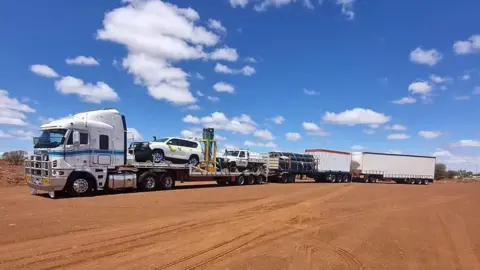 Terry Snell
Fischer's business is based in Howlong, a border town between the Australian states of New South Wales (NSW) and Victoria.
Every week, he sends more than a dozen road trains - which can be about the length of an Olympic-sized pool - across the unforgiving terrain of the Nullarbor Plain, a 1,200km (750 miles) expanse of desert named for being a treeless landscape.
Book-ended by Ceduna in South Australia and Norseman in Western Australia, there are about a dozen fuel stations along the way, with distances between some stops stretching to about 200km.
Reports of diesel shortages along the route have caused headaches for lorry drivers, or truckers.
"We've had a few [drivers] that went to put fuel in and they've had none," Fischer says.
His lorries hold 2,500 litres of fuel, and the amount each trip burns up depends on the load - which can range from heavy machinery to large orders of bottled water and mail deliveries.
According to the latest figures from the Australian Institute of Petroleum, the national average price of diesel is 312.7 cents per litre, up from 180.2 cents before the war started. Petrol prices have also jumped from 171 cents to 240.1 cents.
"Instead of me spending $150,000 a month on fuel, I'm now spending $300,000 a month," Fischer says. "And we've had to come up with that money straight away".
That's because operators typically have to wait 60 days before they get paid, meaning Fischer will have to spend about $600,000 before he sees any returns.
"I've got to carry the business through for another two months before I see any of that money. This is where a lot of people are going to come unstuck."
'Everything comes off a truck'
In a bid to address the financial stress on operators, the government announced A$1bn in interest-free loans for the transport and freight sectors as well as fuel and fertiliser producers.
But Alex Randall from freight carrier Loadshift says the offer won't solve the problem.
"Interest-free loans are still debt," he says. "If you're a small carrier whose fuel bill has just doubled and your customers are cancelling jobs, the last thing you need is more on the books."
Instead, Randall says small operators need direct payments or faster help with fuel costs.
For Fischer, it's about keeping food on the table for his family and his staff of eight drivers.
One of those drivers is Michael Webb, 33, who has been a lorry driver for almost a decade.
When he spoke to the BBC, Webb was on the return leg of an "East to West" run across the Nullarbor, having left Howlong in Australia's east days earlier.
It took him three-and-a-half days to travel 3,600km, cutting across Victoria and South Australia and into the Western Australian capital of Perth, where he offloaded large pieces of mining equipment.
"I've never driven a truck that's cost this much to fill up - it's out of control," he said.
Webb also said Albanese's address provided little comfort, and that the industries moving goods around the vast distances of Australia need more support.
"Everything that you get has come off a truck at one point - whether it's your food, your drinks, the shirt you're wearing, the phone you're using," he said.
'Catastrophic' price rises
The fuel price rises could not have come at a worse time for William Hawkes.
He started his lorry business three months ago and has been forced to re-quote all his jobs due to the price hikes, increasing them by around a third.
"That's pretty catastrophic when you're starting out," he says, noting that it's put a strain on new relationships with clients.
Hawkes's company moves essential equipment such as excavators to flood-hit areas - like the outback NSW town of Broken Hill, which saw record rains last month - or tipper trucks to Queensland for emergency road repairs.
Last week, one of his drivers was moving modular homes from one corner of Australia to another - Bendigo in Victoria to Broome in Western Australia - on a 5,300km trip.
"When we're moving an item like that, because of the way it catches the wind, our fuel consumption can be anywhere from 0.6 litre per km to 1.2 litres per km," he says.
By comparison, a car in the city uses on average about eight to 10 litres per 100km.
"We got onto the Nullarbor and there was some chatter through the UHF (ultra-high frequency radio) about different service stations that didn't have any diesel," Hawkes tells the BBC. So he decided to re-route the driver, adding several hours to the days-long journey.
He says his profit margin has stayed the same but the volume of work has plummeted as clients cancel or delay jobs.
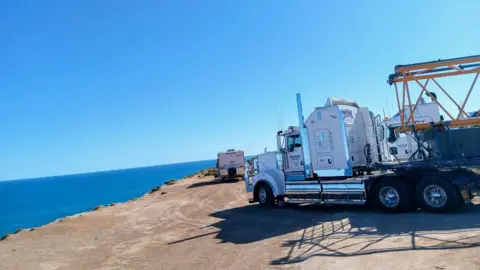 Michael Webb
Meanwhile, veteran lorry driver Terry Snell says the current situation is unlike anything he's seen before.
The 68-year-old has been driving lorries for more than four decades, but has been forced to reduce his workload because of costs and his profit margin becoming "very slim".
"We used to run every week. We now run every fortnight," he says. "With the increase in the fuel charges, if we run weekly, we need to go off to a bank or a financial institution."
Snell just finished a Perth-to-Brisbane run, transporting a franna crane - a lorry and crane combined - and charged the client $18,000, a job that would have cost $9,000 a few weeks ago.
"There's a massive shortage of trucks at the moment because a lot of blokes have just stopped running... they can't afford to," he says.
"If we don't get this problem sorted and get it sorted very quickly, we are going to have a supply chain crisis."
