Rabbi left 'sad and angered' by Bondi Beach attack

 BBC
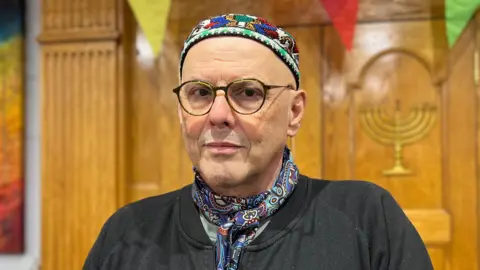
BBCA rabbi said he felt "sadness and anger" after 15 people were killed by gunmen targeting Jewish families celebrating Hanukkah in Australia.
Rabbi René Pfertzel led commemorations with more than 100 people at Maidenhead Synagogue on Sunday, hours after the first reports of the attacks near Bondi Beach.
"I don't want to get used to world where [attacks] becomes the new norm. That each festival, we have this kind of attack," Rabbi Pfertzel said. "I just want a world where we can live alongside each other."
In October, an attack at a synagogue in Manchester on Yom Kippur, the holiest day of the Jewish calendar, saw an attacker stab two security volunteers, including Melvin Cravitz, 66, who died.
"Of course there is a mixture of sadness [after Sunday] but there's anger. Once again we had a Jewish festival and they come again and they kill us," Rabbi Pfertzel added.
"They were in Manchester for Yom Kippur. Is it the new norm? I was upset, angry and sad. A bit of everything."
He said the congregation was happy to be together to start their eight-day festival despite a "heaviness".
The rabbi added that police had been supporting his congregation ahead of Hanukkah and had been in contact before Sunday's attack.
The festival of Hanukkah commemorates how, some 2,150 years ago, a small band of Jewish people revolted against Emperor Antiochus, who had suppressed their faith and demanded conversion to ancient Greek religion on pain of death.
The group, led by the Maccabee family, removed Greek idols from the temple in Jerusalem and, the story goes, were able to light its menorah for eight days with only one day's oil.
"There was a sense of heaviness. What's difficult to explain in the Jewish psyche [is] we had all these moments in the past that seem to be part of Jewish history," Rabbi Pfertzel said.
"We know about it because our grandparents talked about it. People who came from Germany in the 1930s, for example, talked about the rise of Nazism in Germany but for us here – and I'm French so it's obviously a bit different – we all had the sense that antisemitism was part of the past.
"I'm sad but I'm not surprised [by recent attacks]. There's an element of these recurring waves of hatred really."
