Cancer patient 'would have taken surgery advice'

 Family
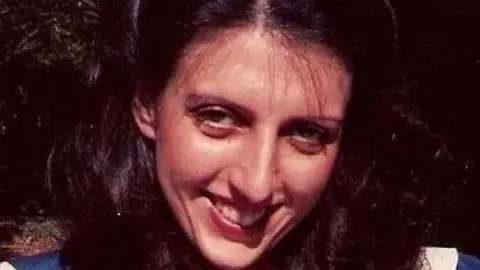
A former breast cancer patient of disgraced surgeon Ian Paterson would have listened to him, if he had advised her to have a mastectomy, an inquest into her death has heard.
Eunice Jones, a mother-of-four from Knowle in the West Midlands, was diagnosed in December 2001 and died aged 47 in 2004.
Paterson performed a wide local excision in January 2002, which removed only a portion of the breast tissue. The surgeon claimed Jones was "adamant" she did not want a full mastectomy.
However, her family believe that if he had encouraged her to have one, she would have taken his advice, the inquest was told.
Eunice Jones is one of 67 former patients of Paterson whose deaths are being investigated at inquest, to determine whether they died an unnatural death as a result of his care and treatment.
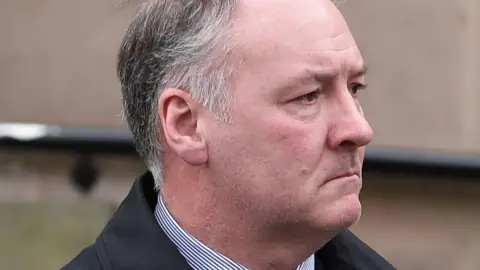
Paterson was jailed in 2017 after being convicted of wounding patients by way of botched and unnecessary operations, and given a 20-year prison sentence.
However, he will be automatically released halfway through his sentence in 2027, before the inquests are due to conclude.
 PA Media
On Monday, the inquest saw a letter that Paterson wrote on the day he performed the local excision and node clearance on Eunice Jones.
In the letter to one of her doctors, written after the surgery, he said: "I am afraid there is residual tumour in the breast and I will discuss this with the lady in the post-operative period but she was adamant that she did not want a mastectomy today, even though clinically and radiologically she has multifocal disease."
Scott Matthewson, counsel to the inquest, told Paterson that Jones's family were finding it hard to square this correspondence with their experience of her attitude to the treatment.
"Their own conversations with her gave the impression her only aim was to get rid of the disease," he said.
He added that she had a great deal of trust in Paterson and his abilities, and that if he had advised her that her best option was a mastectomy, they think she would have pursued it.
However, Paterson told the inquest that Jones asked for a breast reconstruction and opted for a cosmetic option.
While she eventually had a mastectomy, Paterson said: "In the first instance she wanted to try breast conservation."
He added that he thought that she would have discussed the options with her family.
Matthewson posed a theory that Paterson had advised Jones to have breast conservation surgery, then when it did not go well and a mastectomy was required, recast what had happened in his letter.
Paterson strenuously argued against this theory, telling the inquest: "I'm not going to put up with any of your nonsense."
 Family
The inquest also heard that due to the actions of other doctors, Jones received a delayed diagnosis.
She had first visited the clinic in 1998 because she was concerned over her family history with breast cancer, as her mother and aunt had recently been diagnosed and had undergone mastectomies.
Jones had several mammograms and an ultrasound between 1998 and 2000, which the inquest heard were normal and showed no evidence of serious disease, and she was not diagnosed with breast cancer until December 2001.
A radiologist suggested that a biopsy could be taken using a method more accurate than a mammogram or ultrasound, but this did not happen.
A report from Prof Mike Dixon claimed she would have lived "much longer" if her cancer had been diagnosed between 14 and 26 months earlier, claiming that "the failure to investigate the area... resulted in Ms Jones losing many years of life".
Dixon also said the cancer was discovered at the "exact" site where a slight lumpiness was found in September 2000, and previously a small cystic area in 1998.
Dr Mukesh Sinha, who had examined Jones in 1998 and 2000, told the inquest he did not follow up because there was "no clinical evidence of anything worrying" and her mammograms and ultrasound were essentially normal, while clinical examination did not identify anything other than the diffused lumpiness, which could be considered normal.
'Positivity was unwavering'
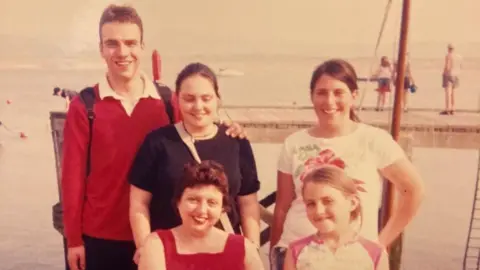
Jones was a mother to four children: Laura, Matthew, Sarah, and Isabelle.
At the start of the inquest, a pen portrait was written by Laura, who was 19 when her mother died.
Laura Bates said: "Her positivity in the face of cancer was unwavering. Her greatest sorrow was leaving her children - something I can only comprehend now as a mother myself."
In autumn 2003, Bates said her mother woke one morning wanting fish and chips by the sea.
"By then she was in a wheelchair, and I hadn't yet passed my driving test. Still, we stuck L plates on her Ford Ka, squeezed everyone in, and I drove us along A roads all the way to Towyn in Wales," she said.
"She was, in every sense, a remarkable person, and we miss her always."
The inquest continues.
Follow BBC Birmingham on BBC Sounds, Facebook, X and Instagram.
