Welsh wind farms win funding with up to 7,000 jobs expected

 Ben Birchall/PA Wire
Two wind farms off the west and north Wales coastline have secured UK government funding to supply the national grid, with up to 7,000 jobs expected to be created.
The Erebus wind farm, set to be built off Pembrokeshire, would become Wales' first floating offshore wind farm, following two projects already operating in Scotland.
It is hoped the development could open up a new industry, leading to as many as 5,000 jobs in the next decade.
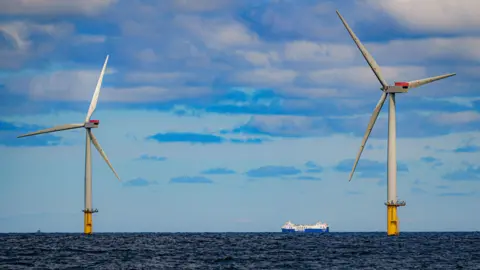
A second wind farm, Awel y Môr, using more traditional offshore turbines, is planned close to existing projects and will be 10km (6.2 miles) off Rhyl, Denbighshire.
The funding comes from a government scheme to encourage investment in renewable energy.
What is a floating wind farm?
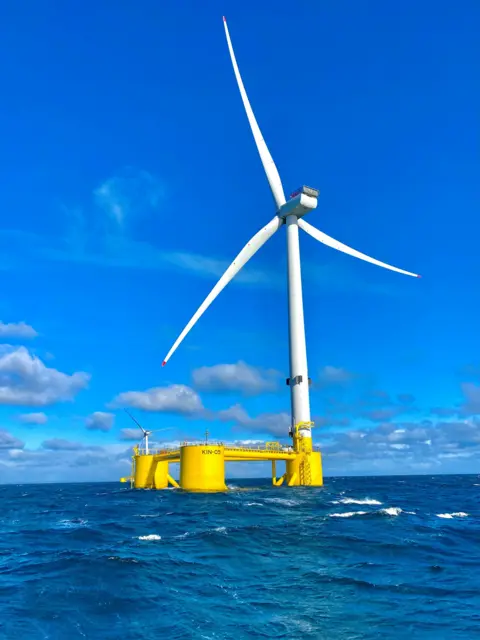
While traditional offshore wind turbines are built into the seabed with fixed foundations, floating turbines sit on large floating steel structures which are then tethered to the seabed.
This allows the turbines to be manufactured and also maintained and serviced on land, then carried on ships to locations further out at sea with higher winds.
The long-term goal is to establish the Celtic Sea as a major hub for floating offshore wind energy. The Crown Estate is currently leasing three large-scale projects, with an estimated 264 turbines to be installed by the mid-2030s.
 Blue Gem Wind/PA Wire
The Erebus wind farm off the Pembrokeshire coast would be able to produce 96MW - enough to power about 90,000 homes.
The plans by Blue Gem Wind - which is co-owned by the French energy giant Total - include building between seven and 10 turbines, in the Celtic Sea, about 45km (28 miles) off the coast.
While it may sound like a small amount compared to other offshore projects, it has been described as a "pathway project" for the Celtic Sea.
But, as it will be the first project to use this new technology in the Celtic Sea, there is currently limited infrastructure, supply chain or workforce in Wales to produce these turbines - which can be as tall as skyscrapers.
In addition, ports in the Celtic Sea are not yet prepared to handle the large-scale infrastructure, with three Welsh ports, in particular Port Talbot, in the running for contracts to develop these projects.
Scotland is already home to two of the largest floating wind farms in the world, Hywind Scotland and the Kincardine.
These will soon be joined by the Pentland and Salamander projects, along with the 560MW Green Volt project, which previously secured funding from the UK government.
Awel y Môr will becomethe first offshore wind farm to be built in 10 years off the coast of Wales.
It is one of six projects around the UK which will be paid £91 per MWH on average for the power they generate.
The Conservatives claimed the deals would not lower bills, but analysts Aurora Energy Research said the prices would deliver a net benefit to bills over the next decade.
Majority owned by the energy company RWE, Awel y Môr will see between 34 and 50 turbines, 10km (6.2 miles) off the north Wales coast, next to the existing Gwynt y Mor windfarm.
This could potentially supply enough energy to power half of Wales' homes.
The company claims it has the potential to create 2,000 jobs during the construction phase.
Becky Gittins, MP for Clwyd East - the constituency where Awel y Môr will be - said the funding decision represented "a major step forward for... our local economy, and the UK's energy security".
Aled Jones-Griffith, chief executive of Llandrillo Menai, a local college, told BBC Radio Cymru's Dros Frecwast it would "bring opportunities to young people and perhaps lead them to consider new career options" and was especially positive for their Rhyl campus, "where we have a specialised centre to deal with wind energy".
Abi Beck of trade body RenewableUK Cymru told BBC Radio Wales Breakfast that floating offshore wind farms were "the new revolution".
She likened the deal to a "fixed-term mortgage" adding: "The government has agreed a price to pay for electricity, and that price won't change.
"That means it'll keep bill payers' costs down and will make sure we don't have to import more gas - we don't have control over that price.
"We're protecting our own energy security and protecting our bill payers as well."
Charlotte Wood, commercial manager at Mainstay Marine Solutions which is based at Pembroke Dock, said the announcement was "hugely welcome news".
"It's the next big step in securing what we hope will be a strong pipeline of work for engineering companies like ours and hopefully it reinforces the future of Pembroke Port, and other south Wales ports as vibrant hubs of offshore renewables," she said.

Welsh Secretary Jo Stevens said: "It is a massive vote of confidence in Wales' clean energy industry which is already delivering the well-paid, highly-skilled jobs of the future with the potential to bring thousands more."
Wales' first minister Eluned Morgan added she was "delighted" by the news.
"This demonstrates how Wales is well placed to build on its existing capacity for renewable energy, to reap the benefits of these new projects bringing many high-quality jobs and wider economic benefits to our economy."
How do wind farms work?
Offshore wind farms work on the same basic principle as traditional power stations - electricity is generated by rotating magnets inside a coil of conductive wire.
But, in offshore wind farms, that rotation comes from the wind rather than the steam produced by burning fossil fuels.
Strong sea winds turn the turbine blades, which spin a shaft inside the fixed box on top of the tower. This drives a generator, producing electricity without releasing carbon emissions.
Because a single turbine produces only a limited amount of power, many are grouped together in a wind farm.
Electricity is sent through underwater cables to an offshore substation, where the voltage is increased before being transmitted to land and fed into the national grid.
With a lifespan of 20-25 years, offshore wind farms are maintained by specialist crews who work from vessels stationed at sea.
The largest offshore wind farm in the UK - and the world - is currently the Dogger Bank Wind Farm, located in the North Sea off the east coast of Yorkshire.
Once fully built, it will have a capacity of around 3.6GW, capable of powering millions of homes.
