How AI is posing a threat to democracy in Yorkshire

 BBC
BBCMisinformation and disinformation online could have a serious impact on this year's elections, politicians and experts have warned.
In recent months, fake council posts have been spread far and wide - with one content creator even refusing to remove them as "it was making them money", according to one local authority.
As AI makes misinformation easier to create and harder to spot, BBC Yorkshire political editor James Vincent investigates the potential threat to democracy.
In the era of the endless scroll, how closely are you actually looking at what you see?
Would you be able to spot a faked image - or an AI image? Are you checking something out before you share it?
I'm guessing the answer is probably no, and why should you have to?
Unfortunately, some of the detective skills to spot what's real are becoming increasingly necessary in everyday life.
When we were told about some posts doing the rounds online that were claiming to be from City of York Council, we checked them out. We also asked our colleagues at BBC Verify to see what they made of them.
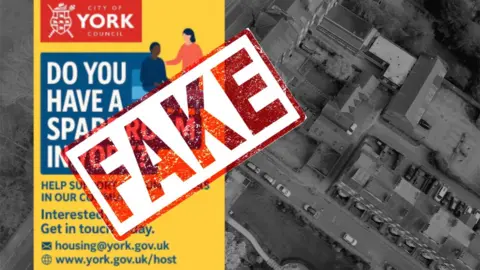
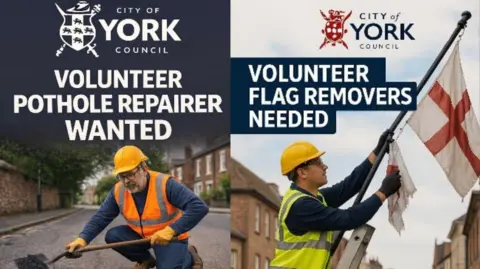
One claimed to be a council advert asking for people to house asylum seekers, while another was asking for volunteers to help take down St George flags. There was also a post seeking volunteers to fill in potholes.
On the face of it, and at the speed most people scroll, they could pass as pretty convincing. There was a logo, council-style presentation and contact details.
But the council had already told us they were not real. They were not council posts and the services and projects mentioned did not exist.
 Supplied
BBC Verify thought they showed some of the signs of being AI generated.
In some the council logo was wrong. It was blurry and lacked the right detail. The font was also different to the official logo.
There were also spelling mistakes in some of the posts and inconsistencies in the hands - a common theme in AI-generated images.
I had already checked out one of the websites listed. It didn't exist.
I also emailed one of the addresses on the poster - that was actually real.
I had a nice conversation with a council worker who realised we were investigating the fake images.
But how many of the inaccuracies would people spot during a quick scroll and who is emailing to check up on council services?
We calculated that so far the fake asylum seeker image had been used on accounts with more than half a million followers.
Of course many people will be sharing this thinking it's real.
City of York Council leader Clare Douglas says: "It's totally untrue and it's fake and the problem is that people don't think that's the case."
She realises fake news has been around for hundreds of years.
"It started with the printing press didn't it, centuries and centuries ago.
"It's not new but it's just how easy it is to do now, and how difficult it is to detect whether something is true or whether it's fake.
"We really need to be careful, it undermines democracy because people start to question what is true."
'We've got to correct it'
In Barnsley, the council has not seen AI adverts - but has faced content creators claiming things about the authority that are not true.
I show council leader Sir Steve Houghton the fake York image.
"It looks real, I wouldn't know," he says.
His council has tried to correct things and get creators to retract false information.
"We've even had some people with content saying we're not going to change this because we're making money out if it. Now that is unbelievable.
"We have to use our channels to try and counter a lot of that activity.
"It is a worry, particularly around social cohesion. We do at the moment get a lot of misinformation about asylum seekers and disinformation about asylum seekers.
"We've got to correct that because people need to be safe.
"People go on social media and go 'oh, look at this, it must be right or people wouldn't have put it on'.
"Well I'm sorry, people do put things on. Sometimes by mistake and they're wrong but sometimes deliberately and we've got to monitor and correct that."
We tried messaging people who were posting some of the images - without much success.
The images could have been created as a joke, or with the intention of misleading people.
But there is no suggestion that the people posting or reposting them know that the images are fake.
Ilya Yablokov, who works at the University of Sheffield's Disinformation Research Cluster, encounters misinformation all the time. Sifting through lies is his job.
"The cost of production of this is almost zero, right? You just have a laptop and you can create a poster," he says.
"You go to the website of your council, you take a screenshot, you attach it to a leaflet then you write in big letters, whatever the main message is."
Yablokov says people feel like they have little time to check everything they see.
"People share with me lots of similar things and every time it's like, have you really checked any of this information?
"Have you? Have you really tried to Google it? But people just don't have interest or motivation to make the next step and really try to, because then they basically rely on their biases."
Yablokov says AI is making it a lot easier to make the images because you need few skills.
"I can create tonnes of them within one day and schedule them to spread them across various platforms.
"The price of creating these things is almost zero."
As we see more and more fake posts created at a local level, the price of producing them might be zero - but the cost to democracy is very high.
Listen to highlights from North Yorkshire on BBC Sounds, catch up with the latest episode of Look North.
