Yorkshire's 'mysterious' murmurations caught on camera

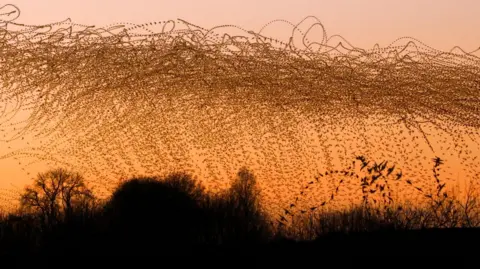 Dr Kathryn Cooper
"There's a certain feeling when you're standing there underneath it: you can feel the vibrations of thousands and thousands of wings," Dr Kathryn Cooper says.
"All it takes is a little patience and you can see what I think is a world-class natural phenomenon on our doorsteps."
Cooper, from near Sheffield, is among a group of nature enthusiasts for whom the winter months bring with them the chance to catch on camera one of nature's mysteries - starling murmurations.
A murmuration is the name given to a group of starlings which come together to fly, swoop and dive in synchronised patterns.
The aerial displays often occur between November and February when daylight begins to fade, with clear evenings offering the best chance of seeing one in action.
According to the RSPB, the exact reason that starlings murmurate is unknown, although conservationists say the dance-like movements can confuse predators.
Every year, the displays spark the interest of walkers, bird-watchers and casual observers alike, many of whom seek to catch an image of a group in flight.
As an artist and photographer, Cooper uses a 19th Century technique called chrono-photography to capture the birds in motion and in extreme detail.
"What I'm trying to do is capture what I think is the essence of the murmuration," she explains.
 Dr Kathryn Cooper
The technique works by taking multiple still images in quick succession, to create a continuously moving picture.
Popularised by photographer Eadweard Muybridge and French scientist Étienne-Jules Marey, Cooper says she still uses the method to explore flock behaviour.
Cooper, whose work picturing a murmuration over Ripon racecourse in North Yorkshire has featured on the BBC's Winterwatch, adds that Yorkshire in particular is "fantastically placed" to spot starlings performing their sky dance.
"In the UK, we have hundreds of thousands of migrating birds come to us over the winter from colder parts of Europe, so we're internationally significant," she explains.
"Yorkshire has a good number of starling roosts, although you can't be guaranteed where they will go each year, it's really accessible.
"You don't have to walk very far, they're usually in easy to get to locations - they're just there, most evenings."
Jono Leadley, Yorkshire Wildlife Trust's head of operations in North Yorkshire, says the number of starlings in a roost can swell to about 100,000 in some places.
According to him, the reason Yorkshire could be considered something of a murmuration hotspot is because of its abundance of wetland habitats.
"Murmurations are best spotted over wetland spaces, because large communal roosts often bed down in reed beds," he explains.
"Ninety per cent of the UK's wetlands have been lost in the last 100 years due to industrialisation and drainage.
"But thanks to concerted efforts by Yorkshire's conservation organisations and landowners, many of our wetland spaces – scattered though they are – are in better shape than ever."
Keen photographer Isaac, 15, has managed to capture a dazzling display over Clifton Ings in York - although he admits it takes a lot of patience and technical know-how.
"You can go out at the right time, but it's kind of chance what's going to be there at the time, you can never quite tell," he says.
His portfolio of work contains many recognisable York landmarks, alongside wildlife shots.
"I'm constantly trying to find new places to go, which I haven't posted before and I haven't taken pictures of," he explains.
"I saw the starlings because the Ings was flooded because we've had so much rainfall."
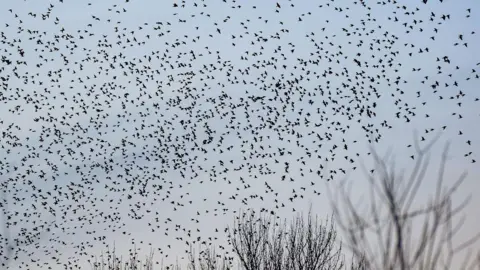 Isaac Savage Photography
Isaac's shot was achieved by putting his camera into continuous shutter release, fixing on the target and slowly zooming in until the birds came into focus.
"You do have to be quite patient, you have to wait and see where they are," he explains.
"When you hear a bird, you have to really try and find out where it is, and you have to be quite a long way back.
"There's loads of them that are blurred, but when I actually find the ones that are in focus out of them, that's a really good feeling."
Isaac often heads out first thing on a morning to photograph local landscapes without the crowds.
His father Dan has accompanied him on many of these early excursions and calls it "an important thing to do for our family".
"Being able to get out there and to sort of practise the art of seeing, because we so often get caught up with our screens in the day, is really good," he says.
"To get out into nature and see what's around us in the natural world is such an important thing for our family and for mental health generally as well."
 Getty Images
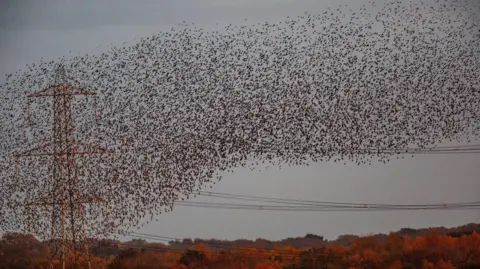
In West Yorkshire, staff at RSPB Fairburn Ings nature reserve reported a dramatic rise in visitor numbers this winter, which they credited to "breathtaking" murmurations taking place there.
During the week between Christmas and New Year alone, more than 2,800 people visited the site - over seven times more than the same week the previous year.
The birds first arrived at the reserve in November and word quickly spread about their impressive displays, according to Lydia Tague, the reserve's manager.
"There's something truly magical about watching a starling murmuration - no two displays are ever the same, and people often leave completely awestruck," she says.
"We've been delighted to welcome so many new and returning visitors this winter, many of whom are seeing this for the very first time."
Keiran Bull, visitor experience manager describes witnessing the spectacle as "mysterious, unpredictable and completely unforgettable".
"You're cold, it's getting dark and you're wondering whether the birds will show at all, then suddenly they appear," he says.
"You can hear their wings beating in unison, see them twist and turn across the sky, and for a few minutes everything else just stops."
Listen to highlights from North Yorkshire on BBC Sounds, catch up with the latest episode of Look North.
