Lantern base find may reveal ship explosion cause

 The London Shipwreck Project
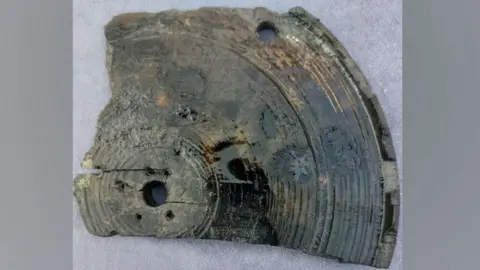
The remains of a scorched wooden lantern base retrieved from a 17th Century warship wreck may help explain what caused its explosion.
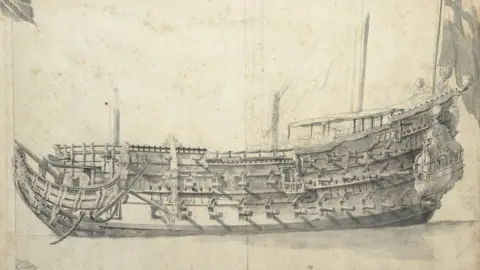
The London blew up 360 years ago off the Essex coast near Southend-on-Sea and an astonishing array of well-preserved finds have been retrieved from it in recent years.
Diving resumed this month thanks to two companies that donated most of the £13,000 needed to replace the dive ship's condemned engine.
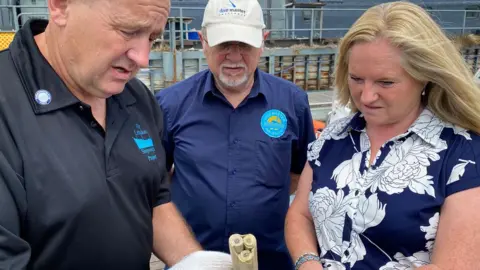
The lantern base, candles and a wooden tool handle were among objects recovered since then, said Steve Ellis, one of Historic England's licensed divers.
 NAS
NAS"Last year we found a wooden lantern top and while on our latest dive, we retrieved the base of a different wooden lantern and both have scorch marks," he said.
"They wouldn't have had glass, just wooden battens and, with the flame not being that secure and on a ship full of gunpowder, is this one of the reasons she blew up?
"That's what I love about diving the wreck, the more you find, the more questions you ask - it's never boring."
 NAS
NASThe warship is one of England's most important shipwrecks and is a Protected Wreck Site.
It is being rapidly eroded because of its location at the end of the hugely busy Thames Estuary shipping lanes.
This also means seabed sediment is constantly being churned up, resulting in terrible visibility, "like diving in blancmange", Mr Ellis said.
"I came across some beef tallow or other animal fat candles, packed in threes, which felt like modern plastic," he said.
Another exceptional find was a wooden handle. All the items will go to Historic England for conservation.
 The London Shipwreck Project
The London was on its way to fight in the second Anglo-Dutch War in 1665, when it exploded while moored at The Nore in the Thames Estuary.
Many women and children, families of the sailors, were on board and the disaster was written about by diarist Samuel Pepys.
Mr Ellis said the area the dive team was currently working on was "a bit more like the Mary Rose [a Tudor wreck], a brilliant time capsule, with complete boxes, complete bottles - everything seems to be in order".
"Every dive brings us closer to understanding the lives, struggles, and stories of people of that era, before this information is washed away and lost forever," he added.
 National Maritime Museum, London
The project was put at risk when the dive team's boat engine was condemned a few months ago.
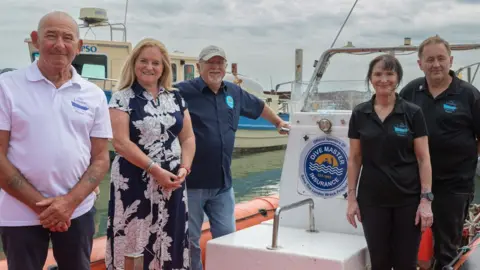
Mr Ellis said the dive team was "profoundly grateful" to DP World and Dive Master Insurance, which contributed £6,000 each towards a new engine, alongside £1,000 in public donations.
 The London Shipwreck Project
Follow Essex news on BBC Sounds, Facebook, Instagram and X.
