Remains of Roman fortlet found under house gardens in Bearsden

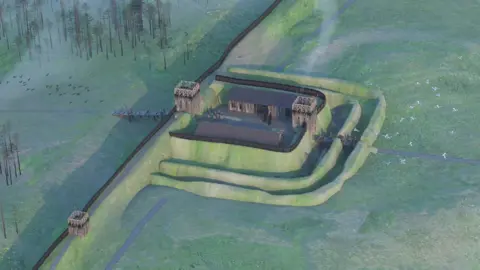 Guard Archaeology
The remains of a small Roman fortification have been discovered in the back gardens of three homes in Bearsden, East Dunbartonshire.
Archaeologists said the fortlet was uncovered along with likely surviving fragments of the Antonine Wall.
Almost 2,000 years ago the wall marked the most northerly frontier of the Roman Empire. It stretched for about 37 miles (60km) from Bo'ness on the Firth of Forth to Old Kilpatrick on the River Clyde.
In new research, Guard Archaeology said the fortlet would have provided soldiers with "commanding views" over lands beyond Roman control.
Fortlets were used as bases and look-outs for small patrols or detachments of troops.
The site at Bearsden was discovered in 2017 under the gardens of three adjacent properties during archaeological work done in advance of a development.
An initial dig unearthed the stone foundations of a turf rampart.
Public body Historic Environment Scotland (HES) then commissioned a further excavation and research.
 Guard Archaeology
A ditch was found containing peat deposits, wood and vegetation.
A geophysical survey - a study that uses sensors to detect buried objects - then revealed stone structures, likely to be surviving fragments of the Antonine Wall.
Guard archaeologist Maureen Kilpatrick, who led the work, said: "What made these discoveries significant was that both the kerbed stone base and its parallel ditch lay perpendicular to the line of the Antonine Wall that crosses this part of Bearsden."
Wood from the bottom of the ditch was radiocarbon dated to AD 127–247, which is within the period of use and immediate aftermath of the Antonine Wall.
Two broken pieces of Roman pottery were found beneath the stone base.
The Antonine Wall was built in the years following AD 142 by the Roman Army on the orders of its emperor Antoninus Pius.
Guard Archaeology said the wall had cut Scotland in two, separating the conquered Britons of the south from the free Britons to the north.
Unlike Hadrian's Wall, which was built of stone, the Antonine Wall was constructed of turf set onto a stone base.
But little more than 20 years after it was built, sometime in the AD 160s, the Romans abandoned the norther frontier and retreated back to Hadrian's Wall.
Kilpatrick said: "This fortlet lay on an area of high ground right next to the Antonine Wall.
"It had commanding views over the landscape, particularly to the north, which was beyond Roman control."
She said there was a larger fort on lower ground nearby and the fortlet was likely to have been an "integral part" of the wall's defences.
Specialist analysis of plant and fossil beetle evidence, from the bottom of the ditch, revealed that when the fort was built, the surrounding landscape was open pasture with areas of partially cleared woodland.
