The tale of the 'fine lady upon a white horse'

 Getty
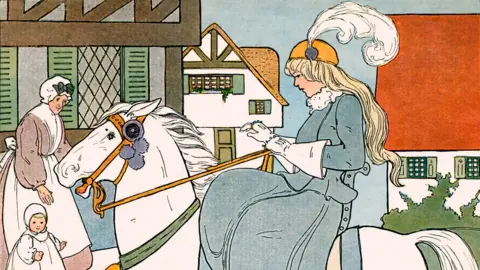
GettyFor generations, parents and grandparents have recited the famous nursery rhyme Ride a Cock Horse to Banbury Cross.
It conjures up a vivid image of a fine woman, with rings on her fingers and bells on her toes, riding a spirited horse.
But just who is she, where does the rhyme come from and what is the significance of the Oxfordshire landmark?
Radio Oxford's Jordan Brooks went to meet Simon Townsend from Banbury Museum who might have some of the answers.
"Banbury is a really interesting, important town," said Townsend. "If you walk around today, its buildings and its street scenes take you back to the very early 1100s when it was really laid out.
"It was a town of trade, so it has a really interesting history, and the nursery rhyme is something which passes down to us today.
"Some people say it's related to a woman called Celia Fines, or Fiennes, she travelled around Britain in the very late 1600s, recording her journey in a book.
"[Her] journey is a really interesting and rather important work, connected with Banbury because she was related to Lord Saye and Sele, and their family still live at Broughton Castle today."
"Ride a Cock Horse to Banbury Cross,
To see a fine lady upon a white horse,
With rings on her fingers and bells on her toes,
She shall have music wherever she goes."
There have been many versions of the nursery rhyme over the years, one talks about what Tommy can buy, a penny white loaf, a two penny pie, another is about little Johnny's visit to buy a galloping horse, but all start with Banbury Cross, said Townsend.
The museum director added: "The Banbury Cross we have today certainly isn't the one referred to in the nursery rhyme.
"Banbury Cross had three crosses, all of which were destroyed in the early 1600s, late 1500s."
The current cross was put up in 1859, to commemorate the marriage of Queen Victoria's eldest daughter to a Prussian prince.
One of the reasons why Banbury was so important was that it played a key role in the civil war between 1644 and 1646.
Townsend explained: "[It] had the misfortune to be in the centre, if you like, of that conflict in the 17th Century.
"It had a very impressive castle, which was pretty much under continual siege, and much of the town was destroyed.
"After the civil war, the castle was pulled down and used to rebuild the town so nothing of it is left."
He said the nursery rhyme has likely survived for hundreds of years because of another tradition, chapbooks - small, inexpensive booklets, with typically 15 to 40 pages.
"In the 18th Century, perhaps the first printed version of small, short stories were published very cheaply in chapbooks.
"They wrote down some of these stories for the first time and Banbury had a very good tradition of chapbook makers, the Rusher family published chapbooks, and this is one of the nursery rhymes that they preserved in their publications."
Although we still can't be sure where the rhyme came from or who exactly the fine lady was, what we do know is that it is a nursery rhyme that will continue be loved by children for generations to come.
 Getty
Getty