'It was part of my childhood' - keeping Ulster Scots heritage alive

 BBC
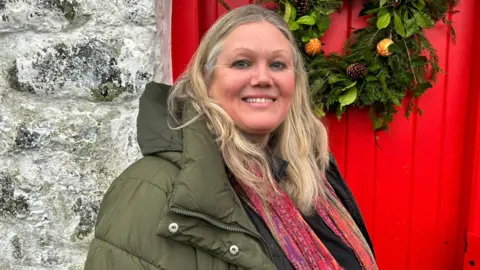
BBCFor Gillian Rea, speaking Ulster Scots was a normal part of her childhood and she wants to see others enjoying the culture.
A newly-minted tour guide, she has turned her dream into a reality sharing her Ulster Scots heritage with those who wish to learn the history and customs.
"People travel more now, and visit other countries," Gillian said. "But sometimes we don't know what's on our doorstep.
"I think it's really important to explore the culture around you, to know who you are and where you come from in order to see where you're going."

The term Ulster Scots refers to people who migrated from the Lowlands of Scotland to Ulster in the 17th century.
Now, it can refer to their heritage and cultural traditions including language, music, and dance.
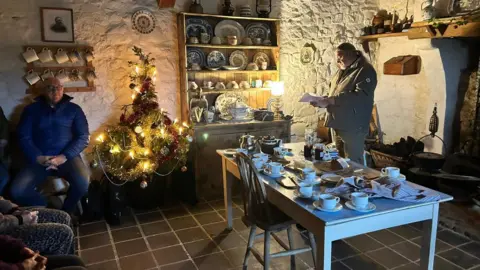
Gillian, who is from Kilwaughter in County Antrim, was one of several people to share readings and stories at an event in Cullybackey as part of Ulster Scots Leid (language) week.
Who were the weaver poets?
Much of Ulster Scots poetry is centred around the home, work, rural living and connection to the land.
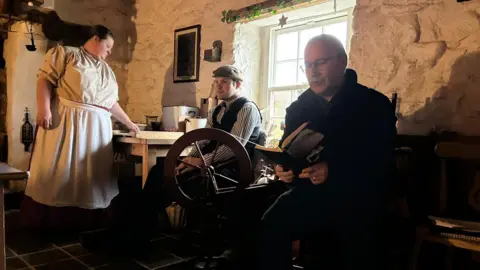
This event celebrated the weaver poets, also known as the Rhyming Weavers, who wrote in 18th and 19th century Ulster, inspired by the booming linen industry.
They earned this name through their style of verse that, when read aloud, sounds like the rhythm a loom makes.
An Ulster Scot historian and writer, Dr David Hume, was also at the Cullybackey event.
"At this time Ulster Scots was under pressure and these people were writing bilingually in both English and Ulster Scots," he said.
Centuries later, Gillian said Ulster Scots is facing a new raft of challenges.
"It's important to keep that language alive, particularly in the world of technology and social media where everything is becoming very much generic with how people speak.
"There's Americanisms coming in, influenced obviously from film, TV and media.
"To counterbalance that, we've got to have more celebrations of the Ulster Scots language.
"We have to keep it alive and rich by passing on these stories."
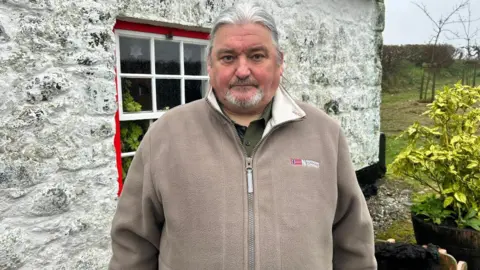
Similar to Gillian, Davy Moore also grew up in a home where Ulster Scots was part of everyday life.
"There were five of us living in the house with my mum and dad, granny and granda," he said.
"We spoke this way all the time. I went to a local primary school, farmer sons and daughters went there and they also spoke like that.
"The teacher didn't correct us, she let us tear away."
It wasn't until grammar school where he felt a changing attitude towards how he spoke.
"People who didn't speak this dialect or language, they would sometimes look down on it as if you were not intelligent, or you were like a redneck."
After taking a creative writing course, Davy has since published his own novel and a collection of short stories.
He hopes to one day put together his own modern book of Ulster Scots poetry, in the hope that when he's gone, a younger generation may pick it up.
"I'm not saying for one minute I'm anything like the weaver poets," Davy joked.
What are some commonly used Ulster Scots phrases?
Those who attended the Cullybackey event discussed fond memories of growing up and hearing some words and phrases that are now very rarely used.
"Instead of fed up, you'd say I'm scundered with this weather," Gillian said.
"If it's cold, you would say I'm foundered."
Another is the phrase "read up" (pronounced like red up) which means to tidy up or clean up.
Davy added the use of the word "tovi", which means to boast.
He also enjoyed talking about the use of the word "thran" (stubborn or difficult) - something he joked is a common trait of Northern Irish people.
